Get Full Government Meeting Transcripts, Videos, & Alerts Forever!
Get email alerts on the Code And Zoning topic
No spam. Unsubscribe anytime.
Commission approves code changes to align city codes with AIM Norman and to limit rural certificate‑of‑survey lots in urban reserve
Summary
The planning commission voted to forward two ordinance amendments—O‑2425‑32 (zoning code updates) and O‑2425‑31 (chapters 20 and 30 amendments)—that update definitions to reference the AIM Norman package and add a 30‑acre minimum for rural certificates of survey within the plan’s urban reserve area.
The Norman Planning Commission voted to forward two ordinance amendments to the City Council that update city code to reflect the AIM Norman comprehensive plan package and to add a substantive land‑use implementation rule. The commission approved both items by unanimous votes and will send them to council for first and second readings in June.
City Attorney’s Office staff explained the changes. Beth McCullough told the commission the proposed updates define “comprehensive plan” to refer to the full AIM Norman package (the land‑use plan and six master plans) and add sub‑definitions for each master plan so future code references can be precise. The amendments replace references to plan‑specific phrases from the prior plan and move that terminology into Chapter 36 (zoning) and into Chapters 20 and 30 where appropriate.
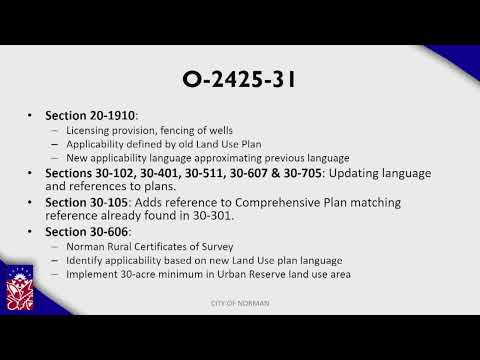
One substantive change in Ordinance O‑2425‑31 amends subdivision code language to require a 30‑acre minimum lot size for rural certificates of survey (COS) located within the plan’s urban‑reserve land‑use designation; staff said the change implements a plan policy intended to preserve land for future urban services and avoid building acreage subdivisions that would preclude efficient extension of utilities. The zoning ordinance amendments in O‑2425‑32 also remove a once‑applicable “northern community separator” provision and update references to the city’s TV/radio tower and oil‑well fencing rules so those regulations track the new land‑use boundaries and definitions.
McCullough said the amendments are intended to bridge the gap between plan adoption and a larger, forthcoming rewrite of zoning and subdivision regulations: “these ordinances aim to kind of bridge the gap, in the time between the passage of the ultimately adopted comprehensive plans and the implementation of new ordinances and regulations,” she said.
The commission approved the ordinance packages on motions to forward the items to council. Staff advised the commission that first readings of the related ordinance work are planned for June 10, with second readings and City Council consideration scheduled for June 24.
Authorities changed or cited in the drafts include Chapter 36 (zoning) — particularly Section 36‑201 and related numbered sections — Chapter 20 (licenses and occupations) Section 20‑19‑10, and multiple subdivision code sections in Chapter 30 (including 30‑105, 30‑301 and 30‑606). The changes also add references to the AIM Norman resolutions already forwarded by the commission.
Next steps: staff will forward the proposed ordinance language and a memo summarizing commission comments to the City Council for the June readings. The planning commission’s approval is a recommendation; the City Council will take the final actions on the ordinances and code amendments.