Get Full Government Meeting Transcripts, Videos, & Alerts Forever!
Get email alerts on the Utility Finance topic
No spam. Unsubscribe anytime.
Committee approves remittance of kilowatt-hour tax to Cleveland Public Power
Summary
The Utilities Committee approved an ordinance authorizing the general fund to transfer 100% of kilowatt-hour tax remittances back to Cleveland Public Power, providing roughly $6 million a year in operating funds for the utility.
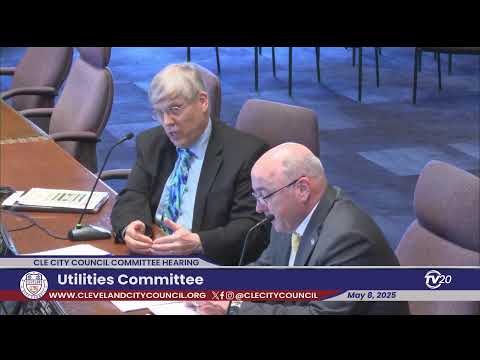
The Cleveland City Council Utilities Committee voted to allow the general fund to receive and immediately remit back 100% of kilowatt-hour tax remittances collected by Cleveland Public Power, a move staff described as critical to CPP's operations.
Under the emergency ordinance introduced as 5272025 by Council members Casey and Griffin, the general fund will receive tax remittances and then transfer the full amount back to Cleveland Public Power (CPP) for operating expenses. Department staff told the committee the annual remittance is budgeted at approximately $6 million for 2025, up from about $5.8 million in 2024.
The director told the committee the kilowatt-hour tax collection is required by the Ohio Revised Code and that municipalities with municipal electric utilities receive remitted tax revenue back from the state. “Under the Ohio Revised Code, the division of Cleveland Public Power is required to charge our customers a kilowatt hour tax,” the director said.
Council members asked how the remitted funds are used. The commissioner for Cleveland Public Power told the committee the dollars are essential to CPP's operations and to maintaining capital capacity. “It's essential for our operations. It's very close to our capital fund, essentially,” the commissioner said. Committee members asked for capital-outlay details for CPP and staff agreed to provide the 2025 capital plan for the division.
Council members also discussed who sets the tax rate. The committee was told the rate is mandated at the state level; municipal electric utilities collect the tax for remittance under Ohio law, and municipalities that do not operate a municipal electric provider do not receive remittance proceeds.
The committee approved the ordinance. Staff said the arrangement has been in place previously at lower return levels (50% was returned in earlier years) and that the current ordinance continues the practice of remitting the full collections back to CPP.
Committee members requested additional information about CPP capital outlays and agreed staff would provide mappings of facilities and expenditure history for review.