Get Full Government Meeting Transcripts, Videos, & Alerts Forever!
Get email alerts on the Vote Centers topic
No spam. Unsubscribe anytime.
Monroe County committee reviews proposals to cut vote centers from 29 to 22 or 20
Summary
A Monroe County advisory committee reviewed maps and community feedback about proposed reductions in vote centers, discussed impacts on retirement-home voting and travel board services, and reviewed cost and equipment trade-offs ahead of an election board decision.
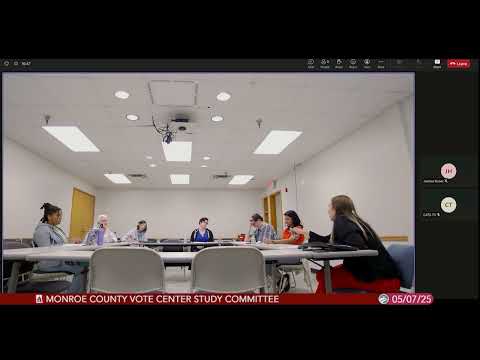
A Monroe County election office staff member briefed the county's Vote Center Advisory Committee on public feedback and three proposals to reduce the number of vote centers from 29 to either 22 or 20 ahead of a potential election-board decision.
The staff member said 63 written responses had been submitted on the county's comment form and that "83% are just, yes" to the plan, with about 8% "yes, with changes." "They have until 11:59 on the eighteenth," the staff member said, adding that the comments would be sent to the election board at 8 a.m. on the 19th and the board would meet that evening at 5:30 p.m.
Committee members said the choices should balance access and cost. The group discussed eliminating low-turnout sites such as Meadowood retirement facility (eliminated from earlier lists and reintroduced for 2024), small-town locations in Harrisburg and Smithville, and several school and church sites. One committee member urged caution about removing sites before the county has data from a full vote-center cycle.
The staff member outlined logistical concerns and mitigation measures. Travel-board services, which bring ballots to voters unable to come to polling places, remain available but require individual requests and can run until midnight on election day. The staff member said travel-board sign-ups were modest: "Last year, we had I think it was about 150 that we had that signed up for travel board," but added that many long-term care residents instead use vote-by-mail and that turnout at some facilities produced many provisional ballots because voters lacked ID.
On costs and equipment, the staff member said converting to vote centers requires up-front purchases of equipment, printers and toner and additional ballot paper; one figure discussed for initial equipment purchases was about $600,000 spread over election cycles. Committee members noted that staffing costs for poll workers are a major recurring expense and that some savings from fewer locations could be offset by later needs to buy additional equipment if turnout or lines require more sites.
The committee also flagged communication problems: several community members had called county offices after seeing school calendars listing "election day" closures that confused residents and staff because there was no election on that date in Monroe County. The staff member urged clearer messaging ahead of any changes.
Members discussed creating a resolution or "shovel-ready" list so the election board could adopt 29, 22 or 20 locations without having to redraw maps at the meeting. The staff member said the advisory committee's work is informational: the election board will decide the final number and list, and any changes returned by the board would come back to the committee for revision before final adoption.
The committee took no formal vote on the site lists. It approved the minutes of its last meeting by voice vote and then adjourned.
The advisory committee recommended that the election board consider retaining a larger number of centers at least for an initial vote-center cycle to collect usage data (where voters actually vote, turnout by center and travel patterns) before permanently trimming locations. Committee members said that data would inform any future reductions and help avoid creating access gaps for seniors, voters without IDs and residents who rely on nearby locations.