Get Full Government Meeting Transcripts, Videos, & Alerts Forever!
Get email alerts on the Water Quality Certification Fees topic
No spam. Unsubscribe anytime.
State Water Board unveils conceptual tiered fee plan for water quality certifications; counties warn of costs for flood-control maintenance
Summary
State Water Resources Control Board staff on May 21 presented a conceptual, points-based fee methodology for water quality certification applications that would group projects into five fee tiers and assess higher per-acre charges for higher-risk projects, while county flood-control officials and mitigation developers urged changes to avoid large bills for routine maintenance and restoration work.
State Water Resources Control Board staff on May 21 presented a conceptual, points-based fee methodology for water quality certification applications that would group projects into five fee tiers and assess higher per-acre charges for higher-risk projects, while county flood-control officials and mitigation developers urged changes to avoid large bills for routine maintenance and restoration work.
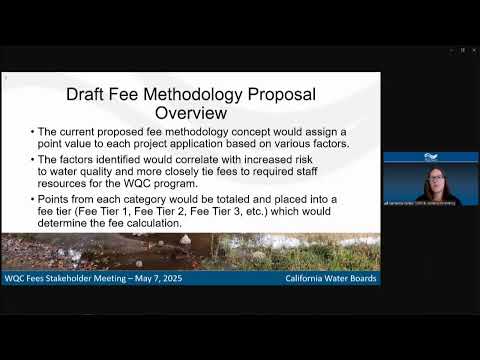
The proposal — described by Samantha Parker, a wetland permitting program staffer with the board, as “still at the concept phase” — would assign points to projects across factors such as permit type, whether a Waste Discharge Requirement is needed under the Porter-Cologne Water Quality Control Act, permanent versus temporary impacts, and the level of alternatives analysis. Points would be totaled to place projects into one of five fee tiers; tiers 2–5 would include a flat application fee plus a per-acre component, while tier 1 would replace the existing low-impact category and be a lower flat fee. Parker cautioned that “these numbers are just conceptual placeholders,” and said staff will work with the fee unit in the Department of Administrative Services to translate points into dollar amounts based on the fee-setting budget for the fiscal year in which a methodology is adopted.
Why it matters: Water quality certification in this program is entirely fee funded through the Waste Discharge Permit Fund, meaning changes affect permit holders directly and must cover staff costs. Paul Hahn, one of the program managers attending the meeting, reminded participants that “this really is a 0 sum game,” noting staff must balance expense coverage while trying to limit fee impacts.
Concerns from county flood-control agencies. Michelle Derry, supervising planner with the San Bernardino County Department of Public Works (which includes the Flood Control District), said many of her district’s maintenance projects are large but predominantly temporary impacts and exist to protect public safety after storms and wildfires. Derry estimated that, under staff examples shown in the presentation, her county could “probably pay between $2,000,000 and $5,000,000 for some of our ... to maintain our facilities for public safety,” and said such fees would be “a huge hardship for counties across the state to try to protect life and property.”
Staff response: Samantha Parker said the proposal intentionally separates permanent and temporary impacts so maintenance projects could be treated differently, and that “separating out the valuation of permanent impacts to temporary impacts would kind of reduce the fee barrier for maintenance for public safety projects.” Paul Hahn added that the meeting’s framework provides “a number of knobs that we can turn,” and suggested staff can consider a maintenance-specific approach, though he did not commit to changes. Cassandra White, branch manager of the Fee and Revenue Branch, noted that the program currently has a fee cap of $365,000 under existing rules and that the team had not decided to remove the cap, saying the final cap or adjustments will be addressed later in the process.
Mitigation and restoration projects. Angela Leneau of Westerville Ecological Services said mitigation-banking and voluntary restoration projects are being treated as category A projects rather than the ecological restoration category and that some conversions of managed wetlands to higher-functioning wetlands are being counted as permanent impacts despite being environmental improvements. Leneau asked whether conversion that increases functions and values could be analyzed differently; Parker said staff would consider adding impact-type distinctions or other factors to avoid penalizing beneficial conversions.
Other technical and process questions. Attendees asked how tightly proportional per-acre fees across tiers would be fixed; Parker and White said proportionality and exact per-acre numbers are not yet set and will depend on the fee-setting budget and analysis of permit data from the current and prior years. Staff used example placeholders (application fees and per-acre multipliers such as a hypothetical $2,000 application fee plus $20,000–$50,000 per acre) only for illustration. Elise Ozielor of E Corp Consulting asked whether acreage thresholds in the draft calculator were placeholders; Parker confirmed they are and encouraged stakeholders to submit suggested values.
Annual fees and invoicing. Participants asked about annual fees for multi-year permits. Parker said annual fees are not part of this current methodology proposal and will be assessed in a later stakeholder discussion. She clarified that “as long as the permit is active an annual fee is assessed,” and staff welcomed input on potential changes to annual billing practices.
Next steps and how to comment. Staff asked stakeholders to submit written feedback to feebranch@waterboards.ca.gov and requested additional input by May 21 to inform upcoming meetings; staff also said they will post the presentation and the meeting recording on the board’s videos page within about a week. The board plans to aim for implementation in fiscal year 2026–27 (at the board’s second September meeting in that fiscal year) but said timing will depend on further feedback and the fee-setting budget. The general Waste Discharge Permit Fund stakeholder meeting is scheduled for June 11, where budget and revenue forecasts will be discussed more broadly.
Ending note: Staff emphasized the proposal remains conceptual, that precise dollar amounts and tier thresholds will be set later based on data and budget, and that additional WQC-specific stakeholder meetings will be scheduled to refine the methodology and consider issues raised at this session.