Get Full Government Meeting Transcripts, Videos, & Alerts Forever!
Get email alerts on the County Budget topic
No spam. Unsubscribe anytime.
Talbot County presents $161.05 million FY26 budget as schools ask council for $1.1 million more
Summary
County staff and the public discussed the proposed fiscal year 2026 general fund budget of $161,052,000, reserve policies, state-driven cost shifts for teacher retirement and SDAT, and a public request from Talbot County Public Schools leaders for an additional $1.1 million to fund staff and salary increases.
Talbot County Manager Clay Stamp and Finance Director Martha Sparks presented the county’s proposed fiscal year 2026 general fund budget — $161,052,000 — at a public hearing, and Talbot County Public Schools officials and residents urged the County Council to increase the school appropriation by $1,100,000.
The supplemental request from the school system would fund two categories: $600,000 to hire nine high-priority positions (including two social workers, six instructional assistants and one special education teacher) and $500,000 to support salary increases as the district moves toward the state-mandated $60,000 minimum starting teacher salary by fiscal 2027. “If we’re unable to fund these positions with local funds, two of our school communities will be left drastically underserved,” said Dr. Sharon Papakayi, superintendent of Talbot County Public Schools.
The request was echoed by Emily Jackson, president of the Talbot County Board of Education, and by several teachers and parents during the public comment period. “We need your help right now this year to maintain our pace to comply with the law,” Jackson said, referring to the state minimum salary requirement. Andrew Burke, president of the Talbot County Education Association, urged the council to fully fund the district request, saying underfunding would worsen staff recruitment and retention.
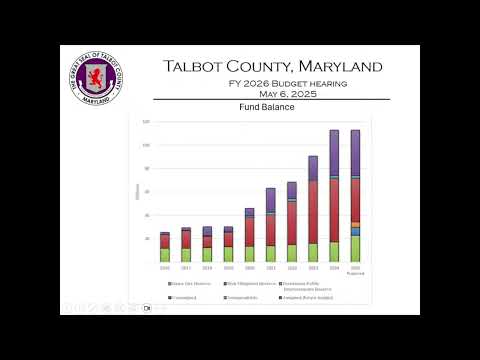
County staff described the FY26 proposal as conservative and driven by risk mitigation. “This was a year that we needed to flatten the budget,” County Manager Clay Stamp said, citing federal grant reductions, state funding shifts, rising material costs and workforce competition. Finance Director Martha Sparks said the budget was developed using conservative revenue projections, a strategic use of fund balance and newly adopted reserve policies intended to protect the county’s fiscal position.
Sparks described several specifics in the FY26 proposal: no new general government positions, a 2.5% cost-of-living adjustment and one performance-based step for county employees, reduced capital investment to “finish what we started,” and continued funding for completed projects such as the new public safety building and St. Michaels library renovation. She also said the county will use reserves for one-time capital outlays: approximately $3,840,000 for equipment and vehicles, $13,700,000 for capital projects, and $1,700,000 for recreation fund capital projects.
Several speakers and staff noted state policy changes shifting costs to counties. Stamp said counties are now required to pay 50% of teacher pensions, and Sparks said the county will be billed $440,000 for teacher retirement previously funded by the State of Maryland. Sparks also noted the county will pay an additional $176,000 to cover 40% of the local SDAT office cost, and that Moody’s and Fitch have cited the county’s conservative budgeting and strong reserves in recent credit reviews.
School speakers stressed operational impacts if the council does not provide the requested funds. “We do not currently have adequate staff to support our student population,” Papakayi said, adding that the district’s spring staff focus groups reported critical staffing needs. Parents and teachers told the council that insufficient staffing affects students with higher needs, summer-school access and teacher retention. “We have students that aren’t verbal. They can’t advocate for themselves,” said a pre-K special education teacher who testified during public comment.
Council members were told the council would hold final FY26 budget deliberations at a public work session on Tuesday, May 13, with budget adoption scheduled for Tuesday, May 27; the public comment deadline for written comments was announced as Thursday, May 8. For more information on the FY26 proposed budget (Bill No. 15-85), Sparks directed the public to talbotcountymaryland.gov.
No formal vote on the budget was recorded at the hearing; the council approved a motion to adjourn and reconvene for the May 13 work session. The council’s next scheduled open session for final deliberations is May 13 in the Bradley Meeting Room at the Talbot County Courthouse, South Wing.