
Nantucket Conservation Commission closes hearing, approves amended order for 76 Eel Point Road project
Get AI-powered insights, summaries, and transcripts
Subscribe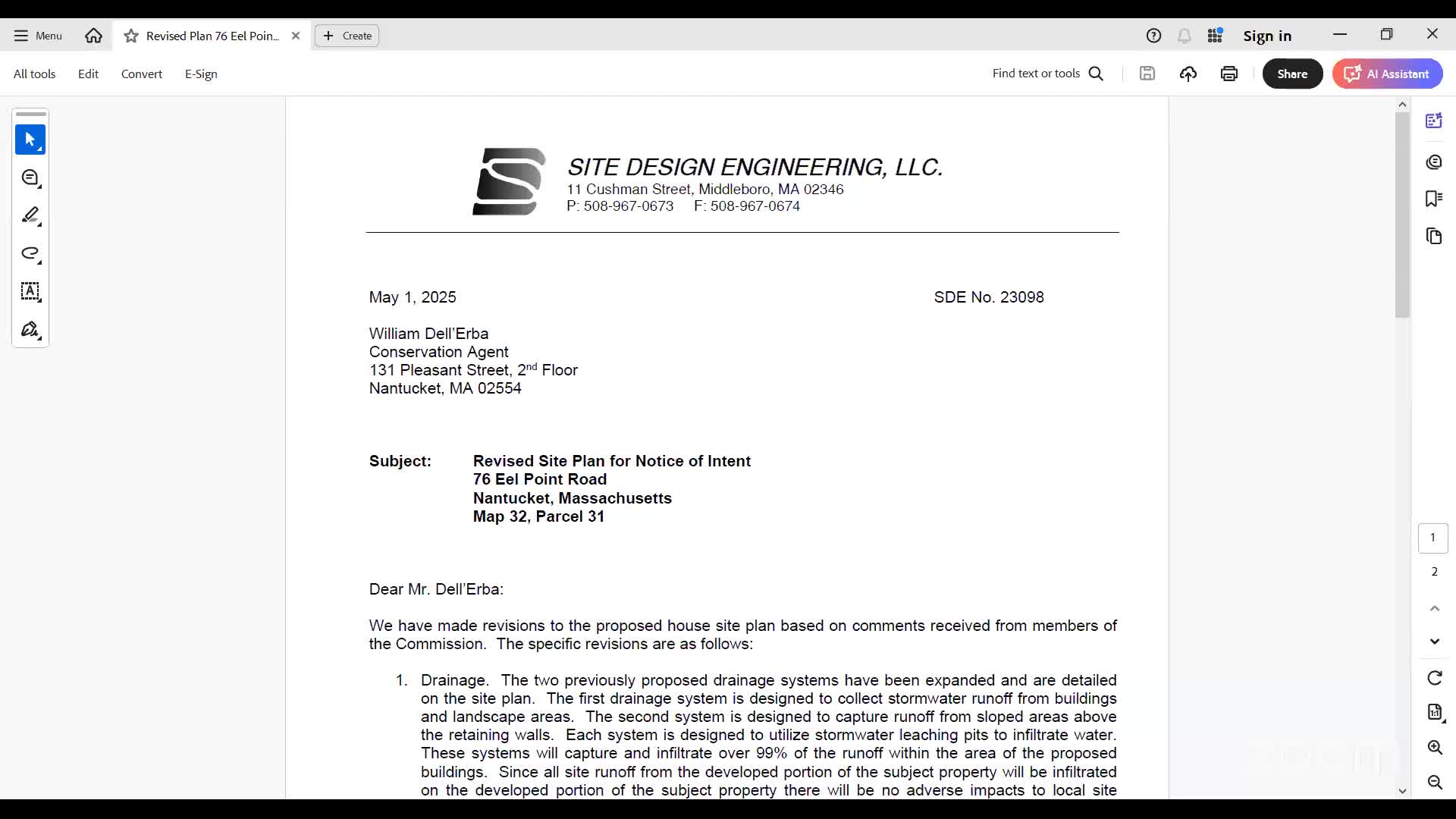
Summary
After extended technical review and public comment, the Conservation Commission closed the public hearing on the 3 Star Farm LLC project at 76 Eel Point Road and approved an amended order requiring additional conditions, including awaiting Heritage/NHESP review.
The Nantucket Conservation Commission closed the public hearing on a notice of intent filed by 3 Star Farm LLC for work at 76 Eel Point Road and subsequently approved an amended order of conditions after commissioners and abutters raised questions about large volumes of fill, stormwater capture and potential impacts to nearby wetlands.
The project team — represented by Mark Ritz and engineer Dan Malloy — provided revised plans including a cross section, construction sequencing, additional infiltration capacity and a construction fence to limit encroachment onto an abutter’s property. “We have included a site plan that shows a cross section through jurisdictional areas of work,” Ritz said, adding the submission includes additional infiltration so “now we’ll be capturing everything.”
The commission’s deliberations focused on the scale of fill, changes to existing topography and whether the project would change how stormwater moves toward nearby wetlands. Commissioner RJ Turcotte asked whether the proposed infiltration pits would sit below utilities, pool and cabana elevations; Dan Malloy replied that “the bottom of the leach pits [are] right around elevation 12… the bottom of the propane tank… probably only be 4 or 5 feet underground,” producing a differential of “6 to 10 foot” in places. Turcotte also noted the project moves ground from elevation around 10 up to about 26 feet across an area he estimated at about 8,300 square feet and said he was “wrestling with how this isn’t going to fundamentally change how a raindrop that lands there right now is gonna find its way down” to downstream wetlands.
Public comment included representatives of the Nantucket Land and Water Council and counsel for abutters. Willa Arsenal of the Land and Water Council urged the commission to require a waiver because, she said, the need for mitigation indicates the project “doesn’t meet the performance standard of 3.02(b)(2)” and that a waiver would give the commission “more leverage to require more information about this project or ask for an alternative analysis.” Natalie Kaufman, counsel for abutters, pressed the commission to consider cumulative impacts from multiple structures and accessory uses that she said intensify development in a sensitive area.
Commissioners asked for, and the applicant acknowledged they did not have, a calculated volume of imported fill; Dan Malloy said the team had not calculated cubic yards and did not want to give a guess on the record. The applicant did confirm most of the cut-and-fill material would come from the on-site excavation (he estimated roughly 50–75% of needed material could come from on-site excavation).
The commission voted 4–3 to close the public hearing. Later in the meeting, after editing a findings page and adding a condition referencing outstanding Heritage/NHESP review, the commission approved the amended order of conditions (motion to approve as amended made by Commissioner John Schafer; seconded by Commissioner Mike Mizzarelli). The roll call on approval recorded five votes in favor and two opposed; staff will condition final work on compliance with any Heritage/NHESP requirements and the revised plan of record.
Why it matters: commissioners pressed the project on large changes in elevation adjacent to wetlands, long-term stormwater routing, and cumulative development patterns on the north end of Trot’s Hill. The commission approved an amended permit but attached an explicit link to outstanding heritage review and asked for monitoring/documentation to ensure mitigation measures function as intended.
What happens next: the order is conditioned on Heritage/NHESP findings; the permit includes a revised plan of record and conditions requiring the stormwater/infiltration measures described in the revised submission. The commission requested additional deliverables and monitoring for the project during construction and after initial site work is complete.