Get Full Government Meeting Transcripts, Videos, & Alerts Forever!
Get email alerts on the Mexican Wolf Management topic
No spam. Unsubscribe anytime.
Cochise County supervisors hear plan to seek U.S.-only downlisting as wolf conflicts rise
Summary
At a May 8 work session, county officials heard a presentation on Mexican wolf population growth, local depredation reports and legal options; supervisors scheduled a May 13 public meeting and asked staff to draft a resolution.
Cochise County supervisors heard a detailed briefing on the Mexican wolf program at a May 8 work session and scheduled a May 13 public meeting as officials and law enforcement described rising livestock depredations, limited local investigative resources and a legal path that could seek a U.S.-only downlisting under the Endangered Species Act.
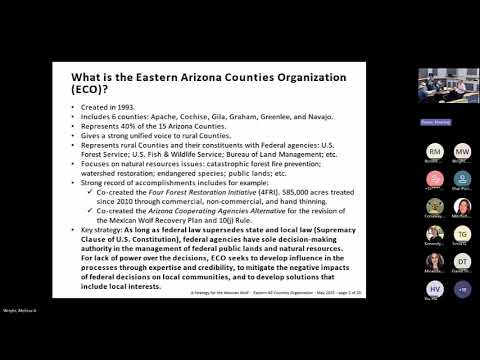
The presentation by Pascal Berriault, executive director of the Eastern Arizona Counties Organization, and field reports from the Cochise County Sheriff’s Office focused on population data, compensation shortfalls and the limits of local authority when federal law governs management decisions.
Berriault said the U.S. minimum count at the end of 2024 was 286 wolves and that the population has grown consistently in recent years, adding that a sustained growth rate near 10% would put roughly 500 wolves on the U.S. landscape by 2030. He said the recovery plan defines specific criteria for downlisting and delisting and that the most executable near-term option is downlisting the U.S. population only — not the entire U.S.–Mexico population — because Mexico’s population remains far below the plan’s thresholds.
"There is a path," Berriault said. "And that path is not delisting and defunding." He stressed that meeting downlisting criteria would require continued funding for capture, cross-fostering and population counts as well as progress on genetic diversity goals; as of March 1, 2025, he said the program had recorded 21 successful gene incorporations in the U.S. and needed 22 to meet the U.S.-only downlisting benchmark.
Detective Cody Esfry of the Cochise County Sheriff’s Office, Ranch Patrol Division, told supervisors the office had documented six confirmed depredations in the county in recent months and had received another report the morning of the meeting. He described operational gaps: U.S. Fish and Wildlife Service and USDA Wildlife Services (APHIS) have legal responsibility for depredation confirmations and compensation eligibility, investigators are based in northern Arizona, and Arizona Game and Fish has limited local "range rider" coverage in the county.
"Our primary role is acting as a liaison between the sheriff's office and the ranching community within Cochise County," Esfry said, adding that local deputies currently preserve scenes and can photograph evidence but are not certified as official wolf-depredation inspectors under state administrative rules, which affects compensation eligibility.
Speakers and several supervisors discussed options raised in the federal recovery plan and federal rules: the presentation summarized the plan's U.S.-only downlisting criteria (a U.S. four-year average at or above 320 wolves plus gene-diversity benchmarks), the two-population option (separate U.S. and Mexico thresholds) and the higher bars required for delisting entirely from Section 9 of the Endangered Species Act. Berriault warned that efforts to defund the program without delisting could remove federal management tools while leaving ESA protections in place, reducing the ability to perform cross-border transfers, cross-fostering and compensated prevention work.
County participants raised several recurring concerns: delays in depredation investigations (local deputies wait for USDA/APHIS investigators to travel from northern Arizona), the narrow federal evidentiary standard adopted recently that emphasizes subcutaneous hemorrhage, insufficient federal funds for depredation compensation, and the absence of adequate field staffing for Arizona Game and Fish programs in Cochise County.
Multiple speakers urged the board to pursue short-term, actionable steps in parallel with any longer litigation or federal-rule campaigns. Those steps included asking the county to: seek increased federal depredation compensation, request that U.S. agencies allow local deputies to be certified or formally included in depredation investigations, press the U.S. Fish and Wildlife Service to begin planning a 4(d) rule now so states can prepare to manage a downlisted population, and push for funding that supports transfers of wolves to Mexico and ongoing cross-fostering.
The board directed staff to draft a resolution reflecting those concerns, to consult with the Ranch Patrol and stakeholders, and to hold a public meeting on Tuesday, May 13 at 5:30 p.m. in the same hearing room to collect public input before finalizing the resolution.
Background and data cited in the session included: the Eastern Arizona Counties Organization's record of securing about $1.5 million in depredation compensation since 2011 through a Livestock Demonstration Grant process, ECO donations of about $135,000 since 2020 to Arizona Game and Fish prevention programs, an annual federal depredation grant of roughly $200,000 cited by presenters, and the recovery-plan thresholds for downlisting and delisting (U.S.-only downlisting: four-year average ≥320 wolves and completion of required gene incorporations). Presenters and law‑enforcement officials emphasized that many management tools and compensation programs depend on continuous federal funding and on the U.S. Fish and Wildlife Service's regulatory process.
No formal vote was taken during the May 8 work session; the board's next public meeting on May 13 will include public comment on a draft resolution that supervisors plan to circulate for local input before a formal action.