Get Full Government Meeting Transcripts, Videos, & Alerts Forever!
Get email alerts on the Special Education Referrals Lita topic
No spam. Unsubscribe anytime.
Committee hears bill to give families earlier written notice of local IDD services; public testimony from Handley family
Summary
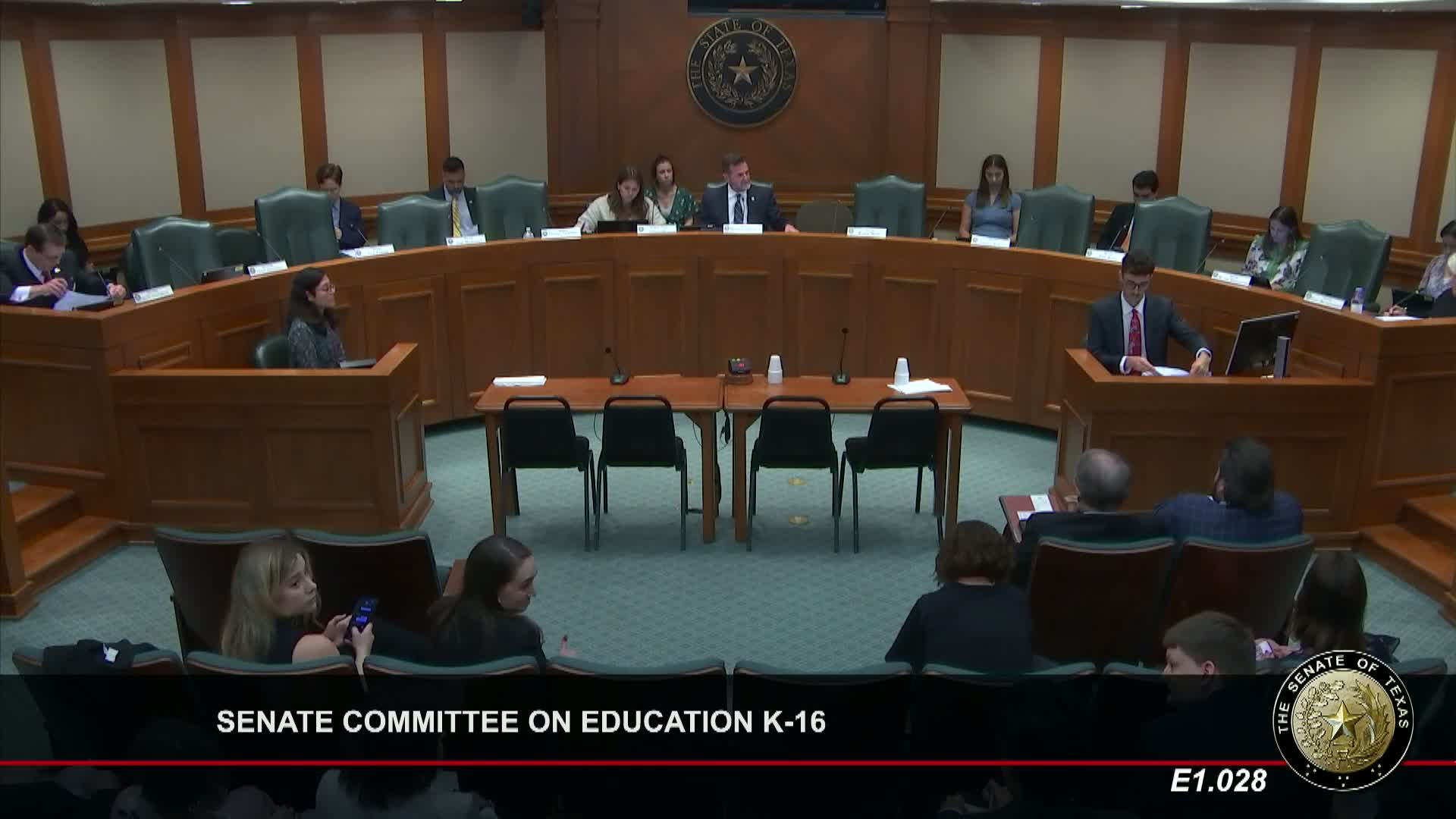
Senate committee members heard testimony on House Bill 1188, known in the House as the Caitlin Handley Act, a measure that would require Texas school districts to provide parents or legal guardians written information about their local intellectual and developmental disability authority at the first admission, review and dismissal (ARD) meeting for students found eligible for special education because of an intellectual disability or developmental delay.
Senate committee members heard testimony on House Bill 1188, known in the House as the Caitlin Handley Act, a measure that would require Texas school districts to provide parents or legal guardians written information about their local intellectual and developmental disability authority at the first admission, review and dismissal (ARD) meeting for students found eligible for special education because of an intellectual disability or developmental delay.
The bill’s sponsor in the House and county-level officials were present for testimony, which featured the Handley family and representatives of disability advocacy groups and employer organizations. Proponents told the Senate committee that earlier notice would connect families to services — including Medicaid waiver wait lists, crisis supports and service coordination — long before the current default referral point at age 14 for transition planning. After public testimony, the committee closed testimony and left HB 1188 pending subject to the chair.
Proponents said the bill is a modest change to current practice that can give families an earlier pathway to supports. "HB 11 88 is a simple yet impactful bill," Carrie Handley said in testimony describing the proposal and the family’s effort to develop it. Her daughter, Caitlin Handley, testified in support as well: "I'm here to represent myself and to testify in support of HB 11 88, the Caitlin Manley Act, and I just wanna help others like me." Boyd Handley, who identified himself as a special‑needs attorney, described encounters at school and community fairs where parents of older students said they had not received information about available services.
Advocacy organizations expanded on the problem the bill seeks to fix. Sabrina Gonzales Salcedo, director of public policy and advocacy for the Arc of Texas, urged lawmakers to imagine "a new mom" hearing a diagnosis for the first time and said, "What that parent needs most in that moment is support." Linda Litzinger of Texas Parent to Parent told the committee the state’s Medicaid waiver wait list contains about 185,000 duplicated names and that the Legislature adds roughly 950 waiver slots per year, creating "a lifetime of a wait" for many families.
Witnesses and proponents also described how LITAs serve as a gateway to publicly funded services, including eligibility determination, service coordination, waiver navigation and crisis supports; several witnesses said many families do not hear about those authorities until years after a diagnosis, if at all. Testimony noted that HB 1188 directs the Texas Education Agency and the Health and Human Services Commission to work together to develop and distribute standardized informational materials for school districts.
Supporters told the committee the bill carried no fiscal note and has broad bipartisan support in the House: witnesses said the measure was unanimously advanced by the House Public Education Committee and was renamed for the Handley family during a near‑unanimous House floor vote. Several senators praised the family’s advocacy during the hearing.
The chair closed public testimony on HB 1188 and the committee left the bill pending subject to the chair. No committee vote on final passage or specific amendments occurred during the hearing.