Get Full Government Meeting Transcripts, Videos, & Alerts Forever!
Get email alerts on the Public Health Budget topic
No spam. Unsubscribe anytime.
Council committees confront public-health budget choices: Montgomery Cares, HIV services, school reproductive health and East County dental access
Summary
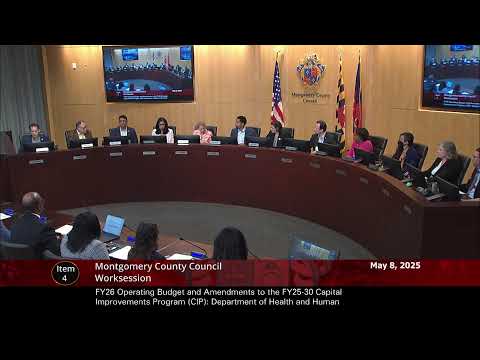
County officials debated multiple public-health budget items on May 8, including higher Montgomery Cares reimbursement rates, county funding to replace federal cuts to HIV/STI staffing, restored youth reproductive-health services in the Care for Kids program, and a contested East County dental reimbursement proposal.
The Montgomery County Council’s health and human services discussions on May 8 encompassed several linked public-health budget items the council said are central to county safety-net services: a proposed increase to Montgomery Cares reimbursement rates, funding to sustain HIV/STI clinical staffing after federal reductions, a county-backed reproductive-health service for children enrolled in Care for Kids, and a contentious set of dental funding proposals intended to expand access in East County.
Council staff described a recommended Montgomery Cares reimbursement increase to 45% of the cost of care, which the packet quantified as an increase of $963,361 and a rise in the encounter rate from $2.15 to $113.36 per encounter. The HHS committee approved the primary-care reimbursement increase 2–1; Council member Lukey recorded a dissenting vote in committee and asked for a more phased approach to the increase. Committee leaders said many primary-care clinics rely on these reimbursements to sustain staff and operations and that last year’s underfunding had led some clinics to reduce staff.
Another recurring theme was replacement of federal grant dollars with county funding for positions providing HIV and STI services. Council staff said the FY26 recommendation would cover about 6.3 FTEs at an estimated $848,709 to replace federal funds and sustain the HIV clinic, dental clinic and new Germantown services; the HHS committee approved the recommendation 3–0. Public-health leaders warned that reduced funding could require reducing clinic days in Germantown and laying off staff if county funds were not approved. “If this is not funded, what that means is we will likely need to cease services at our Germantown clinic, and we will need to drop the number of clinic days for our HIV program, and we would need to lay off staff,” Dr. Ashford (Public Health) said during the meeting.
The council also considered an addition to Care for Kids to support reproductive health and family-planning services for youth enrolled in the program. Council members described Title X providers in the county that already deliver similar services but said continuity of care for enrolled youth matters because requiring a separate visit reduces the likelihood young people will receive and continue contraception. After a motion to restore the full requested amount, the council voted unanimously to approve the reproductive-health line for Care for Kids.
Dental access in East County generated extended debate. The County Executive’s FY26 proposal included a new contract to reimburse community dental practices for treatment for about 300 East County residents. Public-health leaders said a contract with the University of Maryland at Shady Grove (USG) launched in February has already taken referrals and delivered same-week appointments for some patients. The HHS committee recommended adding a $300,000 reduction for the East County dental line to the reconciliation list; at full council the motion to add the reduction to the reconciliation list passed on an 8–3 split. Council members in favor of preserving the line emphasized East County’s relative lack of providers who accept Medicaid or provide weekend hours; those who supported putting the line on the reconciliation list cited fiscal constraints and the need to apply consistent standards to new one-time contract requests.
A separate but related procedural debate involved a planned FY26 contract for the nonprofit MVMA (a Vietnamese American community provider referenced in committee documents). Committee members and council staff discussed a proposed $89,941 sole-source restoration of an MVMA contract after staff observed the organization could not simultaneously compete for a Healthy Communities Fund award because of a per-organization cap. The committee placed the $89,941 MVMA item on the reconciliation list for consideration. Council members discussed multiple ways to make the MVMA funding neutral for the Asian American Health Initiative’s grant pool, but no final paired action was taken during the morning session.
Council members emphasized the limits of county authority when federal Medicaid and Title X funding change and repeatedly signaled a willingness to use supplemental appropriations or reconciliation actions in coming weeks as federal impacts become clearer. Public-health leaders asked the council to consider budget items in the context of rising demand, higher costs and recent federal reductions.