Get Full Government Meeting Transcripts, Videos, & Alerts Forever!
Get email alerts on the Infrastructure Water Wastewater topic
No spam. Unsubscribe anytime.
New Watershed commissioner outlines priorities: compliance, collections, meters and RM Clayton upgrades
Summary
The Department of Watershed Management presented FY26 priorities to City Council: maintaining compliance with state and federal rules, accelerating collections and meter upgrades, filling licensed operator vacancies, and capital work at treatment plants including RM Clayton.
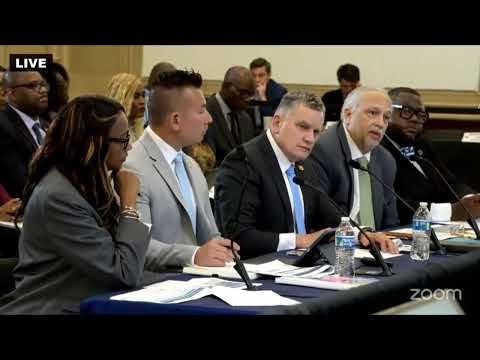
Greg Eyerly, the City’s new commissioner of Watershed Management, presented the department’s FY26 budget priorities and operational status to the Atlanta City Council, citing compliance work, workforce development, meter modernization and capital projects at wastewater and water plants.
Eyerly opened by placing Atlanta’s challenges in historical context: the city’s water and sewer infrastructure predates the federal Clean Water Act of 1972, which he said creates additional complexity and compliance burdens relative to newer systems. He described Watershed as one of the nation’s larger municipal utilities and listed core services as: delivering safe drinking water, treating wastewater to regulatory standards, and reducing urban flooding while improving water quality.
Key metrics and near‑term priorities were given in the presentation. The department said it manages roughly 1,556 full‑time equivalent positions, treats about 98 million gallons of drinking water per day, receives roughly 138 million gallons of wastewater per day, and manages about $5 billion in assets. The five‑year capital plan totals roughly $1.2 billion, while the department’s FY25 adopted budget was presented as about $796 million.
Eyerly and Watershed staff described workforce and recruitment plans to fill vacancies, particularly for licensed water and wastewater operators. Director of HR Kim Frazier said the department repurposed roughly 85 extra‑help vacancies into FTEs and has developed partnerships with local technical colleges and a DWM University program to create pipelines and apprenticeship‑style ramps into licensed operator roles. The presentation said RM Clayton and Entrenchment Creek treatment plants have several licensed operator vacancies prioritized for hiring and training.
On collections and billing, Deputy Commissioner Jonathan Williams said the department resumed water shutoffs for nonpayment in March 2023 and has since shut off nearly 4,000 accounts, established about 1,630 payment plans and collected roughly $3.8 million in additional revenue. He said collections remain a priority and Watershed expects to add technical and staff resources to improve outreach, remote payment plan setup and intergovernmental collections.
Meter modernization and advanced metering infrastructure (AMI) received particular emphasis. Staff said a pilot for smart metering is planned; AMI would reduce estimated bills, detect leaks faster and give customers near‑real‑time consumption data. The department noted an elevated share of estimated bills — driven partly by historical billing gaps and by leaks that surfaced when shutoffs resumed — and identified shorter reading cycles and the AMI pilot as fixes.
Treatment plant work and compliance actions were described in detail. Watershed staff reported completing upgrades on UV systems and secondary clarifiers at RM Clayton and said upgrades and automation work are underway to improve reliability and address odor and permit compliance problems. Deputy Commissioner Quinton Fletcher said the department aims to return RM Clayton to full and reliable compliance; some projects will continue across the five‑year CIP and include clarifier, digester and headworks work.
Financial staff summarized risks and funding context. Municipal option sales tax (MOST) revenue has grown but is volatile; interest income helped FY25 performance, yet market uncertainty and inflationary pressures mean the department expects a downward trend in equity roll‑forward beginning in FY26. Watershed staff said the city treasury has used refunding and reserve management to free capital resources when possible, and that the department is evaluating alternative financing strategies, debt packaging and prudent expense management to bridge gaps.
Councilmembers asked for additional documentation: a FY25→FY26 projection column in the packet, a monthly breakdown of collections and write‑offs, a map or table showing where collections shortfalls are concentrated, and a schedule of RM Clayton‑related projects and FY26 planned expenditures. Watershed committed to provide follow‑up materials and to prioritize licensed operator hiring and the AMI pilot.
Ending: Council members thanked the commissioner for the presentation and requested detailed follow‑ups on collections, meter modernization timelines and RM Clayton capital spending. Watershed said it will deliver the requested supporting documents and continue recruitment and capital work to restore reliability and regulatory compliance.