Get Full Government Meeting Transcripts, Videos, & Alerts Forever!
Get email alerts on the Food Security topic
No spam. Unsubscribe anytime.
Council trims community gardening grants as Office of Food System Resilience warns federal cutbacks have reduced local food supplies
Summary
The Montgomery County Council’s HHS committee approved moving $100,000 out of the community gardening grant program for FY26 while the Office of Food System Resilience told the council that federal and logistical changes have reduced commodity supplies and increased costs for local food assistance providers.
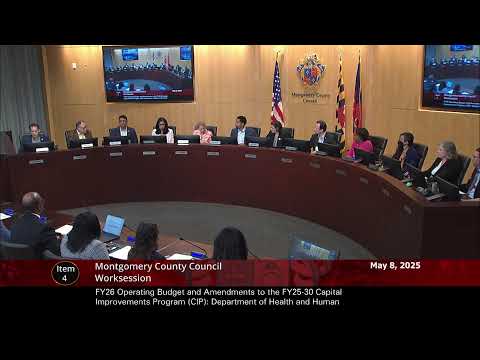
The Montgomery County Council on May 8 approved a $100,000 reduction to the community gardening grant program in the FY26 operating budget while the county’s Office of Food System Resilience reported worsening supply and program conditions that county officials said will heighten local needs.
Council staff said the community gardening grant program — first funded in FY24 as part of a strategy to reduce childhood hunger — was paused in FY25 to better align grant cycles with growing seasons. The FY26 program budget is listed at $200,000 and was expected to help five to 10 organizations; the HHS committee voted to reduce that line by $100,000 based on affordability guidance and because the program is starting a new grant cycle.
“Through our FY24 gardening grant programs, there were 1,800 residents that were directly receiving food through this program,” Office of Food System Resilience staff said during the council meeting, describing yield and community benefits beyond food production. Staff also said funded organizations increased the amount of land in production by roughly 50% after receiving grants.
At the same time, the Office of Food System Resilience reported multiple federal and supply disruptions that officials said are shrinking the effective resources available to local providers. Director Breskin told the council that a federal office overseeing Meals on Wheels had been “dismantled,” that the Capital Area Food Bank canceled shipments of 28 tractor-trailers of commodity foods that had been scheduled for distribution to local partners, and that the federal market-match program for farmers markets had been scaled back from a $30 per-purchase cap to $10 per purchase in some instances.
“We’ve heard a 40% increase reported by our food assistance providers in their costs of sourcing food,” Director Breskin said. Staff added that roughly 85% of the office’s program budget is dedicated to purchasing food, which explains why flat funding can translate into substantially reduced on-the-ground capacity.
The Office of Food System Resilience’s FY26 recommended operating budget is slightly lower than FY25 — a 1.79% decline the office attributed to the expiration of two one-time pandemic-era grants totaling about $2.85 million (cited in the packet as a $1,100,000 and a $1,750,000 item removed from the baseline). The office also requested two positions (an administrative specialist 2 and a program manager 1) that staff said would be budget-neutral because contractual dollars would be shifted to salary lines; the FY26 annualized costs listed in the packet were $83,779 and $990,065 respectively for those positions’ full-year impacts.
Council members who oversee education and food policy said the school-based food assistance program — which the council is proposing to expand by 20 schools beyond 60 currently served — and pop-up pantry services may play a larger role if federal supports decline further.
The HHS committee recommended approval of the $100,000 reduction on a 3–0 vote; later in the full-council session the reduction was approved by hand vote and recorded as unanimous. Council members and staff urged continued data-sharing and coordination between the office and the HHS committee as the council reconciles the FY26 budget.