Get Full Government Meeting Transcripts, Videos, & Alerts Forever!
Get email alerts on the Public Safety Police Budget topic
No spam. Unsubscribe anytime.
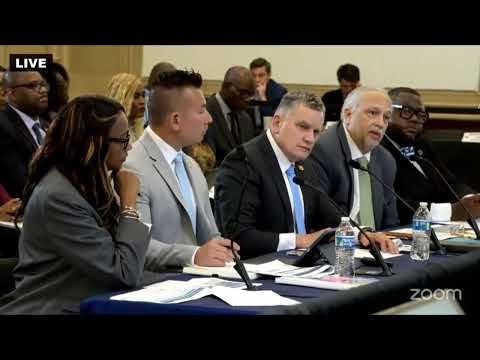
Atlanta Police chief details crime declines, staffing gains and World Cup preparations in budget briefing
Summary
The Atlanta Police Department told City Council it has seen declines in overall crime and homicides since 2022, improved 911 answer times, expanded civilian units, and is seeking budget approval to grow care units, advance e‑citation and expand camera and fleet capacity ahead of next year’s World Cup.
Chief, Atlanta Police Department, delivered a wide‑ranging presentation to the Atlanta City Council on the department’s use of the current budget and proposals for the coming year, saying officers and civilian staff have produced measurable crime reductions while preparing the city for major events.
The chief highlighted year‑to‑date and multiyear crime trends and operational metrics. “We continue to see a reduction around property crimes and overall crime in the city, as of last week down 11%,” the chief said. He also reported that crimes against persons are down 24% since 2022 and that homicides have fallen from 64 in 2022 to 30 so far this year.
The presentation outlined several specific enforcement and prevention efforts. The department said it removed 2,195 firearms from city streets using last year’s budgetary resources (in addition to 2,258 firearms recovered the previous year), shut down 73 unique drug‑dealing operations last year and 25 so far this year, and conducted focused efforts against street racing and illegal gambling. The chief said Operation Burnout led to 47 arrests of street racers, the seizure of 19 vehicles and recovery of six firearms, and that the department has shut down 15 illegal gambling operations, which it links to localized declines in gun violence.
The APD credited outreach and partners for some of the reductions and noted operational challenges during the same period: the department policed multiple large demonstrations, hosted national‑level events and stood up security for the Public Safety Training Center. The chief said these demands contributed to high overtime in specific months — $1.8 million in November and $2.2 million in January — but that overtime spending has dropped substantially this year, citing monthly figures that fell to about $275,000 most recently.
The chief gave several staffing and infrastructure updates. He said sworn officer ranks have grown to “over 1,750 officers” and that hiring rose 34% in the first quarter of the year; the department opened a recruitment center at Public Safety Headquarters and attended more than 120 recruitment events last year. The police chief also described a planned rollback of a recapture (retiree retention) program in three phases that he said will yield $5.6 million in savings as the department stabilizes staffing.
911 and technology upgrades were emphasized as operational successes. The chief said the average 911 answer time fell from 29 seconds in 2022 to 24 seconds in 2023 and to 12 seconds in 2024, with an April average of 9.7 seconds. The department described deploying a new records management system, a body‑worn camera upgrade, digitized internal investigations, and growth in the city’s integrated camera network from roughly 10,000 cameras in 2022 to about 19,500 at the end of 2024.
The presentation described pilot and civilian response programs the department intends to expand. A newly created CARE (care) unit, the chief said, responded to 2,398 calls and completed 1,632 police reports in 2024 (the unit was created mid‑year). Year‑to‑date figures were 1,267 calls and 686 reports; the budget request would fund growth of the program to 20 care officers serving all zones.
Fleet and event readiness were addressed as budget drivers. The chief said the department has issued 316 take‑home vehicles and ordered 163 more this fiscal year; he argued take‑home vehicles improved response and continuity during two recent weather emergencies. The department also identified spending lines for camera maintenance, fleet repair, body‑worn camera cloud storage and other recurring technology contracts.
On enforcement technology, the chief said the budget includes an e‑citation pilot to replace paper citations and speed court and prosecutorial processing. He told councilmembers the contract bundle with Axon includes body‑worn cameras, in‑vehicle cameras, records management and the new e‑citation functionality.
Budget figures were presented at a high level: the chief said the APD’s E‑911 fund is about $23 million, the Aviation Fund roughly $30 million and the General Fund request approximately $308 million, a figure he described as roughly a 19% increase over the FY25 adopted budget that normalizes operational costs and expanded staffing investments. He said about 80% of the department’s budget pays personnel and roughly 9% covers contracts and technology maintenance.
Council members asked about E‑911 staffing and camera maintenance, the CARE pilot and its expansion, vehicle outfitting and timelines for planned precinct refurbishments and a new Zone 5 precinct. The chief and APD staff provided operational answers and committed to follow‑up details such as sworn‑officer rosters by zone, a camera status report in coordination with the Atlanta Police Foundation, and a more detailed overtime breakdown tied to specific events where feasible.
The chief closed by linking the budget request to major upcoming events, telling the council that the funding would be required to support public safety planning for the World Cup and other large gatherings, and reiterated plans to continue the department’s focus on gangs, guns and drugs, youth engagement and technology modernization.
Ending: Councilmembers thanked APD leadership for the briefing and indicated follow‑up requests. APD committed to provide additional details on zone assignments, camera maintenance allocations, and the metrics and rollout timeline for the CARE expansion and e‑citation pilot if the council moves the budget forward.