Get Full Government Meeting Transcripts, Videos, & Alerts Forever!
Get email alerts on the Municipal Budget topic
No spam. Unsubscribe anytime.
St. Pete Beach finance panel hears large capital shortfall, uncertain FEMA timing
Summary
St. Pete Beach officials told the Finance and Budget Review Committee on May 6 that hurricane-related revenue losses, delayed FEMA reimbursements and a long list of unfunded capital projects leave the city facing a substantial funding gap.
St. Pete Beach officials told the Finance and Budget Review Committee on May 6 that the city faces an uncertain revenue picture after recent storms, has received $3.8 million in initial FEMA reimbursements and is carrying tens of millions of dollars in unfunded capital needs.
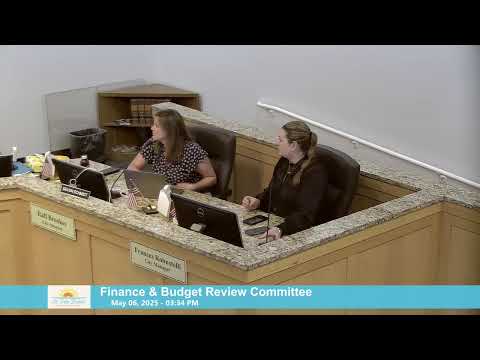
City Manager Frances Ropestelli, speaking to the nine-member committee, cautioned that “you may get a little bit of sticker shock” as staff presented a draft capital improvement plan and a 10‑year financial outlook. Finance Director Devin Schmidt said the presentation is an early workshop and “this is not a final budget,” asking the committee for guidance on priorities before staff brings recommendations to the City Commission.
Why it matters: the committee serves in an advisory role to the commission on the annual budget. Staff said storms reduced parking and property‑tax revenues, FEMA reimbursements can lag years, and the city is currently subsidizing enterprise funds that ideally should be self‑supporting. Without policy changes, the city’s projected capital spending would drive fund balances deeply negative.
Major fiscal issues and sources cited - FEMA reimbursements and timing: staff reported $3.8 million received for initial storm response and noted larger FEMA claims can take five to seven years to settle. That timing, staff said, creates short‑term pressure on operating reserves. - American Rescue Plan Act (ARPA): staff showed a $4.9 million ARPA balance and a planned $11.8 million transfer out to other funds in the 2025 estimates. - Enterprise funds subsidy: Schmidt said wastewater, reclaimed water, stormwater and multimodal funds are receiving general‑fund subsidies and “that is certainly not a best practice.” Staff said a fee and impact study is under way to set enterprise fees closer to the funds’ true costs.
Capital needs and prioritization Staff presented a 2026–2030 capital improvement plan (CIP) that prioritizes repair and restore with resiliency work ahead of amenity enhancements. The CIP showed examples of large projects and the funding gap: - Fire Station 22 — listed in staff materials at $12 million; station demolition was approved by the City Commission but cannot proceed until FEMA confirms eligibility for replacement funding. - Don CeSar / Boca Cica resiliency adaptation — shown at $30.1 million. - Seawall replacement projects, including an $8 million seawall line item. - Public‑services projects spanning seawalls, facility HVAC, emergency backup generators and an operations yard expansion; staff singled out the First Street fishing pier (rehab history, now storm‑damaged) as a safety concern raised by committee members.
Staff contrasted planned versus completed capital work: for 2023 the city planned about $22 million in CIP but completed roughly $4.8 million; for 2024 the plan was about $25 million and completed roughly $7.1 million. Devin Schmidt said the draft CIP as presented would drive the general fund balance deeply negative and is “not a budget that we would put forward or recommend.”
Operational and program details - Reclaimed water: staff reported the system serves roughly 2,900 customers and about 2.8 million gallons per day; the reclaimed water fund ran positive actuals in recent years but requires subsidies for planned 2026 projects and operations without fee adjustments. - Wastewater: staff noted a $2 million grant expected for Pump Station 1 and that some wastewater capital work is being prioritized as essential. - Building inspections and permitting: the city has funded additional inspection capacity for roughly the next 12 months—staff said funds will support seven additional full‑time building staff and contract hires (four plan examiners and four contract building inspectors) while permit volumes are evaluated.
Reserve, borrowing and other tools Staff said the city currently lacks formal reserve and investment policies and is working with its financial advisor and bond counsel to evaluate an emergency bridge loan to backfill operations if needed (staff emphasized such a loan would not fund capital). Committee members asked staff to verify whether a prior Wells Fargo arrangement existed; staff said they would follow up.
Grants and external advocacy Ropestelli told the committee the city has assigned a management analyst in public services to pursue grants, extended its state lobbying contract and engaged a federal lobbyist for two years. Staff said the city will also contract for grant writing when needed.
Committee response and next steps Committee members responded with questions about specific projects, safety issues on fishing piers and the timing of Fire Station 22 replacement. Chair Samirajic and committee members voiced general support for staff’s proposed approach: prioritize repair/restore with resiliency, complete the fee and impact studies quickly, and develop reserve policies. There was no formal roll‑call vote; members expressed verbal agreement and asked staff to return on June 4 with an updated CIP, a position list and benefit projections.
The city will take the workshop materials and the committee’s advisory recommendation to the City Commission for further review in the coming months; staff emphasized that the budget will be balanced before final commission adoption later in the fiscal cycle.