Get Full Government Meeting Transcripts, Videos, & Alerts Forever!
Get email alerts on the Nuclear Energy topic
No spam. Unsubscribe anytime.
Senate committee hears extended testimony on House Bill 14 to fund advanced nuclear projects
Summary
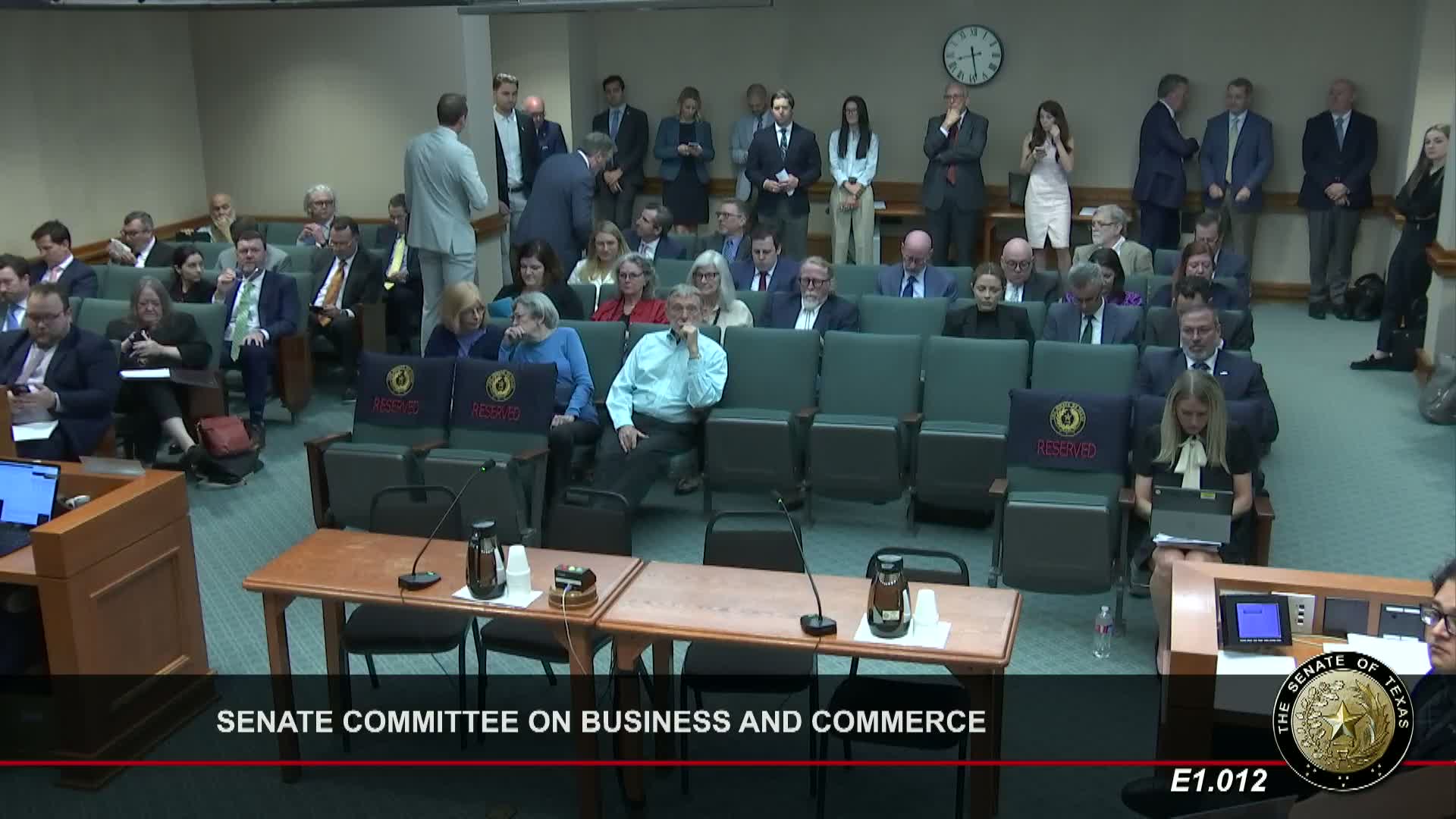
At a hearing of the Senate Committee on Business & Commerce, senators heard more than three hours of testimony for and against House Bill 14, legislation that would establish a Texas Advanced Nuclear Energy Office, grant programs and workforce measures to support advanced nuclear reactors.
At a hearing of the Senate Committee on Business & Commerce, senators heard more than three hours of testimony for and against House Bill 14, legislation that would establish a Texas Advanced Nuclear Energy Office, a nuclear permitting coordinator in the governor’s office, a Texas Advanced Nuclear Development Fund to award reimbursement-based grants, a completion grant program for advanced nuclear projects connected to ERCOT and a workforce-development program administered with state higher-education agencies.
The bill’s sponsor, Senator Schwartner, told the committee HB 14 would “position Texas as a national leader in the next generation of nuclear technologies” and listed the bill’s core programs and grant vehicles. Proponents said the measure would help deploy dispatchable, low‑emission power and attract industrial customers. Griffin Perry of Fermi America said “nuclear is safe, reliable, [and] dispatchable,” and argued a state program would accelerate deployment. Billy Barton of Dow Chemical described a proposed 4×80 megawatt deployment at a Seadrift manufacturing site and said the bill’s support would “send an important signal to the market” and help build a domestic supply chain.
Opponents urged caution. Adrian Shelley of Public Citizen said the bill relies on grants rather than loans, warned that advanced reactor projects have historically been delayed and over budget, and recommended stronger milestone-based financial protections and lifecycle-safety criteria. Craig Daser of the Sierra Club and speakers from Texas Nuclear Watchdogs said advanced reactors and small modular reactors remain unproven at scale and criticized using taxpayer funds to underwrite large commercial projects.
Committee members pressed witnesses on timeline and cost. Witnesses gave wide ranges: one advanced‑reactor presenter said a construction-permit timeline at the Nuclear Regulatory Commission (NRC) could be shortened to about 12–18 months under current process improvements but acknowledged permitting has historically taken years; another industry witness said long‑lead equipment deliveries could mean roughly five years from major procurement to grid delivery for some designs, while others estimated commercial deployments near the early 2030s. Estimates for per‑project capital needs ranged in witnesses’ testimony from hundreds of millions up to multiple billions of dollars depending on technology and scale.
Witnesses from Texas A&M described the RELLIS campus as a possible site for demonstration reactors and said the system had selected several vendors to pursue early‑site permitting. Industry and local utility representatives including CPS Energy and Paragon Energy Solutions argued a state role could attract manufacturing, jobs and data‑center customers. Several industry witnesses proposed hybrid models that bring natural‑gas dispatchable capacity online sooner to finance a later nuclear build.
Public‑interest groups, university and conservation witnesses urged strict guardrails. Suggestions offered during testimony included converting grant funding to loan or milestone‑based reimbursement structures; requiring projects to demonstrate grid benefits to ERCOT; stronger lifecycle waste‑management standards; and tighter criteria for state funding and clawbacks if projects fail to reach milestones.
At the end of the hearing the sponsor withdrew the bill; the chair said HB 14 would remain pending subject to the call of the chair, giving members and staff time to consider amendments, fiscal impacts and the larger supplemental appropriations discussion that several senators said is ongoing.
The hearing record shows robust technical, economic and policy debate but no committee vote on final passage. The committee’s next steps were not offered on the record at the hearing’s close.