Get Full Government Meeting Transcripts, Videos, & Alerts Forever!
Get email alerts on the Elections Ballots Scannability topic
No spam. Unsubscribe anytime.
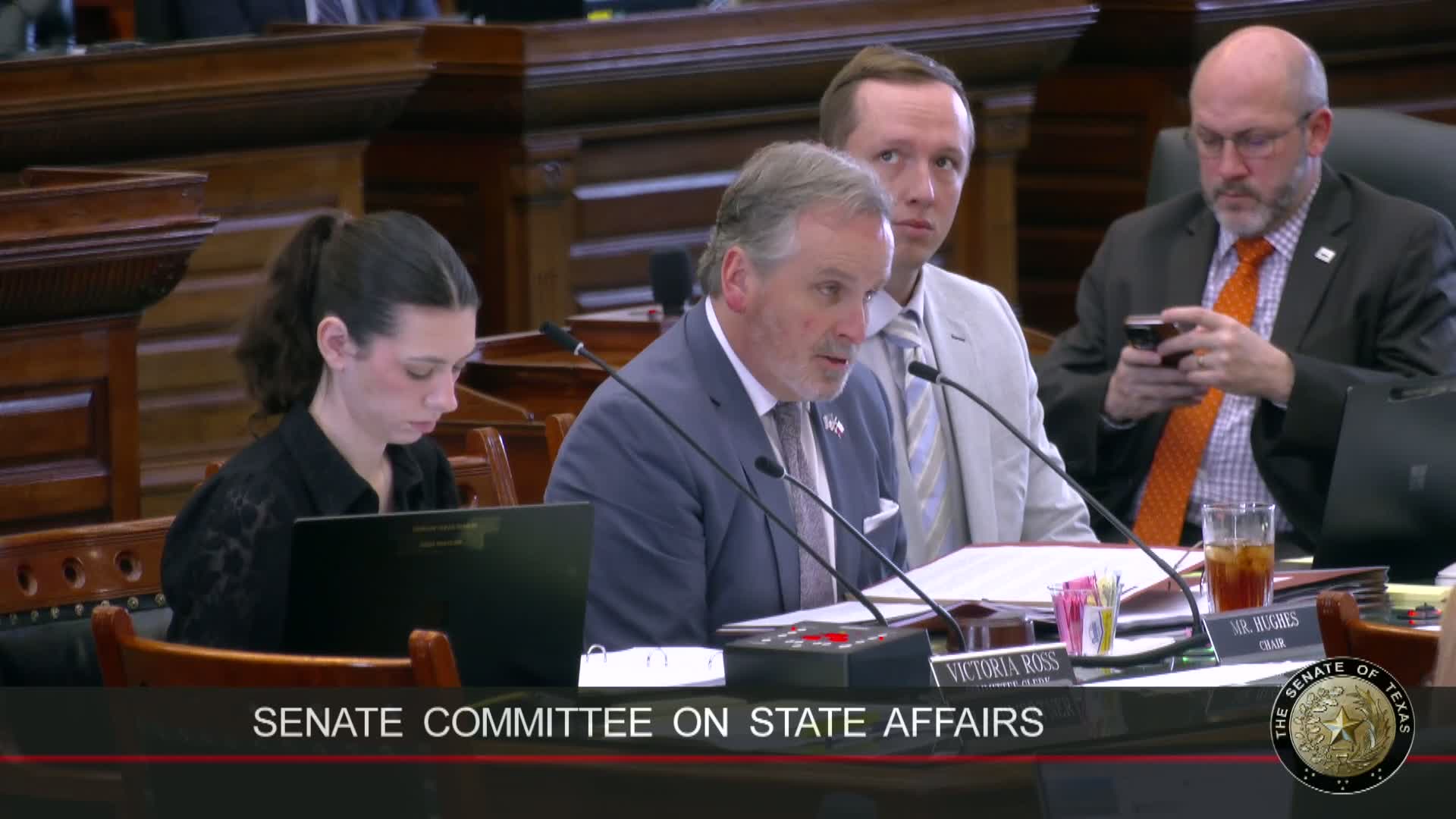
Senate committee hears opposition from hand‑count counties to bill requiring scannable ballots
Summary
Witnesses from Gillespie and other small Texas counties told the Senate Committee on State Affairs they oppose House Bill 3113, saying the mandate that hand‑count counties use ballots scannable by optical scanners would add cost, vendor dependence and could impede locally run hand counts.
Senator Flores told the Committee on State Affairs that House Bill 3113 would require counties that choose to hand count ballots to use ballots that “are capable of being scanned and tabulated by voting machines using optical scanning technology.”
The measure, Flores said, does not prohibit hand counting or require an audit of hand‑count results but would allow quick, accurate verification of election results.
The bill drew sustained public opposition from hand‑count advocates. Cindy Castilla, testifying for Texas Eagle Forum, said, “we are opposed to this bill.” She and other witnesses said HB 3113 would push counties toward vendor‑formatted ballots and could make hand counts more costly and difficult.
Angela Smith, of the Fredericksburg Tea Party, told the committee she helped run Gillespie County’s 2024 hand count and called it “an absolute success.” She said the bill would force counties that want to hand count to “purchase costly and unnecessary scannable ballots with barcodes” and warned the requirement would “impede our hand count process.”
Jeanette Harmuth, who said she helped organize Gillespie County’s Echo 65 hand‑counting team, told senators the only way to make ballots scannable for optical scanners is special formatting performed by voting system vendors. “We would have to do that. It's expensive,” she said, calling HB 3113 a “vendor bill” that could force small counties to subsidize machine vendors “for services and products they do not need, want or cannot afford.”
Opponents also raised accessibility concerns about machine‑printed ballots. Castilla said she received a machine‑printed ballot in Dallas with names “microscopic” and unreadable even with strong reading glasses.
Supporters and the bill text, as presented by the sponsor, emphasize the bill’s stated goal of increasing voter confidence and giving counties flexibility while enabling quicker verification.
The committee opened public testimony and heard from the three witnesses above; no further witnesses spoke. Public testimony was closed and the bill was left pending in committee.
What the committee did not do at this hearing was adopt any amendment or take a final vote on HB 3113; the chair left the bill pending while work continues.