Get Full Government Meeting Transcripts, Videos, & Alerts Forever!
Get email alerts on the Intoxicating Hemp topic
No spam. Unsubscribe anytime.
Lawmakers hear evidence that 'intoxicating hemp' products often exceed federal THC limits and elude oversight
Summary
Attorneys, regulated dispensary executives and industry witnesses told the Joint Committee on Cannabis Policy that products marketed as "hemp" and sold in gas stations and vape shops often contain intoxicating levels of delta‑9 THC, fail safety testing and avoid age checks and taxes.
A panel of attorneys, dispensary operators and industry advocates on Tuesday told the Joint Committee on Cannabis Policy that an out‑of‑control market for products marketed as "hemp" is undermining the regulated cannabis industry and posing public-health risks.
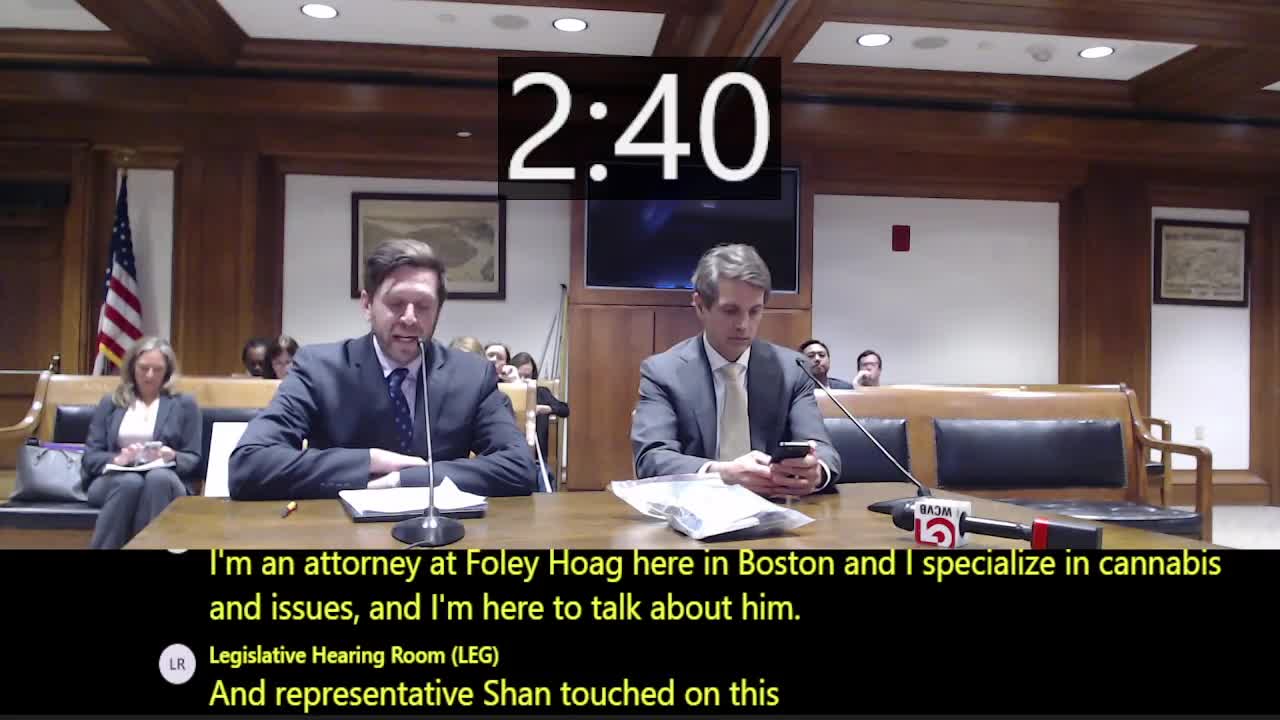
Jesse Alderman, an attorney at Foley Hoag, called federal hemp law a "legal fiction" that has allowed highly intoxicating products to be sold outside the regulated system. Alderman explained that the 2018 federal Farm Bill defines hemp by a delta‑9 THC concentration below 0.3% on a dry‑weight basis and that the combination of that definition and modern extraction methods has produced edibles, vapes and beverages that are intensely psychoactive while technically meeting the federal metric.
"You can have gummies and beverages that have a concentration of less than 0.3% by dry weight yet deliver tens or hundreds of milligrams of THC," Alderman said, and he urged the Commonwealth to use its authority to regulate production more strictly.
Peter Gallagher, CEO of regulated operator INSA, told the committee his team bought more than 100 hemp‑market products from convenience stores, vape shops and gas stations. He said laboratory testing showed roughly 90% would qualify as cannabis because their delta‑9 THC exceeded 0.3%; a third would have failed the state’s regulatory testing for microbials, pesticides or heavy metals. Gallagher said many shops failed to check IDs and in some cases did not collect the higher cannabis excise taxes charged by licensed retailers.
"We found cases of edibles that were 500 milligrams per piece and packages with 10,000 milligrams," Gallagher said. "These products are being sold without age verification, without testing, and often without taxation like regulated retail." The committee members viewed samples of the products Gallagher provided.
Several lawmakers raised enforcement and constitutional questions. Representative Shan asked whether legal challenges would follow if Massachusetts attempted to restrict intoxicating hemp, noting that other states have faced dormant-commerce or preemption lawsuits. Jesse Alderman acknowledged legal risks but pointed to a non‑preemption clause in the Farm Bill that some courts have interpreted as allowing states to impose stricter controls; he encouraged the committee to study other states’ approaches such as New Jersey’s recent legislation and Virginia’s upheld ban.
Industry witnesses and legislators debated which state agency should take primary responsibility if the Commonwealth moves forward: the Cannabis Control Commission, the Department of Public Health, the Alcoholic Beverages Control Commission, or local boards of health were all mentioned. Representative Shan and others urged careful drafting to avoid sweeping up legitimate nonintoxicating CBD businesses and to preserve small agricultural hemp growers.
No formal action was taken; witnesses urged the committee to pursue options ranging from total regulatory capture of intoxicating hemp by the CCC to targeted potency and production limits while protecting lawful MDAR licensees and small farmers.