Get Full Government Meeting Transcripts, Videos, & Alerts Forever!
Get email alerts on the Utilities Securitization topic
No spam. Unsubscribe anytime.
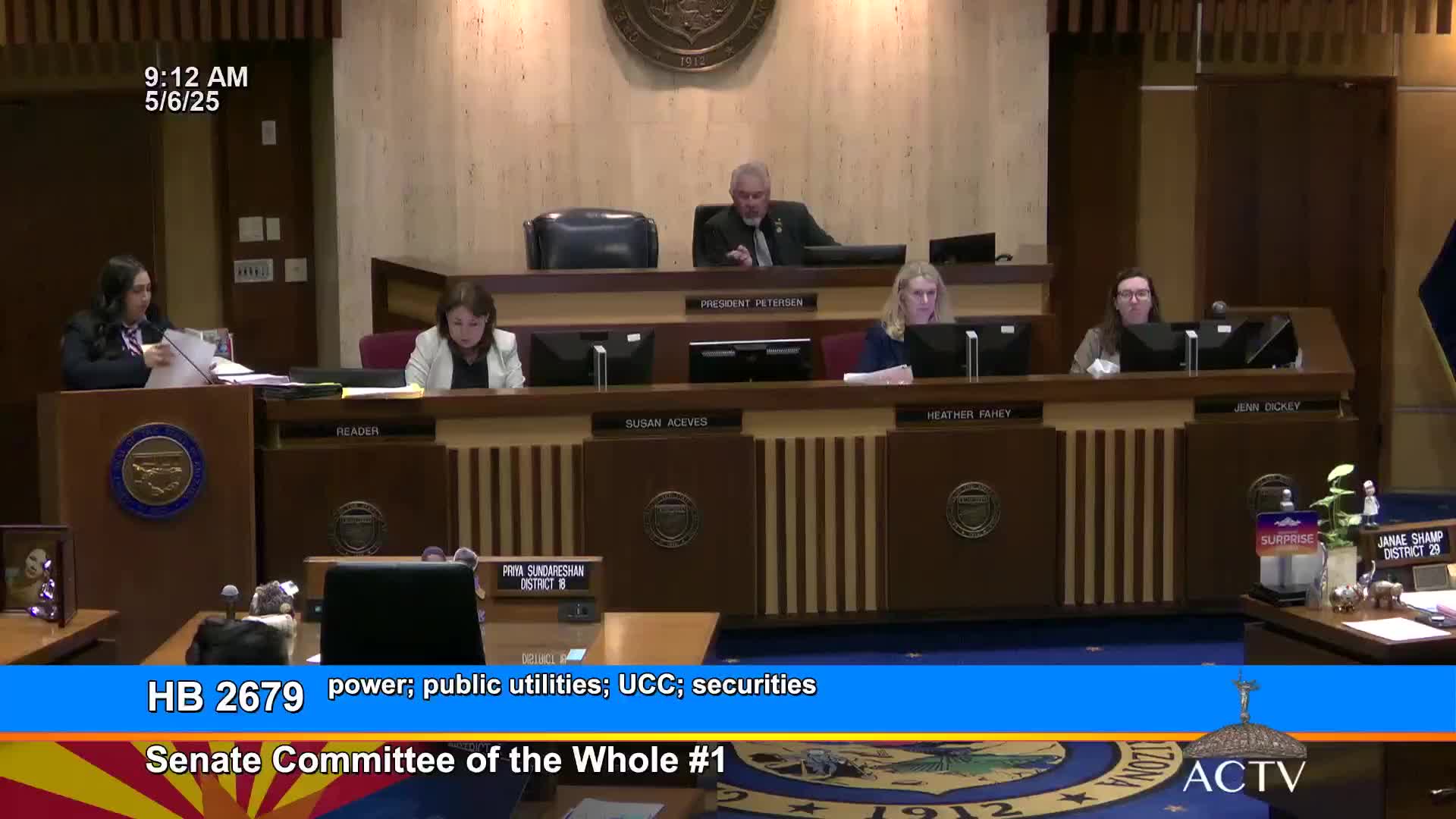
Senate approves securitization bill after floor amendments and hours of debate
Summary
The Arizona Senate voted to pass House Bill 26‑79, a securitization measure that lets utilities move certain costs into bonds, after multiple floor amendments and extended debate over consumer protections, oversight and impacts on ratepayers and tribal communities.
The Arizona Senate passed House Bill 26‑79 as amended on Wednesday, approving a measure that allows utilities to use securitization — issuing bonds backed by customer payments — to finance certain transition and disaster‑related costs.
Supporters said the bill gives utilities a financing tool to lower near‑term rate pressure and to recover costs related to storms and other events; critics said the measure shifts long‑term liabilities to ratepayers and weakens the Arizona Corporation Commission’s (ACC) role in rate setting.
Senator Shope moved the bill onto the floor and led the effort to pass it. Amendments debated on the floor included proposals from Senator Galbadon that would have limited sale price when utilities sell transition assets and from Senator Cuby (filling in for another sponsor) that would have tightened ACC oversight of securitization transactions. Several amendments were rejected; an amendment offered by Senator Schopf that added conditions to ACC review and required net‑present‑value analysis for some transactions was adopted.
Opponents repeatedly pressed the Senate for stronger guardrails. Senator QB said the bill does not require that assets be retired when they are securitized and warned securitization could let utilities move “bad debts off their books” while shareholders benefit. Senator Tothley, speaking from a district that includes parts of the Navajo Nation, said the bill lacks provisions to ensure an equitable transition for communities near fossil‑fuel infrastructure and expressed concern that residents already experiencing health disparities would see continued harm.
Supporters, including members who said they had worked with the governor’s office and the ACC on amendments, argued the bill restricts securitization to certain event recovery costs, excludes fuel purchases and power purchases from securitization, and prevents the securitization of new investments not already in service. Senator Schopf said the bill reflects work with the governor’s office and the Arizona Corporation Commission and that the bill “is what it is” after floor changes.
The Senate recorded the final passage as 17 ayes, 11 nays, 2 not voting. The measure will be transmitted to the House (and then to the governor) as part of the legislative process. The transcript includes repeated questions from members about the safeguards on bond rates and whether securitization would reduce or increase costs for different customer classes; sponsors pointed to ACC oversight and language added on the floor as protections but opponents said the protections are insufficient without stronger, enforceable ACC review and a public evidentiary process.
Why it matters: securitization changes how utilities recover costs from customers and can lock ratepayers into multi‑decade bond payments. The bill prompted debate about regulatory oversight, the role of the ACC in rate making, and potential distributional impacts on low‑income and tribal communities.
What happened next: the Senate passed HB 26‑79 as amended and instructed the secretary to transmit the action. Further ACC proceedings, and any gubernatorial review, will determine how the policy is implemented and whether additional rulemaking or legislation follows.
Speakers quoted in this account include senators who spoke on the floor during the HB 26‑79 debate; quotations are attributed only to the senators who spoke on record.