Get Full Government Meeting Transcripts, Videos, & Alerts Forever!
Get email alerts on the Renewable Portfolio Standard topic
No spam. Unsubscribe anytime.
Renewable portfolio standard draws technical testimony; sponsors, utilities and developers to refine draft
Summary
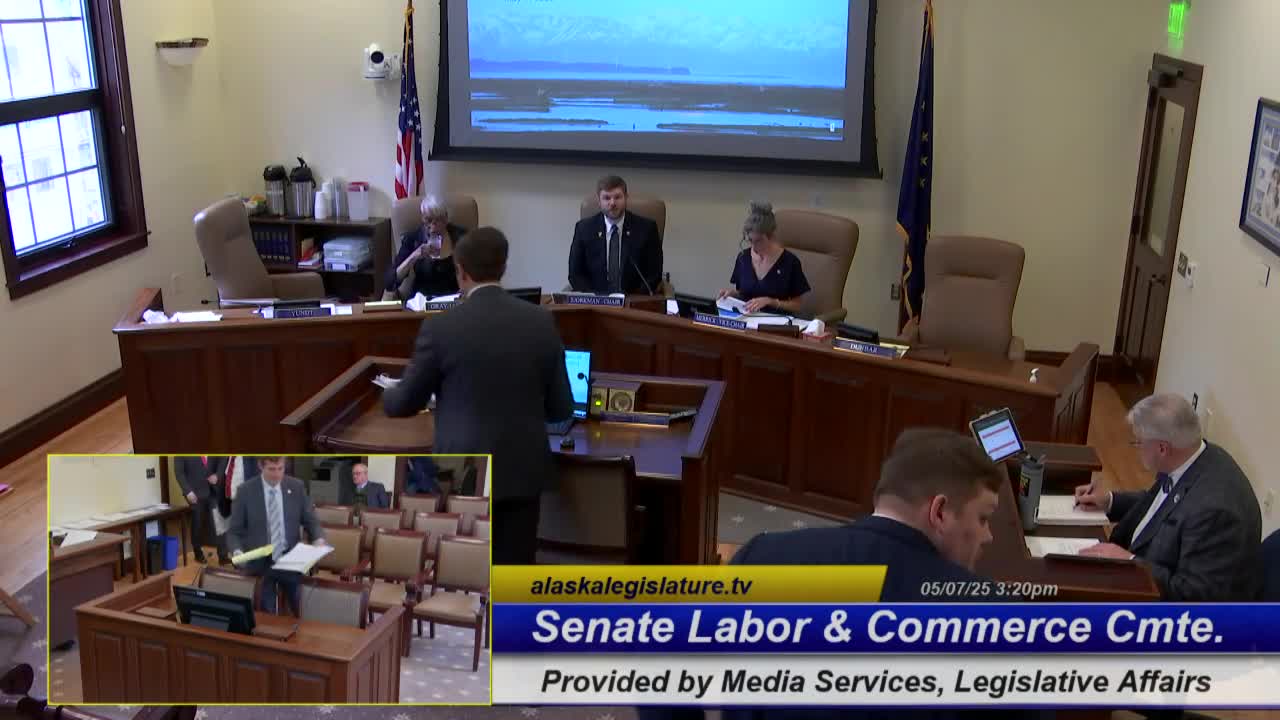
Lawmakers heard technical testimony on SB 149, a proposed renewable portfolio standard for the Railbelt that would set binding percentage targets for renewable generation and create compliance rules with fees and incentives.
Senators and witnesses on Wednesday discussed Senate Bill 149, a proposal to create a renewable portfolio standard (RPS) for Alaska that sponsors and staff said is intended to diversify energy sources on the Railbelt and attract independent power producers.
Senator Bill Wilkowsky, sponsor of SB 149, said the bill responds to what he described as a Cook Inlet gas development shortfall and a need to move beyond repeated, unsuccessful incentive spending. "We don't like to force anybody to do things but... this bill uses a little heavier touch but... will have the impact of incentivizing independent power producers," Wilkowsky said, adding that the measure aims to provide "reliable, affordable energy." He noted House Bill 306 (2010) set a nonbinding 50% renewable goal that Alaska has not met.
Sponsor staff, Hunter Lotzfelt, walked members through a sectional analysis of draft language. Key elements he described include a requirement that utilities' integrated resource plans account for the standard, a compliance structure that contemplates renewable energy credits (RECs), specific incentives (for example, a 1.25 multiplier for certain large wind projects), and a noncompliance fee set in the draft at $45 per megawatt-hour. Lotzfelt said the bill's principal targets in the draft are 40% renewable energy by 2030 and 55% by 2035; he also noted a number of waiver grounds and a sunset clause for certain preapproval provisions.
Independent testimony: Erin McKittrick presented a preliminary independent analysis that found pipeline projects now studied or underway could meet the 2030 target and make progress toward the 2035 target. McKittrick said two proposed wind projects (Little Mount Susitna and Chawla Creek) and other projects such as a Bradley Lake expansion and planned solar would, together, meet the first target. She also presented a worst-case scenario in which no projects are built and utilities pay the noncompliance fees; she estimated that maximal fees could raise Railbelt utilities' revenue requirement by about 5.5% in the first target period and 8.5% in the second, translating to roughly a 1.2-cent-per-kilowatt-hour or about $6 per month increase on a residential bill in her straw-man calculation.
Developers and industry input: Matthew Perkins, CEO of Alaska Renewables (Velasco Renewables in testimony), told the committee an RPS would attract investment capital and increase competition by bringing more independent power producers to Alaska. Perkins highlighted the need for regulatory stability and careful engineering to integrate inverter-based resources and storage. On technical integration, Perkins said modern inverter-based plants and appropriate design can manage variable generation, and he emphasized batteries and long-duration storage as part of the solution.
Committee concerns and clarifications:
- Sponsor and staff stressed the bill is "in flux" and that changes are being discussed with utilities and stakeholders; a committee substitute was not introduced at the hearing.
- The draft sets a $45/MWh noncompliance fee as a cap; Lotzfelt and McKittrick described waiver mechanisms and incentives that could reduce reliance on fee payments.
- Senator Bjorkman expressed concern about fines ultimately being borne by ratepayers and reiterated interest in large hydro projects such as the Susitna-Watana project as a long-term, low-cost resource.
Committee action: The committee heard invited testimony, asked technical questions and set SB 149 aside for further work; staff and the sponsor said they will continue consultations with utilities, IPPs and stakeholders and work toward a revised draft.
Next steps: Sponsors indicated they will work with Representative Holland and other stakeholders on a companion bill in the House and refine compliance, credit and waiver language before returning to committee.