Get Full Government Meeting Transcripts, Videos, & Alerts Forever!
Get email alerts on the Fisheries Management topic
No spam. Unsubscribe anytime.
Committee hears support for new Cook Inlet administrative area to protect East Side set-netters
Summary
The Senate Labor and Commerce Committee heard testimony supporting Senate Bill 158, which would create a new administrative area in upper Cook Inlet to recognize and manage the East Side set-net fishery independently of other Cook Inlet areas.
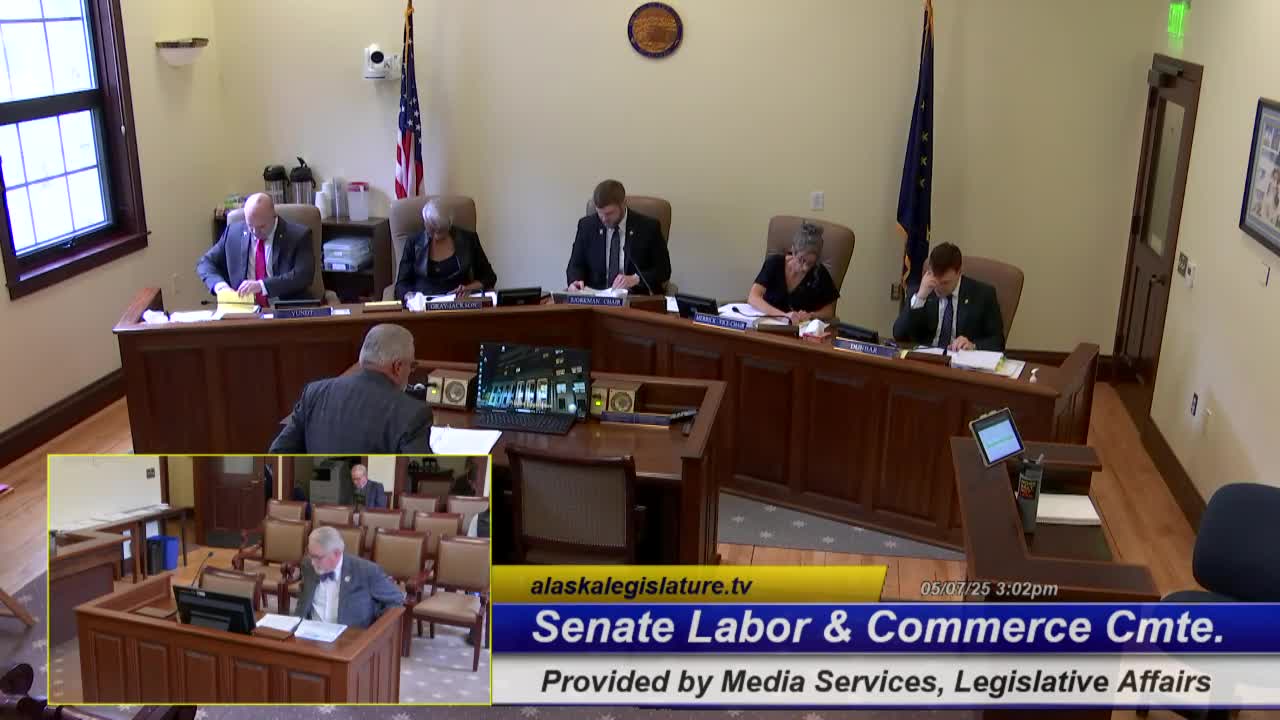
The Senate Labor and Commerce Committee on Wednesday received invited testimony supporting Senate Bill 158, a bill that would establish a distinct administrative area in the upper subdistrict of the Central District of Cook Inlet to encompass the East Side set-net fishery.
Conrad Jackson, staff to Senator Christine Bjorkman and the bill presenter, said SB 158 "proposes a new administrative area be established on the East Side Of Cook Inlet, where the East Side set net permit holders have historically fished." He told the committee the bill does not change allocations or the fishery itself but creates an administrative boundary to allow the Commercial Fisheries Entry Commission (CFEC) to manage permits and offer greater self-determination for local permit holders.
Why it matters: Testimony from long-term set-net permit holders described a fishery with unique management needs and repeated closures tied to paired restrictions for king salmon. Supporters said the new area would let CFEC more easily verify historical participation and economic dependence and would enable local solutions such as a regional fisheries association or a buyback effort tailored to East Side users.
Invited and public testimony included CFEC Commissioner Glenn Haight, who told the committee the bill "creates the area. That's something we do have authority to do," and explained the Commission would run a regulatory project, receive applications and code licensing changes to bring qualifying permits into the new area. Haight said the bill's approach differs from CFEC's usual practice by creating statutory criteria for reassignment and by directing certain appeals to Superior Court rather than through CFEC's normal process.
Multiple longtime East Side permit holders testified in favor. Lisa Gebrott (who introduced herself during testimony as a Kenai resident and "East Side set-netter for over 39 years") said the area's statistical units include two of the Kenai Peninsula's most prized river systems and would allow "self determine what we want our permits, fishery, and family businesses to be." Gary Hollier, who said he received an original set-net permit in 1975 and has fished the East Side for 54 years, added that "the Eastside set-net fishery is managed differently from the rest of Cook Inlet" and that 80% of East Side set-netters are Alaska residents.
Key clarifications contained in the bill presentation and testimony:
- The bill identifies specific statistical areas to be included in the new administrative area (transcript references: statistical area numbers 24431, 24432, 24441 and 24442, roughly from north of Nanilchik to Boulder Point).
- The draft would establish that an individual with a Cook Inlet Central District set-net permit is not entitled to fish in the new area unless their permit has been reassigned to that administrative area; CFEC would administer reassignment following criteria based on historical participation and economic dependence.
- The bill adds an appeals process for the new administrative area; testimony said provisional licenses would be issued pending resolution of appeals and that appeals would be directed to the Superior Court rather than adjudicated entirely within CFEC.
- The sponsor's draft includes an effective-date clause making the bill effective Jan. 1, 2026.
Committee action: The committee took invited and public testimony and set SB 158 aside for future consideration.
Background and next steps: Supporters said the measure would give East Side permit holders tools to pursue local options, including a regional fisheries association and the possibility of a buyback financed and run by the local fleet. CFEC said it would perform the licensing and coding work necessary to implement a new administrative area, and that a rulemaking and application review would be required to identify qualifying permits.