Get Full Government Meeting Transcripts, Videos, & Alerts Forever!
Get email alerts on the Broadband Infrastructure topic
No spam. Unsubscribe anytime.
Regional broadband coordinator outlines BEAD, CAF, FFA and middle‑mile activity for Inyo County
Summary
Regional Broadband Coordinator Scott Armstrong updated the board on multiple broadband grant programs—BEAD, CPUC FFA awards, CAF‑2, RDOF—and on design work for future funding applications and the state Middle Mile initiative.
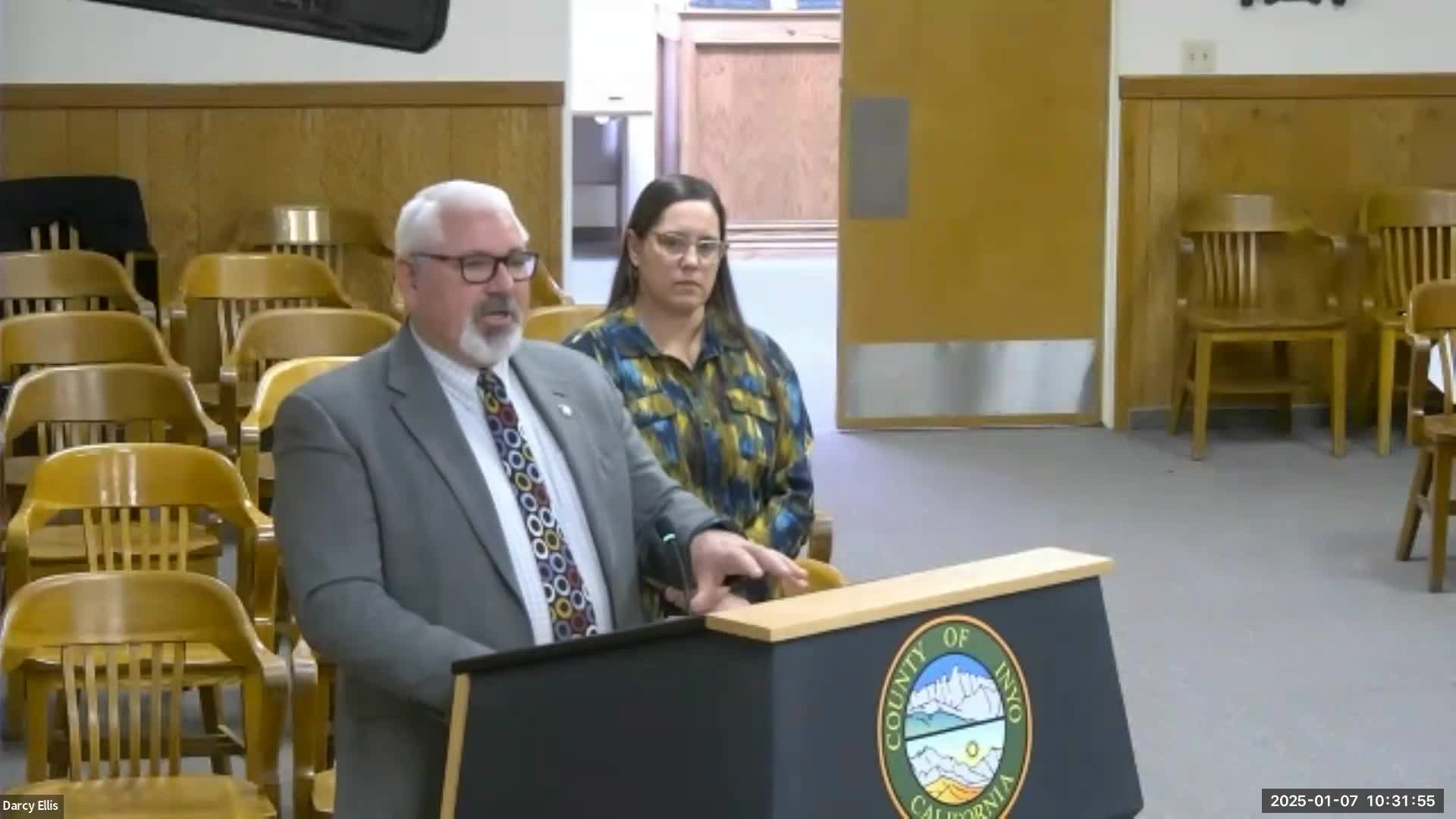
Scott Armstrong, the region’s broadband coordinator, presented a detailed monthly update on Jan. 7 that covered federal and state broadband programs, local project design work, and the status of middle‑mile and last‑mile projects affecting Inyo County.
Armstrong summarized current grant and program activity: CPUC Federal Funding Account (FFA) awards (with Mono County awarded and Inyo awaiting CPUC action), local agency technical assistance and USDA technical assistance projects producing final designs for dozens of locations, CAF‑2 and RDOF legacy awards that make some census blocks ineligible for BEAD funding, and the BEAD program window expected in spring 2025. Armstrong said Mono and Inyo will have design packages ready that include cost estimates and parts lists to make future construction applications more competitive.
The nut graf: Armstrong said the core priority is to produce shovel‑ready designs and coordinate with providers (including Frontier/GeoLinks and Golden State Connect Authority) so Inyo’s unserved and underserved areas can be included in upcoming BEAD, infrastructure and state middle‑mile funding rounds; he also noted that some areas are excluded from BEAD because of existing CAF‑2 or RDOF awards.
Armstrong discussed the California Middle Mile Broadband Initiative, the digital 395 network, and the California Broadband Cooperative (CBC), which has retained last‑mile infrastructure and anchor customers; he said the CBC will continue to transfer remaining agreements and explore options for expanding service to residential customers and lowering prices. He expected Frontier’s FFA awards to fund fiber replacement in Aspendell, Starlight and Bishop Creek and explained that BEAD will require a state submission to NTIA that covers all locations, not just census blocks.
Armstrong also described a public‑facing broadband tool on the regional website that allows residents to estimate bandwidth needs, run a speed test, and check what services are available at their address. Board members asked about Frontier’s buildout plans and the commercial acquisition cycle; Armstrong noted Verizon’s purchase of Frontier and suggested county representation in any proceedings would likely come through SCOG or the counties themselves.
No formal action was required; the board received the update and thanked Armstrong for the work to prepare designs and applications for upcoming funding rounds.