Get Full Government Meeting Transcripts, Videos, & Alerts Forever!
Get email alerts on the Calaim Reentry topic
No spam. Unsubscribe anytime.
Probation accepts CalAIM Path 3 funding to expand justice‑involved reentry services
Summary
Inyo County probation accepted a CalAIM Path 3 implementation and planning award—approximately $2.5 million—to develop systems that support continuity of Medi‑Cal services for justice‑involved individuals and juveniles reentering the community.
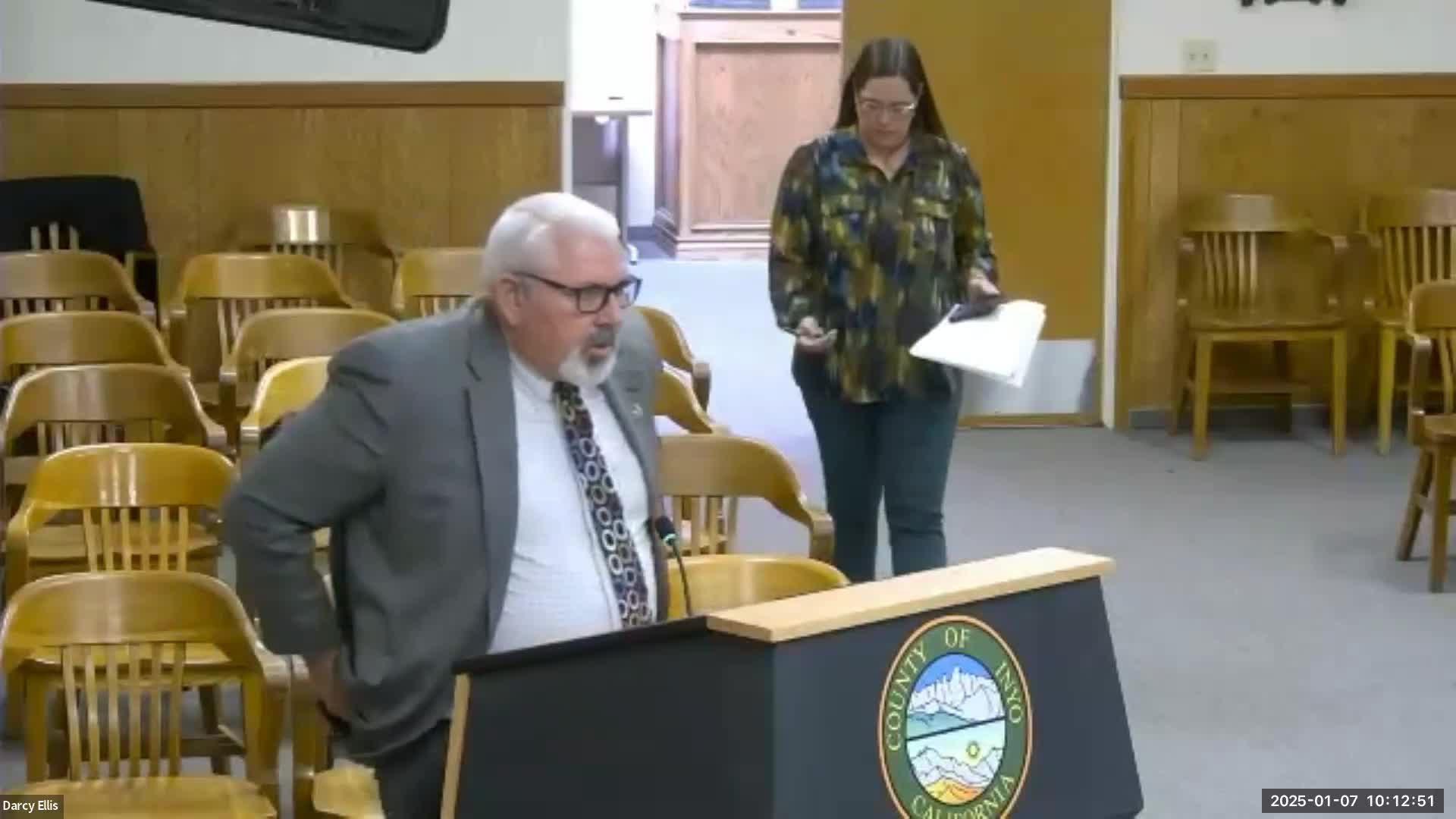
Inyo County Chief Probation Officer Jeff Thompson told the Board of Supervisors on Jan. 7 that the county has been awarded an implementation and planning CalAIM Path 3 grant—roughly $2.5 million—to develop and expand continuity of Medi‑Cal services for justice‑involved people preparing for reentry.
Thompson described CalAIM’s justice‑involved initiative as a state waiver program intended to fund planning and short‑term implementation to improve continuity of medical and behavioral health services for people leaving incarceration and reentering the community. “CalAIM was a coordinated community reentry process that will assist people leaving incarceration and connecting to the physical and behavioral health, services they need prior to release and reentering their communities,” Thompson said.
The nut graf: The award is for planning and implementation (path 3) and is time‑limited; Thompson said the funds may cover IT tools, medical billing development, protocol development with contracted juvenile facilities, some equipment (for example, vehicles for coordination), and partial salary support for probation staff engaged in building the reentry workflows. Thompson emphasized the funding is not intended for long‑term operating costs and noted the state has signaled intent to seek sustainment funding solutions for smaller counties if available.
Thompson said the funding is intended to help counties develop the electronic health records and billing workflows needed to draw down Medi‑Cal reimbursement, establish warm‑handoff protocols between facilities and community providers, and connect people to continuing care such as medication‑assisted treatment or behavioral health services upon release. For Inyo County—where there is no full‑service juvenile hall—Thompson said the county will piggyback juvenile reentry work onto systems already being built for adult jail Medi‑Cal billing and reentry continuity.
Board members asked about scale and sustainability. Supervisors expressed support for the initiative while noting concern about long‑term funding should federal or state waivers change. Thompson and other staff said they are cautious about hiring permanent staff on the probation side because small rural counties may not sustain ongoing positions solely through Medi‑Cal billing and that the state has acknowledged the challenge and is seeking supplemental funding sources for small counties.
The board voted to accept the CalAIM Path 3 funds and proceed with planning and implementation work; staff will return with project details, implementation timelines and budget amendments as specific uses are identified.