Get Full Government Meeting Transcripts, Videos, & Alerts Forever!
Get email alerts on the Policy Review Euthanasia topic
No spam. Unsubscribe anytime.
Commission to review animal‑control policies after commissioners raise concerns about euthanasia access, volunteer limits and force guidance
Summary
Commissioners and staff discussed the Animal Control policies package, raised concerns about use‑of‑force language and the policy that currently prevents owners from being present during euthanasia. The commission asked for remaining shelter policies to be provided by mid‑June and scheduled further review at the next meeting.
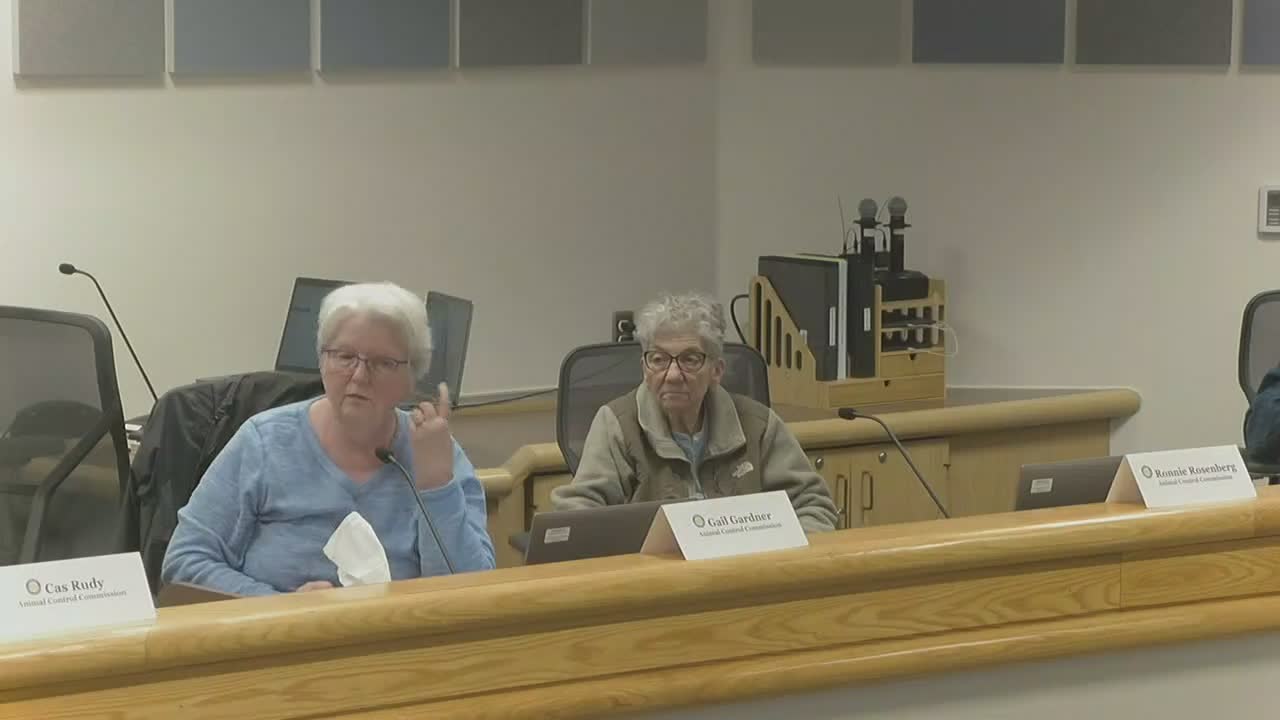
The Animal Control Commission on May 5 reviewed the department’s ACO policy package and identified topics for further review, including the department’s use‑of‑force wording, limits on volunteers in the shelter, and a policy that currently prevents owners from being present during euthanasia.
Commissioner Swan asked that the department reconsider language in the “use of force continuum” and wanted policy wording to mirror the stated purpose language that officers should “exert only the minimum amount necessary to escape the situation safely.” Swan said the current wording could put officers in a difficult position and asked staff to address the apparent inconsistency.
Commissioners also questioned a shelter practice—described by staff as a change made for staffing and space reasons—that limits owners’ ability to be present during euthanasia. Kimberly and Sandra Hill explained the policy’s operational background: limited private space now used for surgeries, and past staffing configurations that made a private end‑of‑life appointment difficult to provide safely and consistently. Hill said euthanasia service was once a meaningful service offered but is constrained now by staffing levels and the multifunction use of the space used for procedures.
Hill said euthanasia had been offered in the past but staff and management found the appointments often exceeded the scheduled time and required more staffing and private space than the shelter currently has. “From the managerial side at the time, I believe it was a voluntary decision as in more staffing was needed to continue the service,” Hill said.
Commissioners urged the department to consider options, including protected private space or a policy that allows owners to choose to be present when feasible. Commissioner Rosenberg cited external shelter veterinary guidelines (industry best practices) and noted those guidelines generally recommend allowing owners to be present when appropriate. Commissioner Sherman asked staff to explore practical workarounds such as locked rooms, scheduling on days when the surgery suite is not otherwise in use, or partial refunds when trial adoptions are used instead of a supervised meet. Staff noted the surgery room is often in use three days a week by the shelter veterinarian and that using the room for multiple purposes complicates scheduling.
The commission did not change policy at the meeting. The clerk and staff agreed to provide the remaining shelter policies to commissioners by June 15; commissioners will review and submit questions in advance and the commission plans to address outstanding ACO policies and shelter operations at the next regular meeting in August, with the option to request a special meeting if necessary.
Why it matters: euthanasia access, volunteer capacity and use‑of‑force policy affect public trust, volunteer engagement and staff safety. Commissioners asked staff to present workable options that balance compassion for owners and animals with staff safety and current operational constraints.
Next steps: staff to address Commissioner Swan’s use‑of‑force wording concerns and to provide additional shelter policies to the commission by June 15 for review; the commission will consider the items at its August meeting and may schedule a special meeting if timely action is requested.