Get Full Government Meeting Transcripts, Videos, & Alerts Forever!
Get email alerts on the Impervious Cover Amendment topic
No spam. Unsubscribe anytime.
Planning Commission reviews proposed changes to impervious cover limits; debate centers on driveways and gravel
Summary
Planning staff presented proposed CDO amendments to change impervious cover maximums by zone and add exceptions; commissioners debated driveway definitions, gravel surfaces and rural impacts.
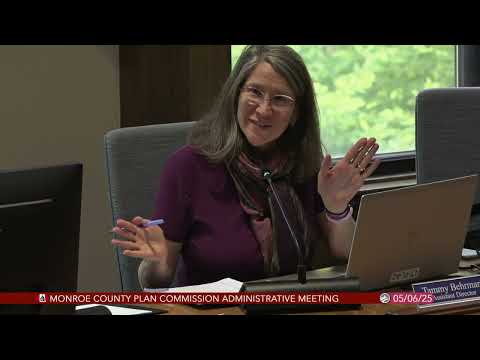
At the May administrative meeting, planning staff updated the Planning Commission on ZOA-25-2, a proposed text amendment to the County Development Ordinance (CDO) that would revise maximum impervious cover limits by zoning category and add clarifying exceptions.
Why it matters: the amendment is intended to reduce the number of variances sought for impervious coverage, align rules with stormwater goals, and make administration more predictable. Changes would affect how much of a lot may be covered by roofs, driveways, parking areas and other hard surfaces—factors that influence stormwater runoff, buildability and property design.
Summary of the proposal Staff said the draft separates lots by acreage bands (for example, 0–2.5 acres, 5–20 acres, and over 20 acres) and adjusts percentage and square-foot caps by zone (AGR, FOR, CVR, R and H, residential and others). Staff added superscript exceptions and revised the impervious‑cover exception section (8.13) to simplify administration. Key proposed exemptions and clarifications in the draft include: - Exempting driveways that existed on March 11, 2024 (the date of the last high-quality aerial flyover used by staff). - Exempting driveways that had proper approvals for installation prior to Dec. 19, 2024. - Treating driveways serving an existing lot of record as exempt. - Exempting sidewalks on private property that are for public use. - Confirming that agricultural buildings are excluded from the impervious calculation (agriculture-related buildings would not be counted as impervious under the draft).
Staff also explained that for many zones staff retained both a percent and a square-foot cap on smaller lot-size bands to avoid producing counterintuitive results on substandard lots.
Commission discussion and concerns Commissioners broadly supported reducing the number of variances but raised several recurring issues: - Driveway surface and definition: Commissioners asked whether gravel/crushed limestone driveways should count the same as asphalt or concrete. Staff said the current draft excludes only gravel used for landscaping applications and that gravel driveways are typically counted; converting an existing gravel driveway to asphalt usually would not trigger planning review unless a new structure or other improvement was proposed. - Rural versus urban application: Several commissioners said rural property owners often need larger driveways, pole‑barn access and space for farm equipment. They cautioned against rules that would feel like ‘‘micromanagement’’ in rural areas while acknowledging denser areas pose different challenges. - Enforcement and future fees: Commissioners asked how an impervious-cover definition would align with any future stormwater fee that might be assessed on impervious area. Staff said the county’s stormwater program intends to use a consistent definition and that staff want to avoid divergent definitions that would cause public confusion. - Data and examples: Commissioners requested additional illustrative diagrams and aerial examples showing typical lot sizes and how the proposed numbers would apply. Staff said they would include overhead imagery and examples in the packet for the May 20 meeting.
Next steps Staff said ZOA-25-2 will be on the May 20 Planning Commission agenda as a final hearing; staff invited commissioners to submit suggested revisions by email before that meeting. Staff also said it could add background materials (such as a 2010 drainage memo discussing driveways and impervious area) and provide updated floodplain mapping information where relevant.
Why it’s unresolved: the meeting was an administrative update and not a final vote; commissioners asked for more examples, clarification on gravel, potential coordination with the stormwater program on future fee methodology, and additional discussion of rural exemptions.