Get Full Government Meeting Transcripts, Videos, & Alerts Forever!
Get email alerts on the Housing topic
No spam. Unsubscribe anytime.
Sedro‑Woolley reviews housing element draft; consultants propose density bonuses tied to affordability and protections for manufactured‑home parks
Summary
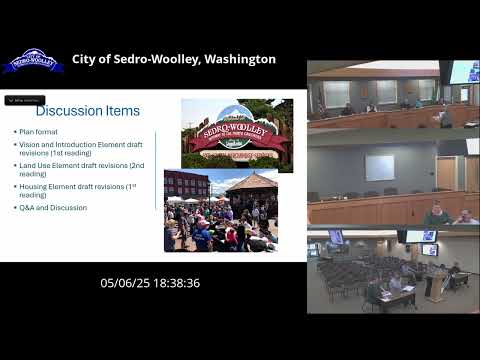
At a May 6 meeting, consultants presented a heavily revised housing element draft that adds policies for density bonuses linked to affordability covenants, displacement mitigation, protections for manufactured‑home parks, and a shift toward actions listed with specific implementation steps.
Consultants from Facet presented a revised housing element draft to the Sedro‑Woolley planning commission on May 6, framing changes as policy and action language to meet Growth Management Act requirements and local housing goals.
Matt, a planning consultant with Facet, said the draft contains extensive edits to the inventory and analysis sections and urged commissioners to focus on goals and policies because "that's really where the rubber meets the road." He described the document as having "a lot of red" in the current markup and said the team intends to reorganize the element so that goals, policies and specific actions crosswalk to each other.
Key policy proposals outlined in the draft include: allowing density bonuses for planned residential development (PRD) projects that provide long‑term affordability through recorded covenants, new policies to mitigate displacement risk with special attention to existing manufactured‑home parks, and an organizational change that moves some highly specific policies into an "actions" section that can be implemented through annual work programs.
Consultants noted existing development tools in the city: PRDs allow a mix of housing types while retaining density caps (PRD density caps referenced in the discussion include an R‑5 cap equivalent to five dwelling units per acre), and the team suggested refining incentives so affordable units at, for example, 80% of area median income, would be tethered to covenants for a specified period. Matt said the density bonus tied to affordability "would be kind of the implementing mechanism of it." The draft also reflects recent local code changes, including a cottage‑housing ordinance.
Commissioners and staff discussed implementation details raised in the draft: whether to retain numeric density limits versus low/medium/high labels, the value of preapproved building plans for ADUs and cottage housing to speed permitting, the PRD minimum lot size that was set previously at 4,600 square feet, and audit ideas for preapproved plan catalogs. Consultants said the draft inserts a "where feasible" clause in several places to provide implementation flexibility.
Consultants recommended pairing actions with specific policies and then using those pairings to form an annual work plan. The draft housing element will go to City Council for initial review on May 14 and return to the planning commission May 20 for additional comment before staff aims to assemble a full draft for July 1 distribution.
Ending
No formal code amendments were adopted at the meeting. The planning commission provided feedback on policy direction and requested refinements to density language, PRD incentives, and implementation details to be returned for further review.