Get Full Government Meeting Transcripts, Videos, & Alerts Forever!
Get email alerts on the Comprehensive Plan topic
No spam. Unsubscribe anytime.
Sedro-Woolley planning commission reviews comp plan format, considers new mixed‑commercial zone
Summary
At a May 6 special meeting, Sedro‑Woolley planning commissioners reviewed draft comprehensive‑plan materials and discussed changing the Transitional Mixed Commercial Overlay into a formal zone, adding chapter design changes and a downtown activation plan to support jobs and reduce vehicle miles traveled.
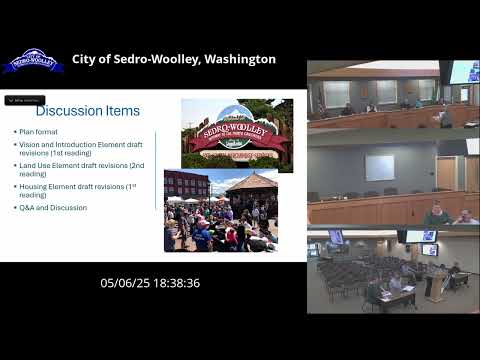
Sedro‑Woolley planning commissioners reviewed draft chapters of the city's comprehensive plan at a May 6 meeting, hearing presentations on the document's format and the land‑use element from consultants and city staff.
Tom Glover, community development director for the city, opened the discussion and introduced consultants who presented revisions to Chapter 1 and the land‑use section. Donna Keeler, a consultant with Bassett, outlined proposed layout and formatting changes and options for the future land‑use map.
The presentation proposed several document‑format changes designed to make the plan easier to read: a single‑column layout with graphics, a one‑page "plan at a glance" summary for each element, chapter color themes, and an early place for an overarching vision statement and a tribal acknowledgment. Keeler said the team would "incorporate a plan at a glance page with a quick summary" and that chapters would include more maps and charts.
On the land‑use map, consultants recommended keeping most existing designations but converting the current Transitional Mixed Commercial Overlay (TMCO) into a distinct zone. Keeler said the change is intended to add "a little more flexibility in that zone to allow for more manufacturing, low impact manufacturing in that zone as well," citing the old Skagit Steel site as an example of where the change could apply.
Commissioners discussed how residential designations would be shown. Consultants proposed replacing specific zone labels such as R‑5, R‑7 and R‑15 with low/medium/high density categories. Several commissioners cautioned that replacing numeric density standards with subjective labels could obscure regulatory certainty. The commission agreed the team should work with city staff on a clearer approach and bring refined language back before council.
The consultants also proposed a downtown activation plan as a new policy to encourage more local jobs and reduce vehicle miles traveled. Keeler said public comment at a recent climate meeting linked more local jobs with shorter commutes.
The planning commission will return the draft materials to the City Council for review at a May 14 briefing; staff said they plan to bring council comments back to the planning commission on May 20. Consultants said they expect to deliver a full draft document in early summer for additional review.
Ending
No formal land‑use zoning changes were adopted at the May 6 meeting; commissioners provided direction to staff and consultants to refine density labeling and the proposed TMCO zone and to return with revised text and maps for additional review.