Get Full Government Meeting Transcripts, Videos, & Alerts Forever!
Get email alerts on the Solid Waste And Waste Management topic
No spam. Unsubscribe anytime.
St. Louis County approves long-term disposal agreement with Resource Renew and funds phase 1 work for Canyon solid-waste campus
Summary
The county board approved a long-term intergovernmental agreement with Resource Renew (WLSSD) to accept outside municipal solid waste and authorized $523,000 from mineral tax grant revenue for a Phase 1 environmental assessment at the Canyon site, moving forward plans for a gravel operation and future solid-waste campus.
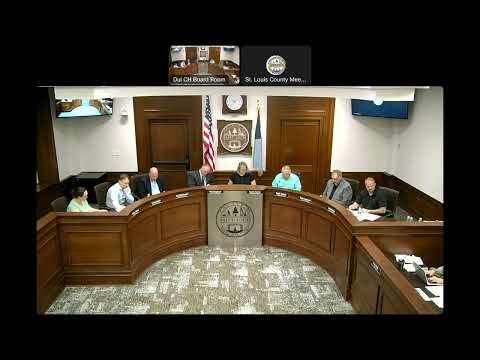
St. Louis County commissioners on Wednesday approved a long-term intergovernmental disposal agreement with Resource Renew (formerly WLSSD) and authorized a Phase 1 environmental assessment for development of a gravel operation and a future solid-waste campus at the Canyon site.
The board voted to use $523,000 from mineral tax grant revenue appropriated by the state legislature to contract with Northeast Technical Services for the Phase 1 work. Director Dave Fink told the board the step is “the first step utilizing these proceeds from the mineral tax grant revenue” and said it sets up work on both gravel reserves and groundwork for a future solid-waste campus.
Why it matters: County leaders said the moves together expand local disposal capacity, aim to reduce residents’ tipping fees over time and address environmental risks such as PFAS in leachate. Commissioners and staff emphasized the Canyon project’s role in preparing wastewater treatment infrastructure that county leaders said is essential to the region’s long-term waste strategy.
Director Fink described the disposal agreement with Resource Renew as a significant regional partnership, saying it “is really the most important and consequential thing that I’ve worked on” during his time with the department. Carrie Clement, executive director of Resource Renew, told the board the agency is “very much looking forward to this long term agreement, which ensures environmentally responsible and affordable disposal for the region.”
Commissioners stressed the relationship between the county’s Canyon site work and state funding. Commissioner Nelson told colleagues, “This is phase 1. We need this project to keep moving,” and said the county will be seeking additional state bonds — he referenced a current bonding request of $6,000,000 — to carry later phases. County staff said the $523,000 is part of a larger package of roughly $2,000,000 previously appropriated to the county by the legislature for related work.
The board also voted to suspend rules to take up and approve the intergovernmental agreement with Resource Renew. County leaders said decades of joint work and recent investments in leachate treatment and infrastructure expansion made the agreement possible. Several commissioners described the vote as a major regional step that could allow the county and partners to manage wastes locally rather than shipping to out-of-area landfills.
What the board actually approved: the Phase 1 environmental assessment contract award (to Northeast Technical Services using $523,000 in mineral tax grant revenue) and a long-term disposal intergovernmental agreement accepting waste from Resource Renew. Both items passed on voice votes; the board did not record a roll-call tally in the meeting transcript.
Next steps and uncertainties: county staff said Phase 1 work will inform subsequent design and permitting for Canyon, including wastewater treatment capacity. Commissioners said further state bonding and federal or other funding would be necessary for later phases. Staff also said any projected reductions in tip fees are dependent on economies of scale and future operational decisions and thus were not quantified at the meeting.
The board’s action leaves several implementation steps: completing Phase 1 assessments, finishing design/permitting, securing additional funding (county staff identified state bonding as critical), and finalizing operational agreements with Resource Renew and other regional partners.