Get Full Government Meeting Transcripts, Videos, & Alerts Forever!
Get email alerts on the School Budget topic
No spam. Unsubscribe anytime.
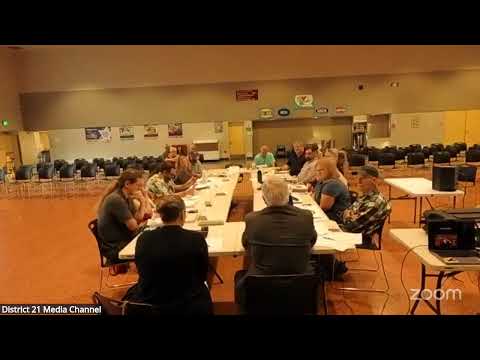
North Wasco County SD 21 budget committee delays approval after CFO outlines tight 2025–26 proposal
Summary
District leaders presented a conservative 2025–26 general fund budget that holds most programs but removes budgeted positions, cites large PERS cost increases and uncertain federal and state revenue; the committee recessed and will reconvene May 13 for further review.
The North Wasco County SD 21 budget committee received a presentation of the proposed 2025–26 general fund budget and postponed final action, voting to reconvene May 13 after hearing that the district faces large pension cost increases, uncertain federal grants and modest revenue growth.
Dr. Carolyn Bunnell, superintendent, opened the presentation and described the document as the plan for the first year of the 2025–27 biennium and said the budget “includes levying local property taxes and the general fund, fund 100.” She outlined the district’s mission and stated the budget aligns with the district’s 2027 strategic plan.
Randy Anderson, chief financial officer and budget officer, told the committee the budget was “particularly difficult, given that the increase in the pension cost” and said the Oregon public employees retirement contribution rate for some employees rose sharply: “that rate went from 10.49 to 23.44% of the wages.” Anderson identified that as the largest cost driver and said total net pension cost increases included in the budget amount to $2,630,000.
Anderson said the draft general fund for 2025–26 is largely a maintenance plan with limited growth and several targeted reductions. He identified these highlights discussed to the committee: an estimated increase in state school fund revenue in the draft, a $2,000,000 seismic retrofit project listed in the budget, a $500,000 U.S. Environmental Protection Agency grant to mitigate hazardous materials at Chandler Middle School, higher risk-management and liability insurance costs (projected to rise about 19%), and continued funding for the Innovations Academy and Innovations Virtual Academy.
The draft budget documents shown to the committee include the district’s estimate that the legislatively approved state school fund is divided across the biennium (noted as a 49%/51% allocation for the two years). Anderson warned that federal grant programs remain uncertain in the president’s recommended budget, citing Titles II and III as programs that had been removed in that recommendation and explaining that if those grants are not funded the district will need alternative ways to provide those services.
On staffing, Anderson described a net reduction of budgeted positions achieved largely through attrition and reclassification rather than layoffs. He told the committee the budget removes nine budgeted positions district-wide (a mix of licensed and classified positions) and that some director-level jobs were reallocated to contracted vendors: “We contract with a company for food service, and they provide a director as part of the contract,” Anderson said, describing the food-service director and some facilities management duties shifting under a contract with Sodexo.
Anderson said the district had preserved as many programs and staff as possible. He described personnel choices as a combination of not refilling vacancies, reassigning staff where possible and, in a few cases, eliminating specific positions. He said current staffing on the ground is somewhat lower than the budgeted full-time equivalents (FTE) in the book because some budgeted positions are vacant.
The committee and public questioned several budget items, including why per-student costs differ among elementary schools and what the reductions mean for classroom services. A community member, David Boyd, urged a clearer breakdown of costs by school and pointed to teacher experience and salary steps as likely contributors to variance.
Committee members asked about use of one-time revenue and reserves. Anderson said the budget does not rely on one-time funds to sustain ongoing services and that a possible community service fee from a local Google property was budgeted conservatively and held in contingency in case it does not arrive this fiscal year. He also confirmed the district is proceeding with a tax anticipation note; last year’s note had been about $1.54 million and this year the district expects to borrow about $1.8 million to help with cash flow.
No formal vote was taken on the budget itself. The committee elected officers at the start of the meeting: a motion to nominate Anthony (first name used in the record) as budget committee chair was made and approved, and Jared Gonsen was nominated and approved as vice chair. The committee moved, seconded and approved a motion to recess and reconvene May 13 for additional review and public comment.
The committee requested clearer, concise public-facing explanations about the nine positions removed from the budget (how many were vacant, reassigned or eliminated and whether any current employees would lose employment). Anderson and Dr. Bunnell responded that the goal was to minimize program and personnel impacts and that many reductions were achieved through vacancies and reassignments rather than involuntary separations.
The budget remains a draft to be refined as state and federal revenue projections change; the committee will review additional materials and reconvene to consider adoption later in the budget calendar.