Get Full Government Meeting Transcripts, Videos, & Alerts Forever!
Get email alerts on the Solid Waste topic
No spam. Unsubscribe anytime.
Cheyenne solid waste budget stresses route optimization, compost expansion and a landfill lifespan estimate of 55–60 years
Summary
Sanitation manager Austin Reiner and landfill manager Sam Quantetrini presented FY26 solid waste plans, including rerouted residential collection, expanded compost work, an increase in grazing revenue at Belvoir Ranch and an estimated Happy Jack Landfill lifespan of roughly 55–60 years under current assumptions.
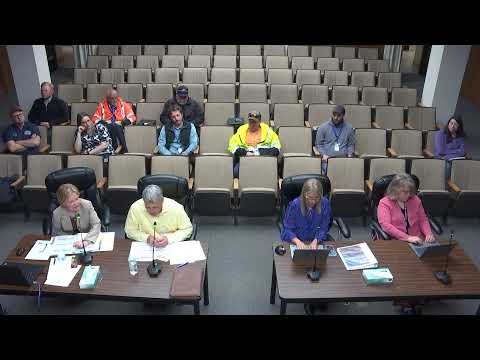
Sanitation Manager Austin Reiner and landfill manager Sam Quantetrini reviewed the solid waste division’s FY26 budget and operational changes, detailing customer counts, recent routing work and near-term needs.
Reiner told council the division serves about "24,000 residential and 2,400 commercial customers." He said the department disposes of "about 20 250 tons of waste daily at our Happy Jack Landfill site," a phrase used in the presentation that staff characterized as an approximate operational figure and that council members asked to verify in follow-up materials. Reiner also said regular collection stops are about 7,000 per day and that optional summer yard-waste pickups add another 2,500–3,000 stops on high-volume days; roughly 12,000 customers participate in the optional yard-waste program.
Reiner described a recent residential route rerouting that the department says improved efficiency, reduced mileage and will be tracked for fuel savings. He said the city is also working to improve recycling education to reduce contamination and is exploring rerouting commercial routes for increased efficiency.
On landfill life, staff estimated that — assuming current recycling, cover-soil practices and modest population growth (roughly 2.5–3% per year) — the Happy Jack Landfill lifespan is roughly 55–60 years. When asked about the effect of greater-than-expected annexation or growth on that projection, staff noted that large-scale annexation (for example a major South Side annexation) could require additional collection trucks and would shorten the landfill’s projected lifespan.
Reiner also flagged a $5,500 increase in Belvoir Ranch revenue tied to new grazing leases and described operational steps such as taller fencing and a customer drop-off area at the landfill to help reduce litter and improve on-site safety.
Council asked about apartment-complex recycling programs and contamination; staff said prior attempts at roll-out to multifamily properties produced high contamination rates and that property-management responsibility had been discussed as a possible model. The council asked staff to provide additional documentation and metrics on contamination rates and to continue public education efforts. No formal actions were taken during the presentation.