Get Full Government Meeting Transcripts, Videos, & Alerts Forever!
Get email alerts on the Urban Renewal Blight topic
No spam. Unsubscribe anytime.
Committee backs expansion of Cheyenne blight study to unlock urban renewal tools for central area
Summary
The committee recommended declaring an expanded area blighted under Wyoming statute to allow use of urban renewal authority tools in a central Cheyenne area; staff said designation does not change taxes and property owners were mailed notice.
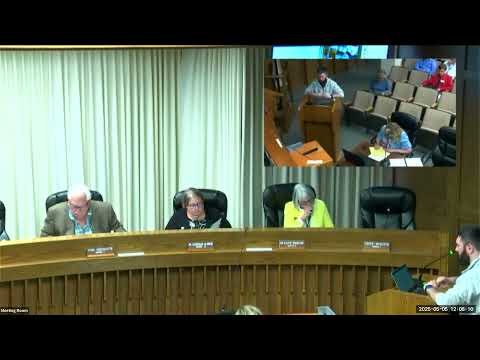
The Cheyenne Public Services Committee voted May 5 to recommend expansion of a blight study area in central Cheyenne, allowing the city to use Urban Renewal Authority (URA) tools if it later adopts a plan for the area.
Brandon Gilchrist of the Planning and Development Department presented maps showing the existing blight designation (yellow) and the proposed expansion (outlined in red). The study identified five indicators consistent with state criteria: deteriorating structures, inadequate street layout, faulty lot layouts, unsanitary or unsafe conditions, and other site improvements in need of repair.
“The URA board recommended approval of the blight study expansion at their April 3 meeting,” Gilchrist said. He emphasized the resolution does not change taxes or rezone property; it opens the URA toolbox for future projects if the city and developers pursue an urban renewal plan.
Director Charles Blum (recorded in the transcript as Director Blum/Bloom) and planning staff said the city mailed notices to property owners in advance of the URA meeting and that staff received no objections from property owners. “In that mailing, we did provide detailed information describing that this is not a tax. This is not rezoning your property,” Charles Blum said.
Committee members asked about the URA’s track record and tax-increment funds. Doctor Aldridge asked for the total dollars collected to date and raised concerns that county processes for distributing tax-increment financing (TIF) had delayed payments in the past. Director Blum and staff said they are working with the county assessor to resolve software and parcel-tracking issues and that payments have been received into fiduciary accounts, but some parcel-splitting issues remain.
Community commenter Brandon Swain, 1611 Morrie Avenue, spoke in support of the expansion and said urban renewal has enabled projects that otherwise would not have moved forward, noting examples such as recent apartment and redevelopment projects. “It’s just another tool available to a developer to create otherwise what wouldn’t be possible,” Swain said.
The committee approved the resolution by voice vote and will recommend adoption by the full City Council. Staff said the designation is the first step; a separate urban renewal plan and project would be required before incremental tax dollars are used for a specific development.