Get Full Government Meeting Transcripts, Videos, & Alerts Forever!
Get email alerts on the Budget topic
No spam. Unsubscribe anytime.
Lancaster County administrator presents FY26 recommended budget emphasizing staff pay, public safety and conservative revenue outlook
Summary
County Administrator Dennis Marston presented Lancaster County’s fiscal 2026 recommended budget on a package that emphasizes a 5% across‑the‑board pay increase, a $15 county minimum wage, public safety staffing and a conservative revenue forecast tied to rapid population growth and forthcoming large retailers.
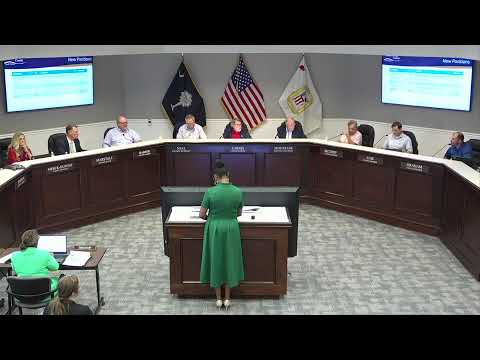
County Administrator Dennis Marston presented Lancaster County’s recommended fiscal 2026 budget to the Lancaster County Council on the county administrator’s recommended budget during a council meeting, outlining pay increases for employees, investments in public safety and a cautious approach to revenue forecasting.
The recommendation includes a 5% across‑the‑board salary increase for full‑ and part‑time employees, raising the county minimum pay to $15 an hour and funding service investments intended to support expanding public safety workloads, county information technology and enterprise resource planning (ERP) work, Marston said. “I am pleased to start the presentation of the FY26 county administrator's recommended budget,” Marston said.
County Chief Financial Officer Sabrina Harris framed the request against rapid population and development growth: “Our county continues to experience growth, looking at our population increasing by 3.1% in just 2024 alone. Over the past 5 years, the county has grown by 16.4%,” Harris said, and she warned that the growth places pressure on infrastructure, public safety and other county services.
Budget Director Jamie Provoznak provided the revenue overview and described the administration’s conservative forecasting approach. As of April 15, 2025, the county had collected $36,000,000 in ad valorem (real property) taxes, and the recommended FY26 general fund total was presented at about $61.2 million. Provoznak said the administration estimates roughly $1,000,039 of new revenue from growth alone but is using a more conservative $6.9 million figure overall versus an $8 million best‑case aggregation of projected increases.
Council members pressed staff on that conservatism and on specific revenue lines. One council member noted recent strong local option sales tax growth and asked whether projections should be higher given imminent openings of large retailers such as Costco and Target; Provoznak replied the administration intentionally balanced trending increases with uncertainty about tariffs and retail spending. Council member Clay Cato was cited by staff as closely watching ambulance revenue, which the budget director projected at about $3.9 million for FY26 with $3.1 million collected as of April 15.
The recommended budget packages personnel investments with specific position requests and conversions. Highlights presented by Marston and staff included: a funding estimate of roughly $2.6 million for the 5% staff increase; about $452,000 to raise the minimum wage countywide to $15; and a $475,000 line for the county’s Christmas supplement. The recommendation identifies a set of position adjustments and new positions tied to workload increases — including detention center corrections officers, maintenance and public works administrative support, three EMTs tied to a new Indian Land joint service model, two park rangers for regional parks, two formerly grant‑funded violent‑crime investigators to be added to the general fund after the grant ends, and a net increase of animal shelter staff following a conversion in the sheriff’s office.
Josiah Park, budget analyst, summarized proposed fee changes that are part of the package: increases to certified copy fees (from $2.50 to $10), a $30 microchip redemption fee at the animal shelter to cover vaccine costs, higher swim lesson fees for ages 3–17, new facility deposit language, increased standby and emergency response fees in emergency management, and a proposed $5.2 million estimate for building permit revenues. Park said some parks and recreation fees would be lowered for certain all‑day programs and nonprofit rates would be added for pool rentals and parking lot reservations.
Council members raised operational and timing questions tied to capital projects. Marston said design for a new EMS station on Van Wyck Road (Indian Land area) would begin this fiscal year, with construction planning targeted to start this summer; staff committed to return with a staffing timeline that aligns construction and personnel needs. On fund reserves, Harris said Lancaster’s unassigned general fund balance is about 58% of operating — well above the county’s stated target range of 28%–32%.
A separate line of discussion addressed compensation for an elected probate judge. Staff said state guidance allows the probate position to receive both the state cost‑of‑living increase and any county increase, which would result in about a 7.25% change to that office’s county pay if the county adopts 5% across the board. Several council members questioned whether giving an elected position that combined increase is equitable compared with other county employees; staff said they would provide the written state guidance.
Council members also urged the administration to use the county’s planned ERP implementation to increase transparency in vendor payments and financial reporting. One council member urged the county to study publishing a searchable “checkbook” online; staff said the ERP rollout includes an application coordinator and technologies that should improve reporting and that the county will examine options.
No formal vote on the FY26 budget occurred at the presentation. The council approved the meeting agenda at the start of the session; Council member McGriff moved to approve the agenda and Council member Neil seconded the motion, which the chair announced as unanimous.
Why it matters: Lancaster County’s recommended budget packages near‑term employee pay increases and targeted staffing to meet growing public‑safety, roads and parks demands, but the board’s decisions on revenue assumptions, reserve use and which new positions to fund will determine how many of those investments proceed and when.
What’s next: Staff will provide additional detail on the unassigned fund balance, a full list of the 76 requested new positions and the administration’s recommended subset, the staffing timeline tied to the new EMS station, and the written state guidance on the probate judge’s compensation before the council takes budget adoption votes later in the FY cycle.