Get Full Government Meeting Transcripts, Videos, & Alerts Forever!
Get email alerts on the Labor And Contracting topic
No spam. Unsubscribe anytime.
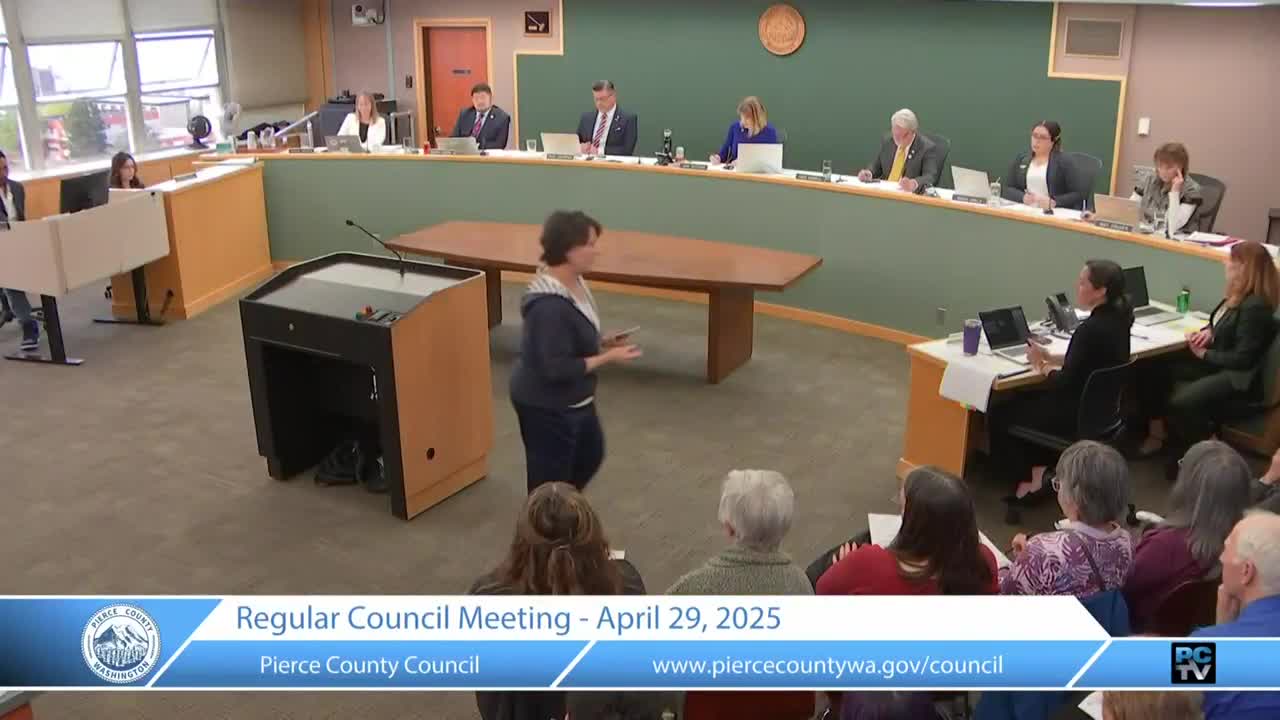
Council removes county-wide E-Verify requirement for contractors, citing redundancy and burden on small providers
Summary
Pierce County repealed code sections requiring voluntary county participation in the federal E-Verify employment-verification system for many contracts and hires, with the council approving Ordinance O2025-510 by a 4-3 vote.
The Pierce County Council voted 4-3 to remove a county code requirement that contractors and certain hires participate in the federal E-Verify employment verification system, approving Ordinance O2025-510.
Council staff and the executive argued the county’s requirement is duplicative of the federally required I-9 employment-verification process, imposes practical burdens on nonprofit and small contractors, and slows procurement and hiring. Supporters of repeal told the council the E-Verify rule requires extra training, duplicate data entry and creates administrative and compliance costs—particularly for subcontractors with high turnover such as childcare and social-service providers.
Why it matters: The county will continue to comply with any federal contracting or funding terms that explicitly require E-Verify; the ordinance removes the county’s more expansive local code requirement for participation as a blanket condition of county contracts above specified thresholds.
Details and rationale County counsel and executive staff told the council that the county code currently requires contractors for county public-works projects in excess of $100,000 and other county contracts in excess of $25,000 to enroll in E-Verify. The proposal removes those code provisions and leaves E-Verify only when federal contracts or subcontracts explicitly require it.
Julie Murray, executive counsel, and other staff told the council the system duplicates the federal I-9 process and can produce mismatches that are disproportionately likely for workers with hyphenated names, recent name changes, or nonstandard spellings—creating extra administrative burden and, in some cases, delays in hiring or contract performance.
Public testimony Contractors and nonprofit leaders said the requirement had forced organizations to learn an unfamiliar federal online system, to pass the burden to subcontractors and to rework staffing practices. The deputy director of a county-contracted nonprofit described the obligation as a duplicative step that required training and extra audits for organizations that already follow I-9 rules.
Opponents of repeal urged caution. Council members who opposed the ordinance warned that removing E-Verify could make it easier for employers to hire unauthorized workers and urged vigilance about wage theft and labor standards. Supporters said the I-9 process remains in place and that E-Verify is voluntary at the federal level except when specifically mandated by federal contract clauses.
Vote and next steps The council adopted Ordinance O2025-510 by a 4-3 roll-call vote. Council members Ayala, Denson, Yambe (Yambi) and Hitchin voted for repeal; Council members Kruger (Kuver), Morrell and Herrera voted against. Staff said the county will continue to use E-Verify when federal grant or contract terms require it but will remove the countywide mandatory-code requirement.
Key contract thresholds (current code being repealed) - Public works contracts over $100,000 - Other county contracts over $25,000
The county advised contractors and subrecipients to watch for contract terms tied to federal funding that may still require E-Verify enrollment.