Get Full Government Meeting Transcripts, Videos, & Alerts Forever!
Get email alerts on the Inquest Program Reform topic
No spam. Unsubscribe anytime.
County officials discuss streamlining inquest hearings and a new multidisciplinary review panel; prosecutors raise concerns about parallel processes
Summary
King County officials described an executive‑ordered shift to streamlined fact hearings for inquests and creation of a multidisciplinary review panel to recommend systemic reforms. Prosecutors warned parallel inquest proceedings can expose evidence and testimony in ways that complicate criminal charging decisions and public perception.
King County officials described a move to a streamlined fact‑finding inquest process and creation of a multidisciplinary review panel to examine systemic issues following deaths involving law enforcement, while the Prosecuting Attorney’s Office cautioned parallel inquest proceedings may complicate criminal investigations and public confidence.
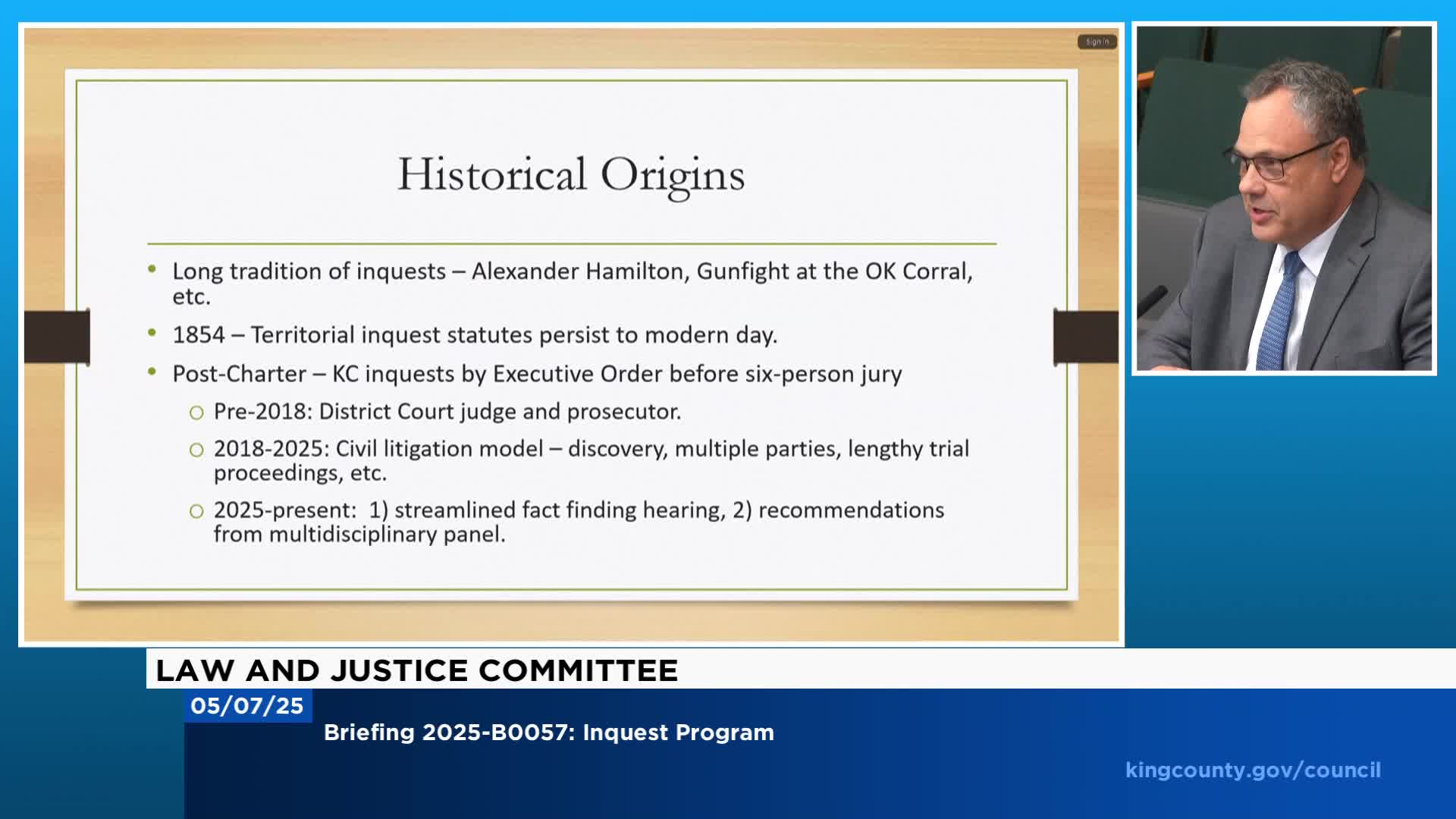
David Hackett, counsel to the King County Executive, summarized the county’s history of inquests and the rationale for recent changes. The county’s charter requires inquests for many deaths involving law enforcement, and in response to criticism of prior procedures the executive adopted an updated approach in early February that aims to shorten hearings to factual presentations and to route broader policy and practice recommendations to a nine‑member review panel, informally described in the briefing as a "deadly incident review and recommendation panel." Hackett said the new process limits compelled (Garrity) statements from officers in the inquest record and assigns the inquest program attorney to present evidence neutrally to a jury focused on who/what/where/when/why questions.
Panel composition and purpose: The proposed nine‑member panel is multidisciplinary, with members representing families, law enforcement and neutral professional backgrounds, and will issue nonbinding recommendations on policies and practices to reduce future deaths after interactions with law enforcement or in custody. Hackett and presenters described the panel as intended to produce forward‑looking, actionable recommendations that policymakers and agencies can adopt.
Prosecutor concerns: Gary Earnstorff and Senior Deputy Prosecuting Attorney Joe Marcasano of the King County Prosecuting Attorney’s Office described a changed landscape: independent investigations, body‑worn and in‑car video, public records, and civil litigation mean these cases receive intense public scrutiny. The PAO created a public integrity unit to provide continuous prosecutorial support for force investigations and said prosecutors will publish detailed legal analyses after review. The PAO raised concerns that inquest processes may expose Garrity‑protected statements or other evidence and that inquest juries operate under different standards and instructions than criminal courts, which could produce findings (such as of "criminal means") that prosecutors later decline to charge under the higher criminal standard. PAO representatives said such divergent outcomes create a risk of public misunderstanding and loss of confidence in criminal charging decisions.
Operational points and next steps: Hackett described the prior (2018–2025) model as litigated and slow, with many cases delayed; the executive’s new order aims for quicker fact hearings and separate normative review by a panel. The county is considering how the inquest process will interact with future Office of Independent Investigations (OII) reviews; presenters said OII could supply investigative findings while the panel addresses systemic recommendations. The county also noted it will explore using the independent hearing examiner’s office for claim hearings to limit perceived conflicts of interest.
Committee members urged legislative branch involvement and asked for a pause to evaluate how the charter, the inquest process, OII and prosecutorial functions interact so the county can achieve both transparency and accountability without undermining criminal investigations. Councilmember Dombowski said she wants more legislative engagement and possible charter review to ensure the system produces timely transparency and credible accountability.
The briefing closed with committee members asking officials and the PAO for continued dialogue before the executive implements further procedural changes.