Get Full Government Meeting Transcripts, Videos, & Alerts Forever!
Get email alerts on the Fair Housing topic
No spam. Unsubscribe anytime.
DCHS presents update to King County analysis of impediments to fair housing choice; finds rising concentrated poverty in parts of South King County
Summary
DCHS briefed the Health, Housing and Human Services Committee on May 6 on the consortium’s 2025 Analysis of Impediments (AI) to fair housing choice. The report updates data, identifies eight top barriers (including exclusionary zoning, high costs and screening practices), and recommends 10 goals to advance fair housing across the county.
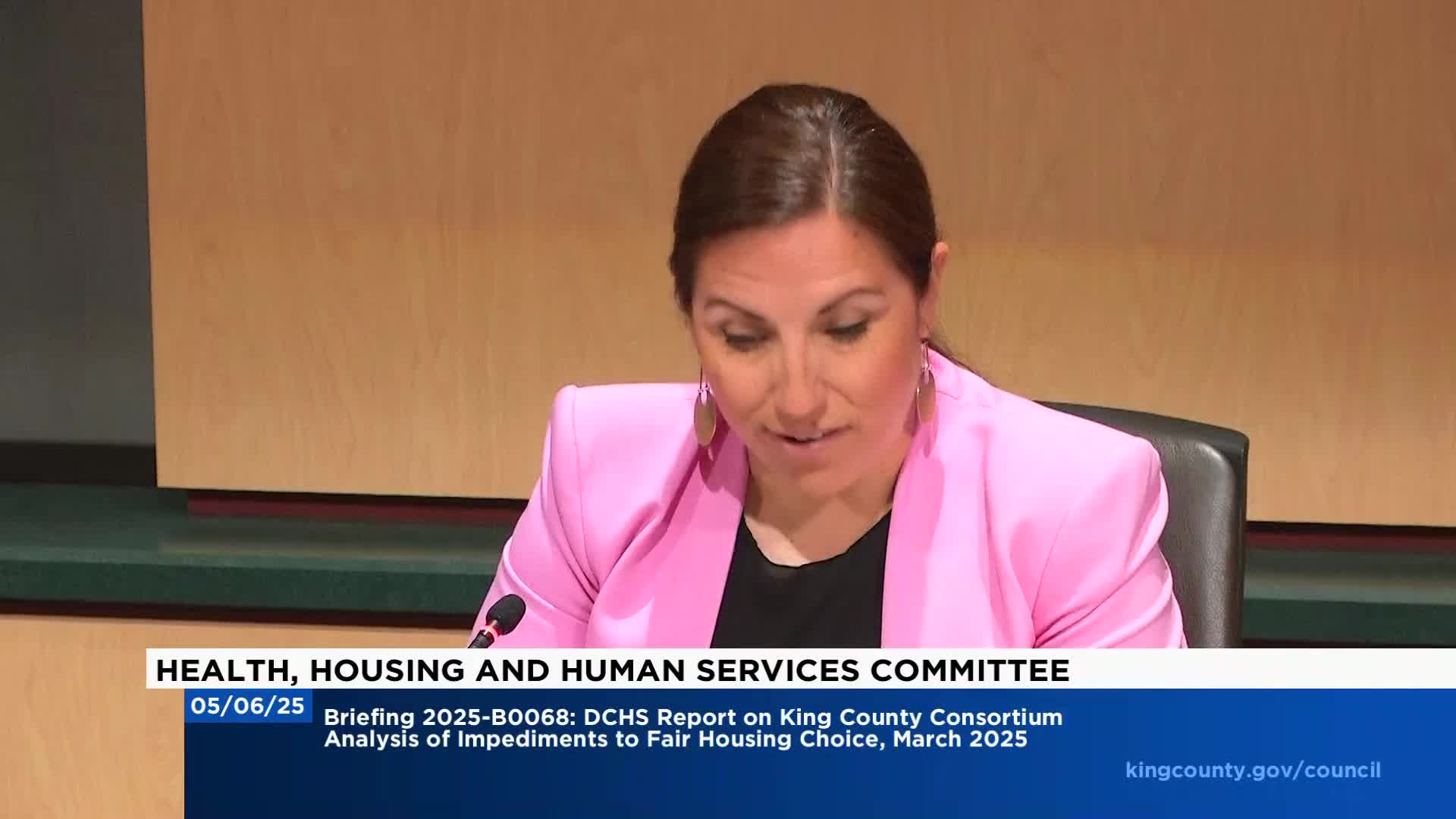
Sunari Marshall, director of the Housing and Community Development Division in King County DCHS, briefed the Health, Housing and Human Services Committee on May 6 on the consortium’s updated Analysis of Impediments to fair housing choice (AI), prepared for the King County Consortium of jurisdictions that receive HUD funding.
Nut graf: The AI updates data and community input, highlights eight top impediments to fair housing choice across King County (exclusionary zoning and land‑use practices, high housing costs, direct discrimination based on protected characteristics, lack of larger units, limited affordable homeownership opportunities, rigorous tenant screening, enforcement capacity gaps, and access issues for people with disabilities) and advances ten goals for 2025–2029 to reduce barriers.
Selected findings
- Data and segregation: Marshall said the county is “becoming more integrated” overall, but HUD’s definition of racially or ethnically concentrated areas of poverty shows an increase from one such area in 2019 to five areas in 2025, concentrated in parts of South King County.
- Housing need and affordability: DCHS highlighted that the largest unmet need is for households at 0–30% of area median income and that Black and Indigenous households and other households of color have persistent higher rates of cost burden and lower homeownership rates.
- Evictions: Marshall said eviction filings declined during pandemic moratoria but rose rapidly after those protections expired; the report included data through late 2022 and the department noted 2023 continued increases.
- Fair‑housing testing: The county and the Fair Housing Center of Washington conducted spot testing. Marshall reported 31 differential‑treatment tests and 24 policy checks; violations were found in 30 of 55 tests, with common issues tied to disability accommodations and source‑of‑income discrimination.
Goals and recommended actions
DCHS offered ten goals ranging from strengthening tenant stability and supports for people with disabilities to increasing affordable homeownership and investing in underserved areas. Specific program suggestions included using county CDBG and Equitable Development Initiative funding more strategically, supporting large‑unit production for diverse households, and improving annual HUD reporting and public transparency.
Discussion and next steps
Committee members emphasized historical federal and local roles in housing segregation and the need for sustained, collaborative action. Marshall said DCHS coordinated the AI with jurisdictional planners and recommended jurisdictions use the AI to guide the implementation of comprehensive plans, community engagement, and future funding allocations.
Ending
Chair Teresa Mosqueda and other councilmembers requested that the executive return with implementation strategies tied to the county’s comprehensive plan and budget processes; DCHS said it would pursue annual reporting and continue outreach to consortium members and providers.