Get Full Government Meeting Transcripts, Videos, & Alerts Forever!
Get email alerts on the Wage Theft Enforcement topic
No spam. Unsubscribe anytime.
Fair Work Center authors urge King County to fund community enforcement and build county labor‑standards capacity
Summary
Presenters of a 2022 Fair Work Center report told the King County committee that wage theft remains widespread in low‑wage industries, that under‑resourced enforcement agencies leave many workers without remedy, and recommended a two‑phase plan: fund community outreach and data collection, then build enforcement capacity at the county level.
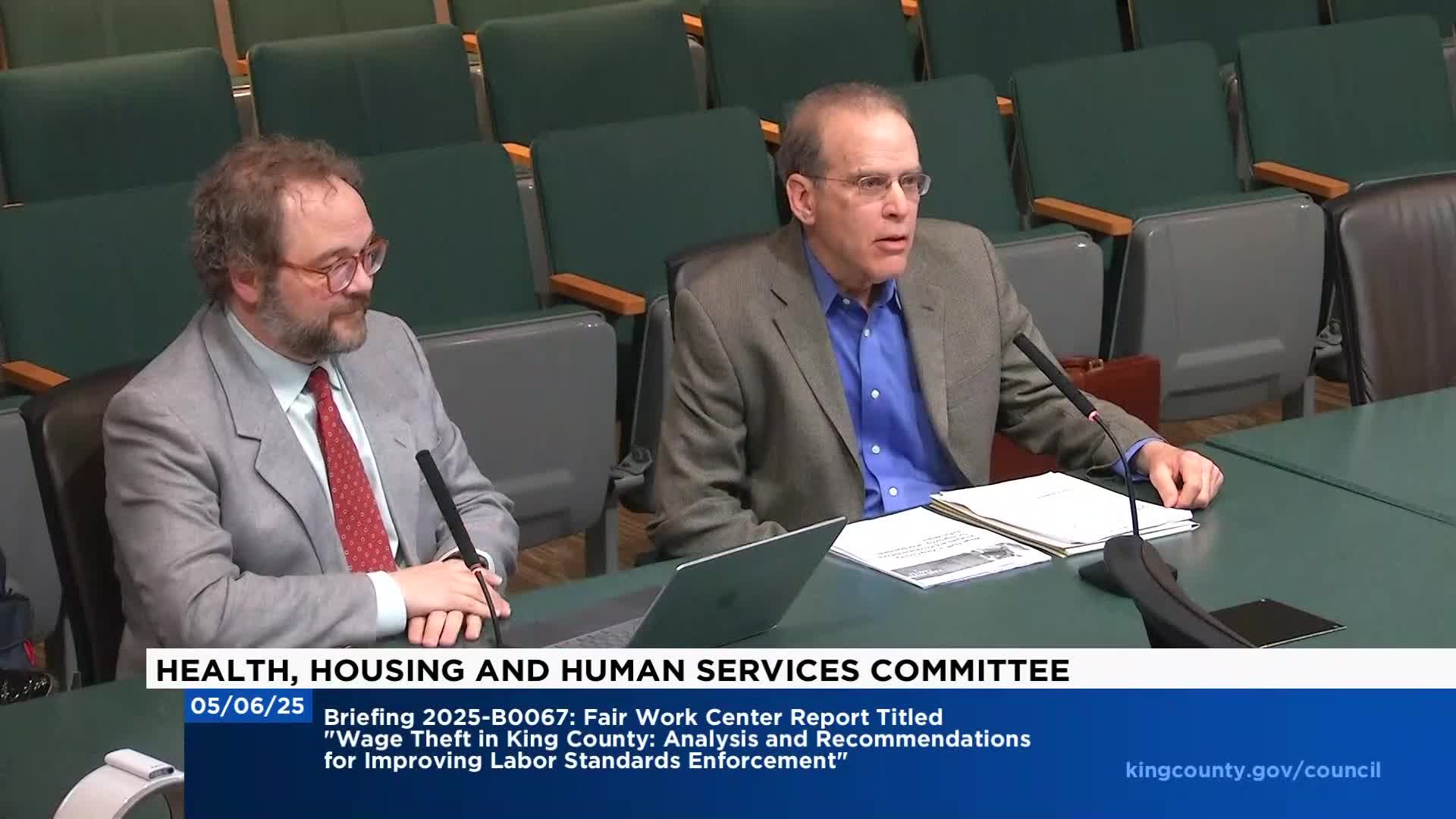
Marty Garfinkel, consulting attorney and co‑author of a 2022 Fair Work Center report, and Jeremiah Miller, legal director at Fair Work Center, briefed the King County Health, Housing and Human Services Committee on May 6 about findings and recommendations to strengthen wage‑theft enforcement.
The nut graf: The authors told the committee that wage theft — unpaid wages, missed final paychecks, overtime violations and similar breaches — disproportionately affects workers in hospitality, childcare, home health and related sectors, and that enforcement gaps leave vulnerable workers without effective remedies. Their report recommends a two‑phase approach: (1) county funding for community organizations to provide education, outreach and data gathering; and (2) a later, evidence‑based expansion of county enforcement capacity.
Key findings and evidence
- Scale and scope: The presenters estimated roughly 8,000 businesses in unincorporated King County employing about 40,000 workers in sectors prone to wage theft. They said available data are insufficiently granular to measure unincorporated King County specifically.
- Enforcement limits: Jeremiah Miller cited state enforcement capacity as an example: Labor & Industries conducted about 9,100 investigations in 2024 with 26 investigators, or roughly 350 cases per investigator, which he said is unsustainable for meaningful enforcement.
- Testing results: The Fair Housing Center (partnering on testing) conducted 31 differential‑treatment tests and 24 policy checks; across 55 tests, the team found violations in 30 instances, with issues tied to disability accommodations, source of income and differential treatment.
Recommended approach
- Strategic government enforcement: Garfinkel recommended triaging complaints toward high‑violation industries, performing employer‑wide investigations where indicated, and using director‑initiated or “directed” investigations rather than relying solely on worker complaints.
- Community co‑enforcement: The report urges funding community groups to do education, help workers document claims, gather sector data and support government investigations. Presenters proposed a two‑year community‑partnership phase to produce the information needed for a second phase of county enforcement capacity.
Costs and implementation
Presenters did not provide a firm county cost estimate in the meeting. Garfinkel said Seattle’s longstanding program size offered a reference point — “something like $600,000 a year” for a robust program — but stressed the county could scale an initial phase up or down. Presenters suggested interlocal agreements so the county could enforce local ordinances for smaller cities that lack enforcement staff.
Discussion and questions
Committee members noted that federal and state enforcement resources are strained and that county action could be more important if federal staff reductions continue. Councilmember Baron raised concerns about worker retaliation and the limited effectiveness of criminal prosecutions for wage theft; presenters said criminal enforcement has had limited success because of higher evidentiary standards and that it cannot be relied on as the primary remedy.
Ending
Chair Teresa Mosqueda and other council members encouraged executive follow‑up on the prior budget proviso to explore a county Office of Labor Standards using the report’s recommendations and to consider interlocal enforcement partnerships. The committee received printed copies of the report and directed staff to make the material publicly available.