Get Full Government Meeting Transcripts, Videos, & Alerts Forever!
Get email alerts on the Federal Budget And Grants topic
No spam. Unsubscribe anytime.
King County officials warn federal staff layoffs and new grant conditions are delaying projects, join suit to block conditions
Summary
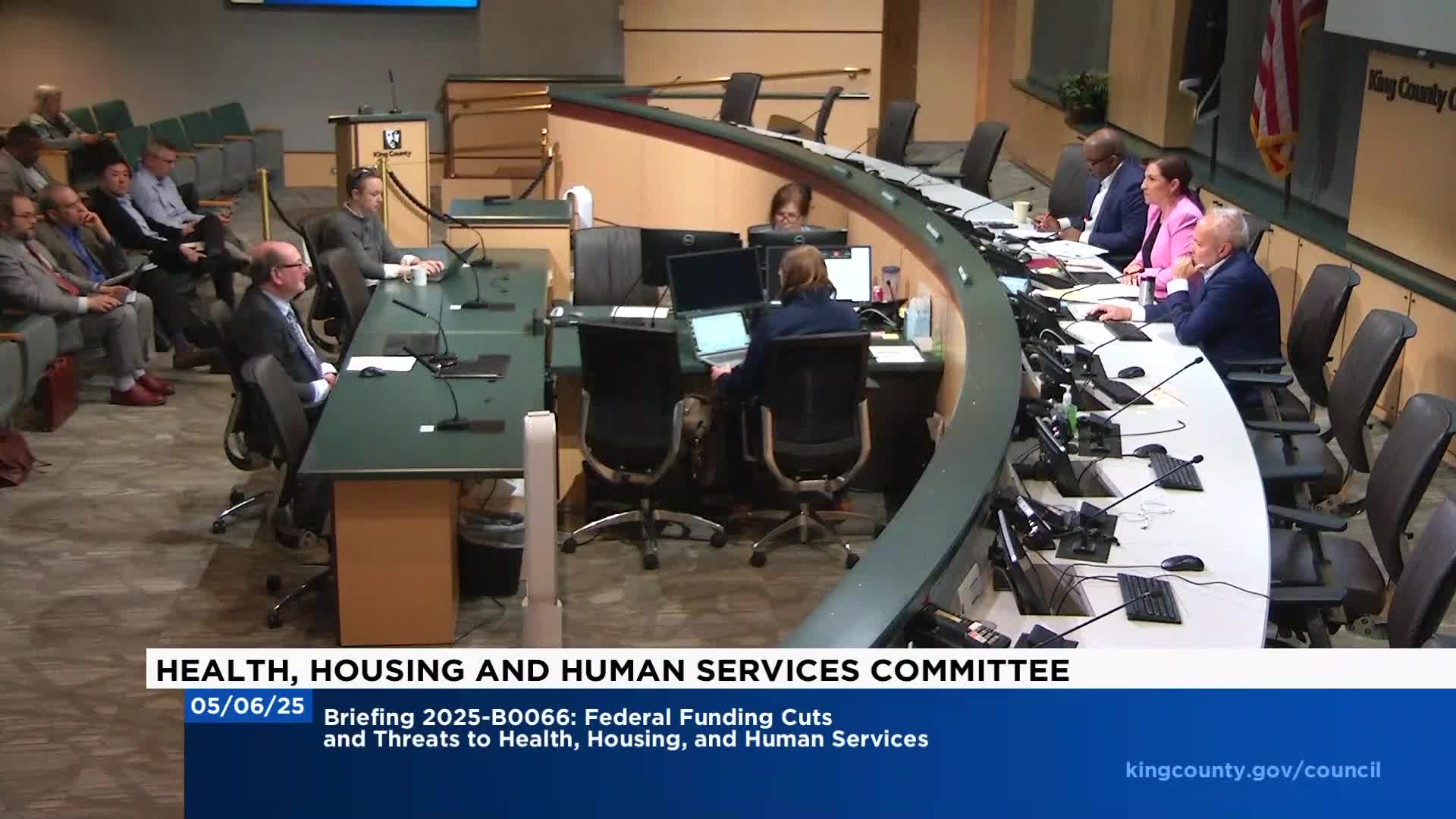
Dwight Dively, director of the Office of Performance Strategy and Budget, told the King County Health, Housing and Human Services Committee on May 6 that threats to federal grants and widespread federal staff layoffs are already disrupting local projects and services and that the county joined litigation challenging new grant conditions.
Dwight Dively, director of the Office of Performance Strategy and Budget, told the King County Health, Housing and Human Services Committee on May 6 that threats to federal grants and widespread federal staff layoffs are already disrupting local projects and services and that the county joined litigation challenging new grant conditions.
Dively said the county is facing three categories of federal risk: 1) federal grants already approved but the administration attempting to stop funding; 2) funds appropriated that require new or renewed contracts but are being conditioned on compliance with presidential executive orders; and 3) deep domestic discretionary cuts proposed in the president’s federal budget. He said the county and partner jurisdictions filed a challenge in the U.S. District Court for the Western District of Washington seeking a temporary restraining order on the new conditions for certain continuums-of-care and Federal Transit Administration funds.
Why it matters: Dively said legal wins have restored some threatened awards, but programmatic disruptions persist because essential federal staff who process permits, inspect projects or coordinate with local partners have been laid off or sidelined. He gave multiple examples of service and project delays where federal employees’ absence prevents local governments from lawfully proceeding.
Most critical examples cited
- AmeriCorps: Dively said King County’s AmeriCorps staff paid by the federal program were “unilaterally terminated” with no notice, affecting offices including emergency management and public health.
- Permitting and environmental review: Dively said permitting agencies such as the U.S. Army Corps of Engineers have lost staff, leaving projects — including a long‑planned cleanup and a bridge replacement in the Bearing community on U.S. 2 — stalled because permits cannot lawfully be issued without federal reviewers. He said the county was told there are “6 people left” nationwide to do certain permitting work and that this could delay some projects an entire year.
- Veterans rental assistance: A partnership between the county and the Department of Veterans Affairs depended on federal VA staff to operate; Dively said those staff are gone and the program cannot function as designed.
- Public-health inspections: Dively said CDC inspections of cruise ships have been reduced to roughly “12 staff left nationwide” to handle required inspections.
Dively also read into the record an example of incoherent federal responses to county staff: “Your message couldn't be delivered to the recipient because you don't have permission to send it.” He said such breakdowns illustrate how the absence of federal employees creates operational failures even when funding is legally available.
County response and litigation
Teresa Mosqueda, chair of the Health, Housing and Human Services Committee, described the county’s multi‑pronged response: joining and leading lawsuits with other cities and counties, adopting local policies to protect immigrant and worker rights, and seeking local revenue to insulate county services. Mosqueda said, “We're saying no to verifying immigration status as a condition of receiving county funding,” and that the county will not preemptively comply with conditions it views as unlawful.
Council members asked how the county should communicate delays to residents and whether interdependencies across programs are mapped. Dively recommended being candid with constituents about projects that are delayed because federal reviewers are not available and warned that some state or federal regulatory requirements might have to be changed if staffing does not return.
Discussion vs. decision
This briefing recorded county staff reports, descriptions of litigation and committee discussion; the committee took no formal legislative action during the briefing. Dively noted the county filed the Western District of Washington complaint Friday with multiple partners and expected a hearing within days; the transcript did not record a court ruling. The committee did vote earlier in the session to approve the April 1, 2025 minutes (see actions array).
Ending
Committee members pressed for continued coordination with federal delegations and public messaging about project delays. Dively said the county is drawing down available federal funds when possible and coordinating with providers and partner jurisdictions while continuing litigation and other responses.