Get Full Government Meeting Transcripts, Videos, & Alerts Forever!
Get email alerts on the Infrastructure Finance topic
No spam. Unsubscribe anytime.
Fortuna council directs staff to explore enhanced infrastructure financing district with Humboldt County
Summary
The Fortuna City Council unanimously authorized staff to contact the County of Humboldt to explore forming an Enhanced Infrastructure Financing District (EFID) after a presentation from a consultant on how the tool could fund transportation, flood control and other infrastructure projects.
On May 5, 2025, the Fortuna City Council voted unanimously to direct staff to contact the County of Humboldt to explore forming an Enhanced Infrastructure Financing District (EFID) that could capture future property-tax growth to pay for local infrastructure projects.
The study presented by Cosmont Companies estimated a present-value funding range for an EFID under several scenarios and argued that a county partnership would materially increase the dollars available for projects such as the Twelfth Street and Kenmore interchange improvements, pedestrian access to the Eel River and downtown streetscape work.
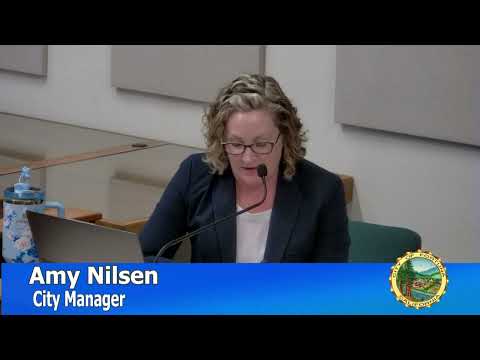
Amy Nelson, the city manager, told the council the feasibility analysis was authorized earlier and that the consultant would present numbers and options. Joe D'Aguz, senior vice president with Cosmont Companies, summarized the analysis and said, "To get to the punchline, when we look at different scenarios ... we see a present value range of up to $80,000,000." He emphasized the district "is not a new tax" and described it as an earmark of future property-tax growth within a defined boundary.
Cosmont presented two boundary options. A smaller alternative focused on the mill-site specific plan and nearby corridors would cover about 372 acres — roughly 12% of the city's acreage — with about $178,000,000 in existing assessed value. The consultant showed year-10 revenue scenarios that ranged from hundreds of thousands to roughly $3 million in nominal annual spending capacity and present-value ranges (accounting for inflation) from about $5 million to $23 million depending on allocation and partner-match assumptions.
Consultant and staff explained mechanics and risks. An EFID typically earmarks only a portion of future growth in assessed value, does not change current property-tax bills, and can last up to 45 years unless the council chooses a shorter term. Formation requires multiple public meetings, mailed and published notices and a protest process; if more than 50% of combined landowners and residents in the boundary file timely protests, the district cannot form. D'Aguz said the early years usually produce modest "trickle" revenues and that jurisdictions generally wait several years to issue bonds, because municipal bond markets expect demonstrated revenue before underwriting a bond.
Council member Trent raised concerns about using future funds when the city currently lacks cash and asked where county funds would come from. The city manager and the consultant explained the county would likewise allocate future growth from its share only if there were a defensible return-on-investment case showing that infrastructure investments would expand the tax base.
After discussion, the council made and passed a voice-motion directing staff to contact Humboldt County to explore an EFID partnership based on the smaller boundary presented. The motion was seconded and carried on a unanimous voice vote; no council member opposed.
Next steps identified by staff include exploratory discussions with county staff and supervisors and continued analysis of boundary, program terms, eligible projects and fiscal impacts before any binding commitment or formation steps are taken. No funds were committed at this meeting.