Get Full Government Meeting Transcripts, Videos, & Alerts Forever!
Get email alerts on the Homelessness Plan topic
No spam. Unsubscribe anytime.
Clallam County task force advances draft five‑year homeless housing plan to public hearing
Summary
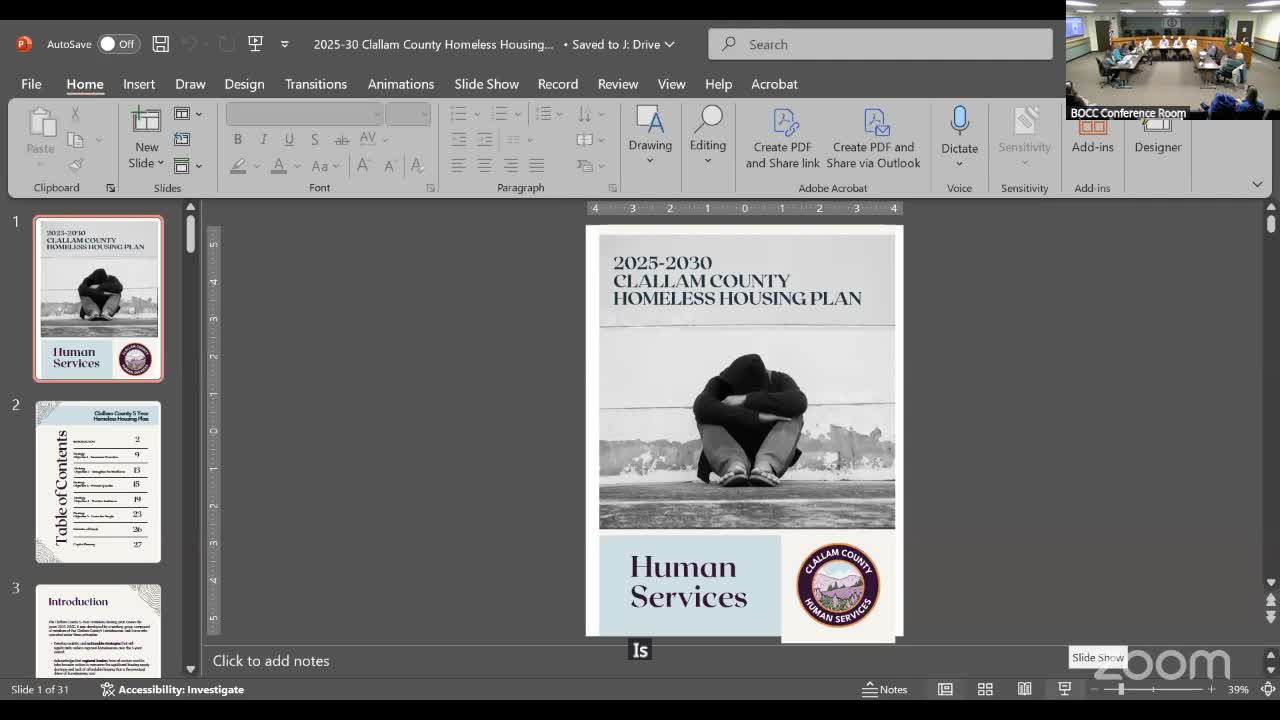
The Clallam County Homelessness Task Force reviewed a draft 2025–2030 homeless housing plan on May 6, endorsing staff to finalize wording and send the plan to the County Commission’s public hearing process after members asked for edits and added emphasis on tiny‑shelter management, safe parking, and cross‑county coordination.
The Clallam County Homelessness Task Force on May 6 reviewed a draft 2025–2030 homeless housing plan and voted to ask staff to incorporate meeting feedback and move the document to public review and a commissioners’ public hearing.
The plan, prepared using guidance from the Washington State Department of Commerce, lays out five‑year needs and strategies including emergency shelter, permanent supportive housing and new deeply‑affordable units. Consultant Paul Knox told the task force the plan’s objectives are “ambitious” and urged members to set targets “big enough to meet the problem at hand.”
Why it matters: the draft projects a significant shortfall of housing and shelter for the county’s lowest‑income residents over the next five years. The task force’s decision starts the formal public‑review process that will allow commissioners and the public to weigh in before the plan is finalized and submitted to the state.
The draft uses Commerce’s data to estimate what Clallam County will need by 2030 in addition to existing capacity: roughly 10 new emergency/shelter beds, about 88 permanent supportive housing beds and about 417 new units affordable to households under 30% of area median income. Knox said the figures are not exact science but are the best available data used across the state to set planning targets.
Public comment at the meeting highlighted operational gaps. Sequim resident and homeless advocate Gina Pratner said the county warming center “was only open 70% of the time that they should have based on their time frame and temperature barriers,” and urged the task force to press for longer or clearer operating hours to keep vulnerable people from arriving to closed facilities. The transcript shows Pratner asked the task force to seek changes so warming‑center hours better match community need.
Task force members debated strategies emphasized in the plan, including development of tiny home/tiny shelter sites, safe parking for people living in vehicles, and establishing a second emergency shelter with respite and recovery supports. Several members cautioned that tiny “shelters” (shared‑facility models without private kitchens/bathrooms) can become de facto long‑term housing if not paired with case management and exit pathways; Viola Ware warned that “if not appropriately managed, [tiny shelters] can contribute to homelessness rather than solve homelessness.”
Shelter policies drew specific operational questions. Members and shelter staff discussed a local practice of limiting shelter stays to two years; Keith, the shelter operations manager, said staff have “started letting the guests know that that’s what’s going on so that they have some kind of idea what their time frame is.” Task force members asked whether a clock would restart if someone left and later returned; shelter leadership said that policy detail remains under discussion and must be decided locally.
Members also pressed for clearer language on action‑step responsibilities. Several recommended replacing named agencies in the draft with broader categories such as “behavioral‑health providers” or “housing service providers” so the plan does not exclude potential future partners. Christie, a task force member, asked that the plan call out ongoing projects (for example, a regional challenge grant project in Forks and Sequim Health and Housing Cooperative efforts in Sequim) so the document reflects local initiatives already underway.
The task force asked staff to add or clarify specific items before public posting: include ongoing safe‑parking pilot data, better distinguish tiny homes from tiny shelters and clarify the plan’s priority ordering and resource‑gap information. Members noted the plan recommends coordination with Jefferson County on housing resources and creating a cross‑county rental list and information hub.
Formal action: a motion asking county staff to incorporate comments from the meeting and advance the draft to public review and a commissioners’ public hearing was placed on the floor and seconded; task force members registered no opposition and the motion carried. County staff will post the revised draft for public comment and schedule the formal hearing with the Board of County Commissioners as part of the plan’s submission process.
The task force and consultant emphasized that while the document is aspirational, it is also intended as a working planning tool: members will return comments to staff for word‑smithing and factual updates before the public posting and subsequent review at the commissioners’ work session and public hearing.
Looking forward, members asked that the final plan include an implementation section indicating responsible parties for major action steps, clearer funding‑gap estimates and a schedule for periodic progress reviews.