Get Full Government Meeting Transcripts, Videos, & Alerts Forever!
Get email alerts on the Open Public Meetings Act topic
No spam. Unsubscribe anytime.
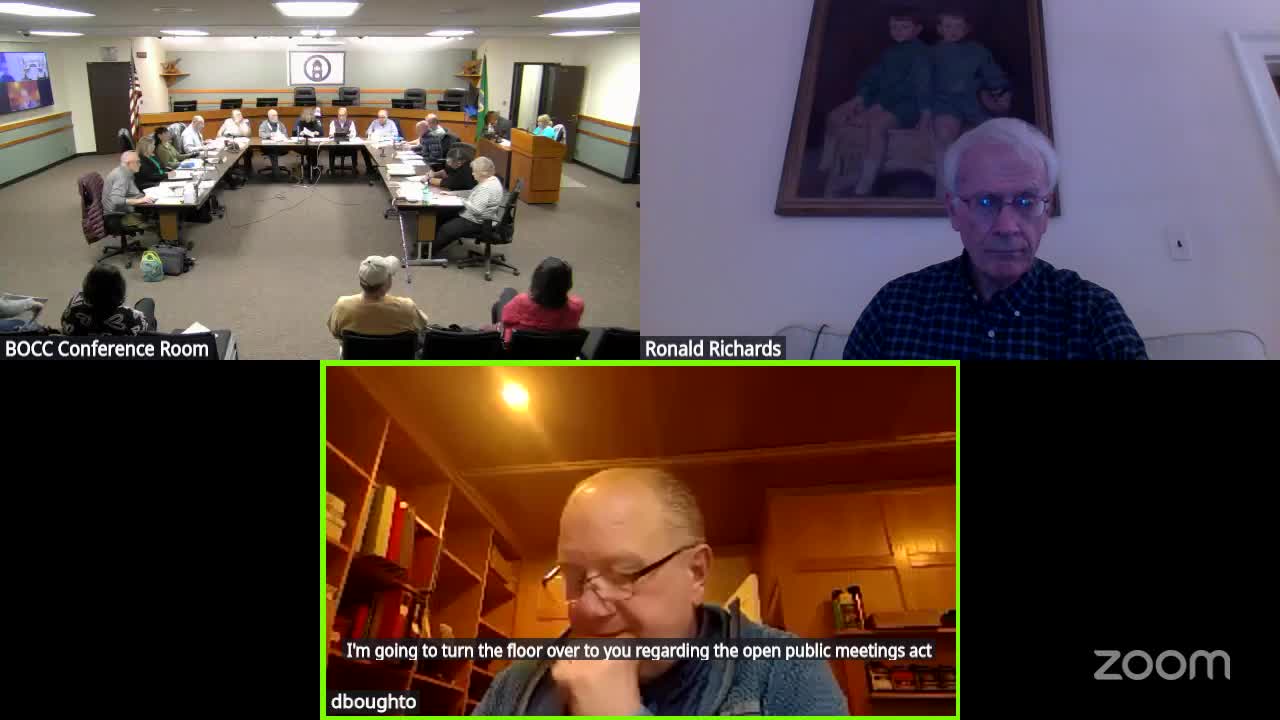
Prosecutor's office briefs Clallam County Charter Review Commission on Open Public Meetings Act
Summary
At its April 2025 meeting the Clallam County Charter Review Commission heard guidance from the prosecutor's office on when Washington's Open Public Meetings Act (RCW 42.30) applies to committees, public comment, minutes and recordings, and on notice requirements for regular and special meetings.
The Clallam County Charter Review Commission on an April 2025 meeting heard a legal briefing from the county prosecutor's office explaining when the Washington Open Public Meetings Act (OPMA) applies to committees, town halls and other bodies that advise the commission.
Prosecutor's office staff member Mr. Bowden told commissioners that OPMA (RCW chapter 42.30) covers "all meetings of the governing body of a public agency" and that a committee becomes subject to OPMA when it acts on behalf of the governing body, conducts hearings, takes testimony or accepts public comment. Bowden added that recordings and streaming are encouraged by statute but not required, while minutes must be promptly recorded and made available for inspection.
The briefing stressed a practical point for the commission: committees that accept public comment or that take final action can be treated as governing bodies under the statute. "If a committee is taking public comment, it is then . . . very likely defined as a governing body and is subject to the OPMA," Bowden said, summarizing the statute and state Supreme Court guidance.
Bowden also reviewed notice rules and recommended the commission adopt clear regular-meeting time-and-place language in its rules or bylaws so the clerk can post agendas consistently. He described the difference between regular and special meetings, and the different notice and agenda-posting duties that flow from that status. He said agendas for regular meetings should be posted online no later than 24 hours before the meeting start time and that special meetings have different notice requirements.
Commissioners asked for practical guidance about email exchanges among members, quorums at town halls and whether committee meetings should accept public comment. Bowden recommended routing substantive intercommission communications through the clerk to avoid creating an inadvertent serial meeting via email and advised that if commissioners expect a quorum at a town hall they should notice it as a commission meeting to remove ambiguity.
The briefing prompted the commission to act later in the meeting to specify a regular meeting schedule in its rules (see separate article). Commissioners said they would consult the clerk about the workload of expanded notice or recording requirements before changing committee meeting practices.
Ending: The prosecutor's office presentation is intended to guide the commission's procedural choices; commissioners agreed to consult the clerk and to consider bylaw or rules language clarifying which committee meetings will accept public comment and whether some committee meetings should be treated as regular meetings for notice purposes.