Get Full Government Meeting Transcripts, Videos, & Alerts Forever!
Get email alerts on the General Fund Balancing topic
No spam. Unsubscribe anytime.
Seattle committee warns of growing structural gap after April revenue downgrade; reserves remain replenished
Summary
Council Central staff told the Finance Committee that one‑time underspends cover a near‑term shortfall but longer‑term forecasts show a growing structural deficit driven by payroll expense tax downgrades and other revenue losses; the executive has ordered department underspend targets and hiring freezes.
Seattle’s Finance, Native Communities & Tribal Governments Committee received a briefing Wednesday showing the city can use one‑time carryforwards to balance the general fund for 2025–26 but faces growing structural deficits in later years after an April revenue forecast downgrade.
Ben Noble, director of Council Central Staff, told the committee that the city’s fiscal transparency ordinance (municipal code 3.1406(b)) requires the regular general fund balancing analysis. “This is a regular, a regular update on the balancing status of the general fund, which is actually, put in statute by the fiscal transparency ordinance. It's municipal code 3.1406 b,” Noble said.
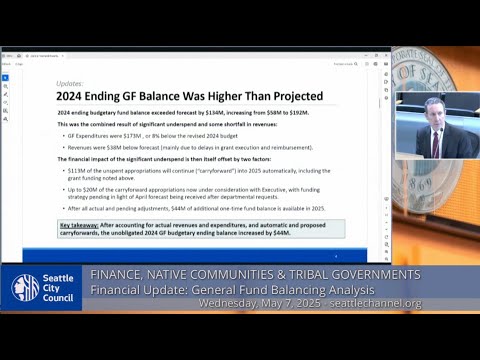
Central staff reported that closing the 2024 books produced $44,000,000 of additional one‑time general fund resources that can be applied in 2025. At the same time, central staff described an April forecast that reduced projected general fund revenues by about $50,000,000 across the 2025–26 biennium. Combining the higher 2024 carryforward with a modest reduction in planning reserves yields roughly $52,000,000 of one‑time resource—enough, at present, to offset the near‑term $50,000,000 downgrade and leave an ending unreserved balance of about $2,000,000 at the end of 2026.
Tom Meiksel and Noble cautioned that the favorable short‑term picture masks a longer‑term structural problem. The general fund structural deficit averages roughly $147,000,000 in the 2027–28 period, up from an $89,000,000 projected gap in the adopted budget. The jump start fund and payroll expense tax (PET) show larger persistent shortfalls: central staff reported a $73,000,000 imbalance in 2025 and about $152,000,000 in 2026 for the jump start fund under current forecasts. Combining the two funds yields an ongoing average deficit on the order of $233,000,000 in out years, central staff said.
Central staff attributed the shift mainly to the April forecast’s downward revisions to payroll expense tax receipts and to weaker out‑year growth assumptions. Meiksel noted that some revenue downgrades in other non‑general funds (for example, sweetened beverage tax, short‑term rental tax, commercial parking tax) are not shown in the general fund analysis but could cause additional pressure because the general fund is sometimes used to backfill other funds.
Staff described how typical carryforwards and encumbrances work: approximately $113,000,000 of the general fund is carried automatically into 2025 for legally obligated encumbrances; another $20,000,000 of carryforward is under review with the executive; after accounting for those items the net one‑time carryforward available is about $44,000,000. Noble emphasized the degree to which some underspends are expected and structural to program timing, while others represent program delays or slow contracting that merit review.
Central staff also reviewed the city’s fiscal reserves and said both the revenue stabilization fund and the emergency fund are fully replenished. The revenue stabilization fund balance stands at about $67,900,000 and the emergency fund at about $85,200,000, staff said. Staff recommended leaving the reserves intact while pursuing other options to address the long‑term structural gap.
The presentation listed immediate executive actions the mayor’s office has taken or instructed departments to pursue: department underspend targets for 2025, continuation of the hiring freeze with exceptions approved by the mayor’s office, freezes on discretionary PET and general‑fund spending for travel, training and nonessential equipment, and review of new consultant contracts and new grants. Noble said departments will return to the executive with underspend plans and that the executive is reviewing proposed carryforwards developed before the April forecast for fiscal feasibility.
The committee and staff discussed policy levers. Staff noted new state legislation that could affect local revenue: an engrossed substitute House bill (referenced in the briefing as Engrossed Substitute House Bill 2015) would authorize a councilmanic 0.1 percentage‑point sales tax for public safety and central staff showed an estimate of roughly $37,000,000 if Seattle adopted that levy. Central staff also discussed an engrossed substitute Senate bill (referenced in briefing as Engrossed Substitute Senate Bill 5814) that expands taxable services; the state fiscal note cited a local revenue impact of about $116,000,000 in 2026 and another $208,000,000 in 2027, and the forecast office is analyzing how much of that will accrue to Seattle.
Committee members requested further analysis and information. Council members asked that the City Budget Office and CBO produce historical reports on departmental underspend (2018–2023), a grant database of external grant awards, and an analysis of early retirement incentives for city employees. Council Member Rivera requested detail on how much carryforward and underspend is typical and which programs are driving large encumbrances; Council Member Kettle asked staff to prioritize structural solutions that protect core services such as public safety. Chair Strauss closed by urging prompt action: “We need to save money today and need to find ways to do that.”
Next steps: central staff said the city will receive a second forecast in August ahead of the mayor’s proposed budget in September and a final forecast update in October that will inform council amendment resources for the fall budget process.