Get Full Government Meeting Transcripts, Videos, & Alerts Forever!
Get email alerts on the Housing Middle Housing topic
No spam. Unsubscribe anytime.
Seattle committee reviews interim HB 11 10 zoning measures, adds work plan and technical fixes ahead of June deadline
Summary
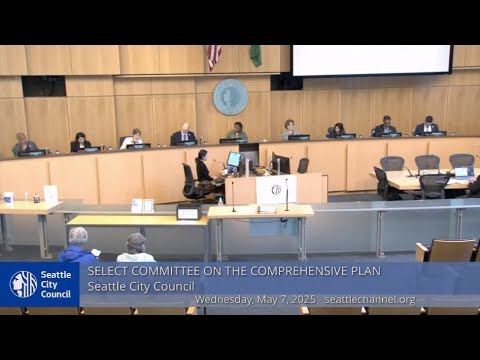
Seattle’s Select Committee on the Comprehensive Plan on May 7 reviewed interim land-use legislation the city is advancing to comply with state middle-housing requirements and discussed seven sponsor amendments and a short work plan ahead of an implementation deadline at the end of June.
Seattle’s Select Committee on the Comprehensive Plan on May 7 reviewed interim land-use legislation the city is advancing to comply with state middle-housing requirements and discussed seven sponsor amendments and a short work plan ahead of an implementation deadline at the end of June.
Chair Joy Hollingsworth, who chairs the select committee, said the legislation responds to a state requirement, noting, “it’s a state mandated legislation to create missing middle housing,” and reminded the public that a May 19 public hearing will be split into an online session at 9:30 a.m. and an in-person session at 4 p.m. Written comments were accepted at council@Seattle.gov.
The committee spent the meeting walking through sponsor amendments to Council Bill 120969, which central staff described as interim controls and a work program for permanent legislation. Central staff summarized seven amendments and the committee’s sponsors described them as either technical fixes or a starting list of topics for deeper work on the permanent code.
Central staff member Lischwitzen said, “So, we have 7 amendments today to talk about,” and then walked members through each amendment. The package included:
- An amendment by Councilmember Solomon to align the interim bill with accessory dwelling unit changes the council approved the previous day; Solomon told the committee she had “nothing to add to what’s been presented by central staff.”
- A work-plan amendment introduced by Chair Hollingsworth to identify topics the committee will study before permanent codification, including anti-displacement measures, whether residential density should be counted by units or square footage, how accessory dwelling units factor into density, thresholds for street and pedestrian improvements, protections for steep slopes and designated non-disturbance areas, tree protection and amenity-area regulations, and whether Mandatory Housing Affordability (MHA) should extend to neighborhood residential zones. Hollingsworth emphasized the work plan is a “work in progress” and a forum for dialogue rather than an immediate set of policy changes.
- A Moore-sponsored amendment to retain current single-family lot-coverage maximums (35% rather than the 50% proposed in the mayor’s draft) to prevent single-family houses from using middle-housing standards to increase lot coverage.
- A Kettle-sponsored amendment to retain existing front-yard standards along Queen Anne Boulevard, which Kettle described as a unique park-like public right-of-way and urged protecting its vistas and pedestrian character as the neighborhood densifies.
- A Rink-sponsored technical amendment restoring existing minimum floor-area language for very small lots so that small lots continue to allow at least 2,500 square feet of residential development, matching current code rather than unintentionally changing policy.
- A technical amendment (also sponsored by Rink) reorganizing and clarifying density rules in both the neighborhood-residential and multifamily (low-rise) chapters to emphasize that 4 units are permitted on most lots (and six in specified circumstances), to move the effective cutoff to the bill’s effective date so that property owners are not penalized for subdividing before an earlier, unintended March cutoff, and to ensure stacked flats are not given a new density limit that does not now apply.
- A direction for the Seattle Department of Construction & Inspections (SDCI) to report back in January on the state’s review of the building code and next steps for implementing changes that could allow stacked flats to be reviewed under the residential code once the state completes its work.
Committee members asked clarifying questions and flagged further edits. Councilmember Strauss said she had held back amendments to save staff time and would focus on the permanent legislation; Rivera, Moore and others asked that tree protections, parking and amenity access be included in the work plan. Rink described his technical package as “mostly technical and a clarifying amendment, not meant to serve as a major change in policy.”
No formal votes were recorded during the meeting; the session was a briefing and discussion. Central staff noted deadlines: the committee’s public hearing is May 19 (online at 9:30 a.m.; in person at 4 p.m.), members were asked to flag last-minute changes by 10 a.m. May 20, and committee and council votes were scheduled the following week to meet the June effective-date timeline.
Chair Hollingsworth closed by thanking central staff for their work and noting the interim process leads into a larger permanent HB 11 10 codification the committee will take up later in the comprehensive-plan phase. She also offered a brief personal remark wishing Representative Jamila Taylor well after a medical emergency; that item was not part of the bill discussion.
The committee’s discussion framed a path for finalizing interim controls before the state-mandated deadline and laid out a list of technical and policy topics the council expects to address in permanent code changes.