Get Full Government Meeting Transcripts, Videos, & Alerts Forever!
Get email alerts on the Noise Ordinance topic
No spam. Unsubscribe anytime.
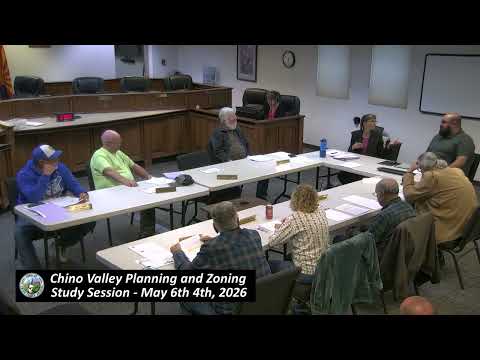
Planning commissioners review proposed revisions to Chino Valley noise ordinance
Summary
At a Planning & Zoning Commission study session, town staff and commissioners discussed draft changes to the town noise ordinance (TA 2025-O4), focusing on decibel-based enforcement, outdated language, residential protections, construction hours and livestock exemptions. Staff will revise the draft and bring it forward to Town Council.
Town of Chino Valley planning staff presented a draft update to the town’s noise ordinance (TA 2025-O4) at a Planning & Zoning Commission study session, asking commissioners for feedback before the text goes to Town Council. The discussion centered on replacing antiquated language, anchoring enforcement to decibel levels measured at the property line, and clarifying exemptions and hours for residential, commercial and construction activities.
The draft is not in the zoning code, staff said, so the commission’s role was advisory: “the text that we will be changing is not in the zoning code. So this will be your opportunity to give us some feedback and input on it,” a staff member told commissioners. Commissioners and staff said the existing ordinance includes obsolete terms (it still references “phonographs”) and has not been substantially updated in roughly 26 years.
Commissioner Pizzi, a former Chino Valley police officer who spoke from enforcement experience, urged “common sense” and said the old audible-distance standard produced unreasonable results: “when anything amplified sound outside of 50 feet…could be considered a violation,” Pizzi said, describing routine neighbor disputes that became enforcement headaches. He and other commissioners pressed for a clearer primary test for officers so they can act consistently.
Many commissioners supported making a decibel reading at the property line the primary enforcement threshold, with a secondary, qualitative test for “disturbing the peace” only if decibel limits are exceeded or other criteria apply. Commissioners discussed examples and benchmarks presented by staff: a normal conversation is about 50–55 decibels; the FAA’s common noise contour for siting homes is 65 dB; and traffic near a site measured in one case at about 65–70 dB.
The commission discussed specific topics that staff flagged for revision: distinguishing intermittent/high-impulse noise (for example, brief revving of a vehicle) from continuous noise; construction start times (commissioners suggested 6–7 a.m. as common local standards, with earlier hours possible for specialized industrial pours under permit); special provisions for events and conditional use permits (for example, the Olsen CUP); and separate treatment for barking dogs (already in another ordinance).
Commissioners also debated how to treat livestock and barnyard animals. The draft currently exempts noises made by livestock on property zoned for livestock uses, but commissioners asked for clearer definitions of “livestock” versus exotic or domesticated birds (peacocks) and how to address complaints about those noises. A staff member noted enforcement officers are likely to exercise caution unless the ordinance offers clearly defined standards.
On enforcement tools, commissioners favored anchoring the ordinance to measurable decibel levels so officers can determine quickly if a violation exists, while acknowledging limits: brief, loud bursts are often gone by the time an officer arrives and neighbor complaints can be subjective. Staff said they would check equipment and decibel definitions with the police chief.
Commissioners and staff agreed the draft is an improvement over the current code and that additional wording clarifications are needed before it advances. “Whatever you do is going to be better than what we have,” one commissioner said. Staff will revise the draft, consult the police chief on equipment and definitions, and forward the updated ordinance to Town Council for consideration.