Get Full Government Meeting Transcripts, Videos, & Alerts Forever!
Get email alerts on the Planning And Codes topic
No spam. Unsubscribe anytime.
Planning Commission adopts 2025 administrative code edits to Titles 16 and 17; changes include tree-canopy cross-references and parking standards
Summary
Kitsap County’s Planning Commission on May 6 approved recommending a package of 2025 administrative code edits to Titles 16 and 17, addressing tree-canopy cross-references, parking definitions, outdoor-storage screening, and other clarifications.
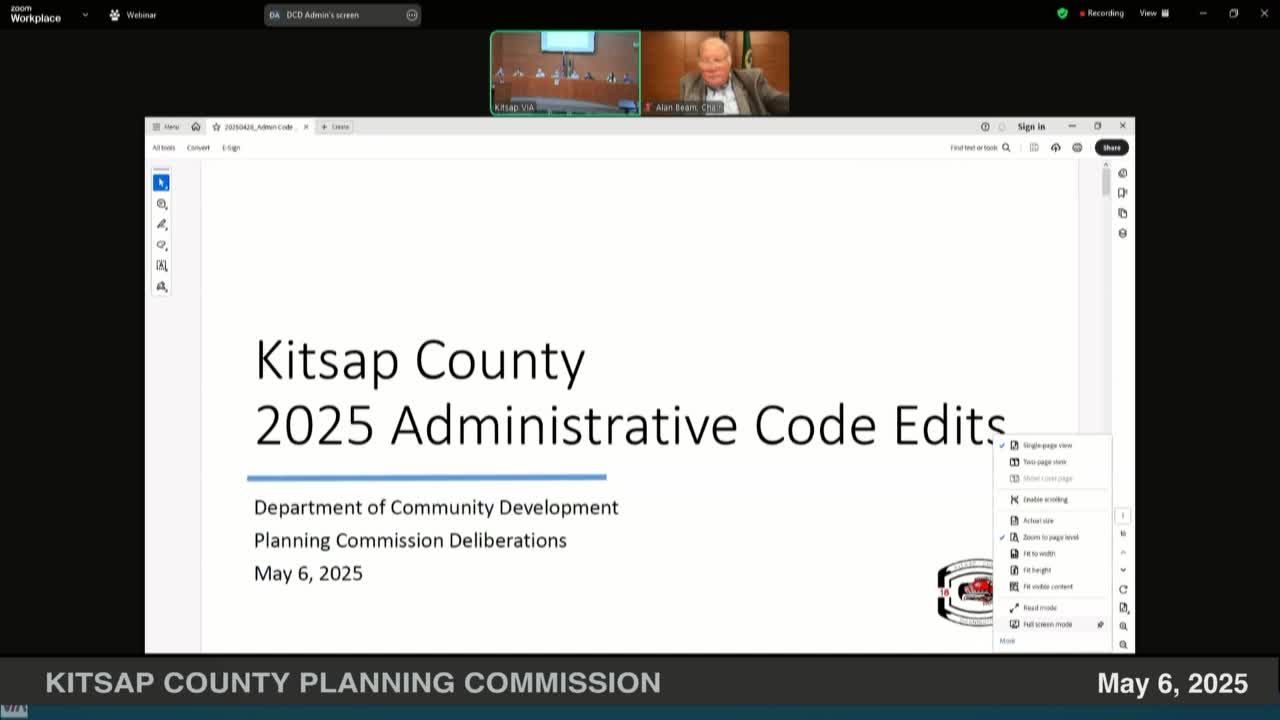
Kitsap County Department of Community Development (DCD) staff briefed the Planning Commission on May 6 about the 2025 administrative code edits to Title 16 (land division and development) and Title 17 (zoning). Long-range planning supervisor Colin Poff presented proposed housekeeping and clarifying changes and answered commissioners’ questions before the commission deliberated and recommended adoption.
The administrative edits are limited in scope but address several items the department said were inadvertently omitted during prior updates or required legal alignment. Key updates the commission considered and recommended include:
- Tree canopy references: add cross-references so subdivision and landscaping submittal requirements show consistency with the county tree-canopy ordinance (KCC 17.495) where applicable. - Definition clarifications: modify the county definition of “school” to explicitly include outdoor schools and add an illustrative parenthetical listing to cover Montessori and Waldorf-style private educational organizations. - Compact-parking dimensions: correct a discrepancy so compact parking stall length matches the parking chapter’s 16-foot standard. - Outdoor storage and screening: re-add a previously dropped “storage of vehicles and equipment” use and require outdoor storage in rural industrial and rural commercial zones to be screened from public view by a 25-foot vegetative buffer (rural-compatibility standard) and to meet exterior lighting standards. - Drinking establishments: make drinking establishments a permitted use in the Kingston UBC (downtown) zone (clean-up from prior comprehensive-plan discussions). - Heavy industrial uses: update certain heavy industrial uses (heavy manufacturing, recycling centers and transshipment facilities) to require a conditional-use permit and public hearing, consistent with recent state legislative direction about public notice for substantial industrial changes. - Garage setback conflict: correct a conflict in the code so a 10-foot setback applies to garages rather than no setback language that was left in error. - Parking counting: align county code with state law on counting enclosed and unenclosed parking toward minimum parking requirements (garages and unenclosed parking both count per the state law referenced by staff). - Landscaping location: move landscaping standards from the density/dimension chapter into the dedicated landscaping chapter (17.500) while retaining a cross-reference. - Sign code clean-up: replace obsolete “CO” references with current “C” commercial-zone designation.
Commission discussion covered applicability of tree-canopy standards, how 25-foot screening buffers would work where adjacent properties use the same rural-industrial zoning, and whether Montessori/Waldorf language could be misread as a legislative exclusion (the commission amended the school definition with an explicit parenthetical to avoid ambiguity). Commissioners also asked staff to improve presentation clarity and to preserve clickable code cross-references in the online code viewer.
The Planning Commission moved to begin paragraph-by-paragraph deliberations, accepted the staff recommendations with the one amendment to the school definition language, and voted to forward the administrative code edits for the Planning Commission findings-of-fact process. Staff said the next steps are final findings on May 20 followed by Board of County Commissioners work study and public hearing and potential adoption by the Board.
No ordinance adoption by the Board took place at this meeting; the commission’s action was a recommendation to proceed through the adoption track.