Get Full Government Meeting Transcripts, Videos, & Alerts Forever!
Get email alerts on the Parks And Recreation topic
No spam. Unsubscribe anytime.
Kitsap County presents 2025 Parks, Recreation and Open Space plan update after 447 public comments
Summary
Kitsap County Parks staff presented a draft 2025 Parks, Recreation and Open Space (PROS) Plan, described public engagement that produced 447 comments, and outlined edits and a schedule that moves the plan toward a public hearing, SEPA comment deadline and eventual consideration by the Board of County Commissioners.
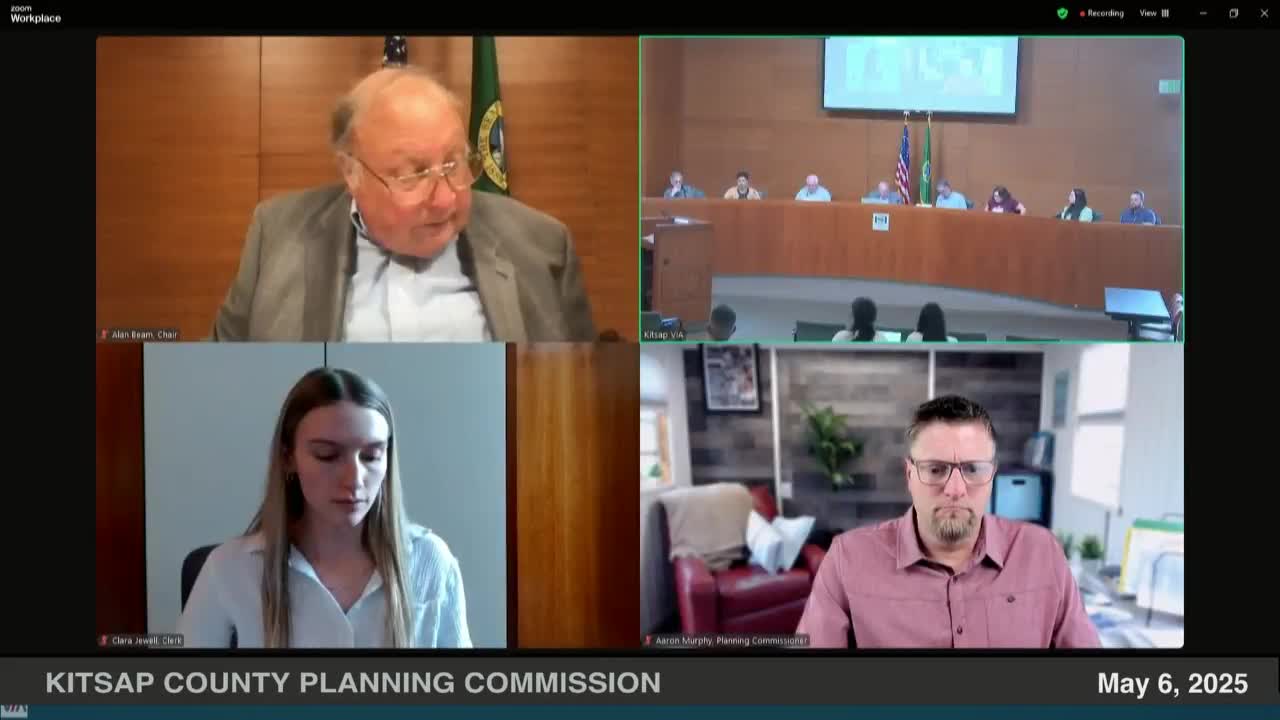
Kitsap County Parks Director Alex Wisniewski and Parks Planner Carmen Smith on May 6 presented a revised draft Parks, Recreation and Open Space (PROS) Plan and a summary of public engagement that produced 447 comments and led staff to make edits before forwarding the plan to the Board of County Commissioners.
The PROS plan is a 20-year strategic document that the county is required to update every six years under state grant eligibility standards; it guides department goals, capital projects and grant applications to the Recreation and Conservation Office. The department told the commission the plan meets Growth Management Act requirements and is structured to inform a six-year rolling capital improvement program.
The plan team said public outreach included three surveys, three district open houses, stakeholder interviews, youth and targeted surveys and Parks Advisory Board review. Carmen Smith summarized the outreach and said, “We received 447 total comments,” and that staff grouped responses by topic and district to guide edits.
Key themes in public comments included athletic-field improvements — particularly artificial turf and lighting at South Kitsap Regional and Veterans Memorial parks — requests for more restrooms and parking, support for inclusive ADA-accessible playgrounds, and calls for stronger natural-resource protections. Beverly Parsons, speaking during the general public comment period, said the PROS draft lacked clarity and consistency with the county comprehensive plan and recommended delaying adoption: “We are suggesting that it would be premature to adopt the 2025 PROS plan as drafted,” she told the commission.
Staff described a set of edits made after the public comment period: housekeeping fixes (typos, mislabeled maps and photos), clarified park classifications and appended a consolidated survey results section, additions to capital projects and reprioritization of some athletic-field projects from a 6+ year timeframe into the 1–6 year window (including Veterans Memorial and Anderson Hill), added projects for the county-owned Village Greens and Rolling Hills golf courses, added energy-efficiency projects, and added several Suquamish-area projects identified in the 2024 comprehensive plan subarea lists. Staff also said completed or duplicate projects were removed from the capital table.
Staff noted the department applied for a programmatic SEPA determination and that the Department of Community Development issued a Determination of Nonsignificance (DNS) on April 29; the SEPA comment period was open through the following Tuesday. The planning commission was given a schedule: a public hearing on the PROS plan on May 20, deliberations on June 3, and findings of fact on June 17 before the plan goes to the Board of County Commissioners and the Recreation and Conservation Office for final action.
Commissioners asked detailed questions about volunteer and stewardship programs, trail construction and maintenance trade-offs (“If we build it, gotta take care of it,” Wisniewski said), how project priorities will be set across districts, and whether the plan’s goals and capital projects will be mapped to measurable timelines. Staff replied they will convene a Parks Advisory Board subcommittee to develop a prioritization process and that the department intends to align annual work plans to PROS goals and objectives.
The presentation also flagged implementation challenges: staff told commissioners that recent maintenance studies show a personnel shortfall (staffing was described as insufficient by a staff speaker) and that many capital additions would increase ongoing maintenance demand. Staff said they will consider staffing and maintenance capacity when prioritizing projects, and they noted potential funding sources including grants through the Recreation and Conservation Office and possible revenue-generating facility strategies.
The County’s next steps are to collect SEPA and hearing comments, present the plan at the May 20 public hearing before the planning commission, revise as appropriate, deliberate in June and then forward a recommendation to the Board of County Commissioners for adoption and RCO review.