Get Full Government Meeting Transcripts, Videos, & Alerts Forever!
Get email alerts on the Seeley Forest Trail topic
No spam. Unsubscribe anytime.
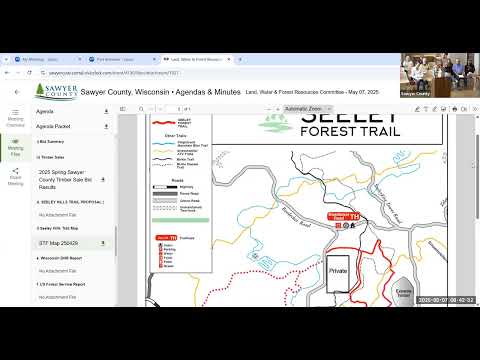
Sawyer County committee forwards Seeley Forest Trail plan to county board after divided debate
Summary
The Sawyer County Land, Water, and Forest Resources Committee voted 3–2 to forward the Seeley Forest Trail proposal to the Sawyer County Board for final approval after extensive public comment and committee debate.
The Sawyer County Land, Water, and Forest Resources Committee voted 3–2 to forward the Seeley Forest Trail proposal to the Sawyer County Board for final approval after more than an hour of public comment and extended committee discussion.
Proponents said the project would expand year‑round, low‑gradient access to county forest lands for older adults, casual recreationists and people with disabilities. “It's a project that expands access for a large audience, including people with disabilities,” said Suzanne Mao, a project volunteer and Seeley resident. The proposal calls for roughly a 4‑mile first phase linking the existing winter route to the Double 0 Trailhead, built as an approximately 12‑foot corridor with an 8‑foot maintained dirt tread so parts of it can be groomed and used year‑round.
Why it matters: Committee members said the decision balances competing county goals — maintaining timber productivity and established motorized routes versus providing inclusive outdoor recreation. Supporters, including neighborhood groups and nonprofits, submitted letters and a petition they say gathered close to 100 signatures; opponents warned that new crossings and added trail density could strain emergency services, increase safety risks and complicate forest management.
Supporters and design details
Suzanne Mao said the project has broad local backing and grant funding available. She told the committee that the trail would use existing logging corridors to limit new disturbance and that a portion would be designed to improve access for people with mobility limitations. “The outdoor recreation plan…7 of the 9 objectives are met by this project,” Mao said, and she told the committee the proponents already have funds in the bank to build the first phase.
Business and community supporters echoed that view. Michael Choate, who operates lodging near the Berkey Trail, said the new trail would help attract a broader set of visitors and be usable in all seasons. “I do believe that there is a need for an additional system that's more accessible to older folk,” Choate said.
Opposition and safety, legal and management concerns
Several speakers and committee members raised concerns about safety where the proposed route would cross existing motorized trails and about limited cell coverage in parts of the Seeley Hills. John Mrotek, speaking for the Sawyer County Snowmobile ATV Alliance, said there is a “huge safety concern” with adding new crossings in an area that already has many silent‑sport (nonmotorized) trails.
County forestry staff flagged additional issues. Greg (county forestry staff) said he had “wrestled with this” and could not recommend approval at this time, citing trail density, steep local topography and the county’s limited staff capacity for administering an additional system. “I recommend that we not proceed with it,” Greg told the committee during the discussion.
Several committee members said any accessibility claims should be vetted carefully. “If you're gonna say it's an ADA accessible trail, it has to be 100% ADA accessible,” said Committee member Peterson, expressing concern about legal liability if the county represents the project as partially ADA‑compliant without meeting federal standards. Project proponents pointed the committee to National Forest Service guidelines for accessible trails as a possible design reference.
Measures proposed to reduce conflicts
The project team outlined mitigations intended to reduce user conflict: signage at crossings, requests that nonmotorized users not congregate on the motorized tread, and seasonal signage adjustments (removing some stop signs in summer and reinstating them for winter use of the Berkey Trails). The proponent also said the area participates in an emergency‑location program using mapped sign codes (the ELM system) so responders can locate incidents, and that proponents would work with CAMBA and local motorized groups on signage.
Committee action and next steps
After discussion, the committee voted 3–2 to forward the Seeley Forest Trail proposal to the county board for consideration. The motion to forward included no final decision about legal requirements; several committee members asked that county legal counsel review accessibility and liability questions before or at the county‑board hearing. Committee members made a separate request that County legal counsel Rebecca Roker be asked to attend the county‑board meeting or provide legal guidance; committee discussion noted that counsel’s availability is not certain and that the county board review will include additional legal input as appropriate.
What remains unresolved: The committee discussion left several implementation details open, including final surfacing and drainage plans, the precise location of the two proposed crossings of the ATV/UTV trail, a final determination of which segments — if any — will be built to formal accessibility standards, and whether the proposal will be scaled back to reduce footprint or density. The county board will receive the proposal and, according to committee members, is expected to consider legal input before any final county approval.
The county board meeting is the next formal step; no date for county board action was set during the committee meeting.