Get Full Government Meeting Transcripts, Videos, & Alerts Forever!
Get email alerts on the Stormwater Master Plan topic
No spam. Unsubscribe anytime.
North Miami unveils stormwater master plan update after June flooding; residents press for faster action
Summary
Consultants presented a stormwater master plan update that adds two islands and new infrastructure to a 2012 model, recommends $11 million in short-term fixes and larger long-term projects; residents say the plan is too incremental and demand stronger code enforcement and funding.
Consultants for the City of North Miami presented an updated stormwater master plan that incorporates new infrastructure and two islands omitted from the 2012 model and recommends short-term and long-term projects to address recurring flooding.
The update, presented by Hans Morsey, director of water resources for RJ Behar, laid out modeling methods, problem areas and a two-tiered implementation plan. "My name is Hans Morsey. I'm with RJ Behar. I'm the director of water resources, and I'm gonna be presenting the stormwater master plan update for this for the city of North Miami," Morsey said at the meeting.
The plan matters because it translates modeling into specific work the city could pursue: 22 short-term improvement locations, estimated at about $11,000,000, and larger long-term upgrades that include underground storage, upsized pipes and additional pumping. The short-term work emphasizes exfiltration (French) trenches, inlet sump modifications and retrofit flap gates at outfalls; long-term work is separated into two groups of increasing complexity and cost.
Key technical findings and recommendations
- The update used the EPA Storm Water Management Model (SWMM) and added new infrastructure built between February 2012 and February 2024 as well as two islands that were not in the 2012 model. - The city's drainage inventory summarized in the presentation: approximately 2,300 stormwater catch basins (about 605 owned by state/county), 366 manholes, 74 outfalls, 113 recharge wells, four pump stations and about 38.8 miles of stormwater pipe. - Short-term recommendations (roughly 5 years, contingent on funding) focus on exfiltration trenches (two standard preliminary sizes: 18-inch and 24-inch), vertical-sump inlets to trap debris, skimmers/baffles to limit floating pollutants, and regrading of swales where feasible. Morsey said: "Short term improvements are recommended to all the critical areas identified ... we identified 22 locations of short term improvements." The short-term package was estimated at about $11,000,000. - Long-term recommendations (15–20 years) are grouped into two levels: Group 1 largely adds more exfiltration trenches and collection piping; Group 2 includes more complex upgrades such as underground storage, upsized trunk lines, larger outfalls and additional pump stations. - The plan incorporated county-adopted sea level projections (unified sea level projections, 2019) and simulated storms ranging from 2-year to 100-year events; Morsey presented storm-surge maps showing increasing inundation from Category 1 through Category 5 hurricanes.
Community concerns and staff response
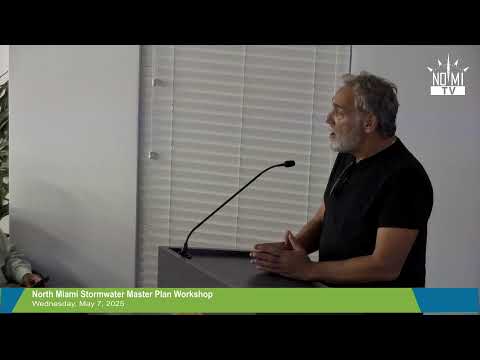
Residents said the draft plan does not go far enough to address chronic flooding. Multiple speakers described repeated, severe flooding in neighborhoods and urged stronger, faster action. Eileen Bekeba, a longtime resident of Northeast Third Court, said: "For 8 long years, I have been talking about the atrocity on Northeast Third Court between 130 First and 130 Fifth Street." Christine Boyzberg, who lives on San Susie Boulevard, summarized the daily impacts: "It floods if it rains more than an hour." Karen De Leon raised code-enforcement issues tied to driveway and setback variances, saying: "We have driveways now that are basically cement." Resident and community member Gio Darda said: "We have a major problem with our drainage."
City staff acknowledged the community's experiences and said the short-term recommendations are intended to address the most critical sites identified after last year's heavy storm. A staff speaker noted the plan will be used to pursue outside funding, saying the short-term package is approximately $11,000,000 and that the city currently lacks that full budget and will seek grants and other funding sources.
What the plan specifies for particular areas
- Several problem basins were highlighted by name or map area: San Soussi (island drainage and outfalls), Keystone Island, Biscayne Canal West, Southeast Caine Canal area, Arch Creek North and Arch Creek South. - Biscayne Canal West: recommended about 12,500 linear feet of French drain plus a collection system to meet the 5-year level of service for roads. - Southeast Caine Canal area: roughly 25,000 linear feet of French drain recommended to meet the 5-year standard. - Arch Creek South: recommended 4,900 linear feet of French drain plus upgrades (upsized outfalls, trunk lines, underground storage) to meet the 10-year standard where feasible. - One island location (referred to as Location 6) was identified as requiring a pump station, dewatering wells and a rebuilt drainage system; Morsey called that the most expensive alternative at about $4,000,000.
Modeling, design assumptions and routine recommendations
The consultant described design assumptions used for preliminary sizing (French-drain depths of about 15 feet, standard widths for 18-inch and 24-inch trench options, and a minimal safety factor of 2 for preliminary calculations). Routine operations recommendations included CCTV inspection and maintenance of drainage infrastructure, a centralized complaint-tracking system, post-construction follow-up, and community outreach and workshops.
Residents requested stronger enforcement and a pause on some approvals until drainage fixes are in place. Several speakers urged the city to require larger on-site retention for new development, to prioritize use of city-owned parcels for retention rather than public parkland, and to dedicate funding to deliver the short-term fixes. One commenter asked that the city better publicize how residents should report flooding so problem sites are captured for planning and funding.
What was not decided
No formal motions or votes were taken at the meeting. The presentation was informational and the consultant and city staff signaled next steps: publish materials on the city website (the presentation is posted) and pursue funding and design for the short-term projects. Staff indicated a plan to review citizen-submitted locations and to pursue grants, but no budget appropriation or project contract was approved during the session.
Ending
The City of North Miami's stormwater master plan update provides a technical roadmap and a prioritized list of fixes; residents at the meeting described repeated flooding and urged faster, better-funded action and stronger code enforcement. City staff said the presentation materials are on the city's website and that the plan will be used to seek grants and further design work to move short-term projects forward.