Get Full Government Meeting Transcripts, Videos, & Alerts Forever!
Get email alerts on the Renewable Energy Ordinances topic
No spam. Unsubscribe anytime.
Committee recommends county board consider solar, wind and battery-storage ordinances
Summary
The Iroquois County Tax Planning and Zoning Committee voted to forward draft ordinances governing solar, wind and commercial battery storage to the County Board after the Zoning Board of Appeals recommended approval without changes. Committee members discussed timing, building-permit questions and site-specific safety conditions for batteries.
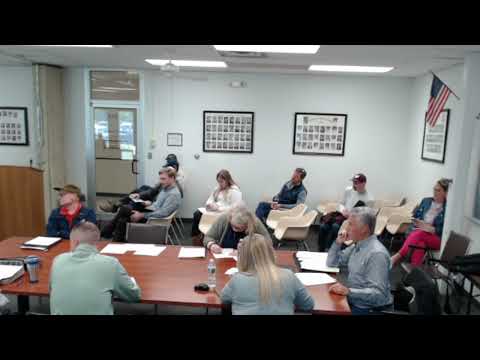
The Iroquois County Tax Planning and Zoning Committee voted May 6 to recommend that the County Board consider draft ordinances governing commercial solar, wind and battery storage projects after the Zoning Board of Appeals recommended the drafts without changes.
The recommendation follows a ZBA public hearing in which most testimony, the committee heard, focused on building-permit details such as vegetation screening and permit fees rather than the zoning provisions that control conditional-use approvals. Andrew Knight, the committee’s attorney, told members that the ordinance provisions in place when an application is deemed complete are those that apply to that application.
The ordinance package covers three separate but related items: a solar ordinance, a wind-energy ordinance and a standalone commercial battery-storage ordinance. Knight said conditional-use approvals and building permits are different steps: "When they come back, there's usually ... sometimes it's several years before a project comes back with the building permit," and that different sections of an ordinance apply at each step.
Committee members and staff discussed safety and site conditions for battery projects. Knight said counties may attach project-specific conditions under the special-use statute (identified in the meeting as 120045) and that many battery-safety issues can be handled through conditions and third-party engineering review. He described common conditions such as heat detection, fire-suppression systems and other protections added at the building-permit stage.
Developers also appeared during public comment. Tom Hill of Scott Community described his firm as "a developer owner operator" working with the Gilman community and asked the committee to consider business-friendly provisions in the solar ordinance. Hill said his company's invested project could approach $200,000,000 in capital expense and that tax credits tied to using domestic materials were an important incentive.
Committee members raised several recurring local concerns: whether vegetation screening requirements would be practical, whether to cap building-permit fees, and whether a 15-foot buffer around battery containers is adequate (some ZBA members suggested a wider buffer such as 40 feet). Knight and staff noted that those are often addressed by condition and that, because no standalone battery projects were pending in the county, the committee can amend details later if needed.
The committee moved and seconded a recommendation to forward the three ordinances to the County Board; the Zoning Board of Appeals had sent the drafts forward with a recommendation of approval. No immediate amendments were made by the committee; members were advised they could propose minor tweaks later through the ZBA process.
Next steps include formal transmittal to the County Board for consideration. Knight said the committee may continue to require third-party engineering review and conditions on a project-by-project basis if safety questions or site-specific issues arise.