Get Full Government Meeting Transcripts, Videos, & Alerts Forever!
Get email alerts on the Commute Trip Reduction topic
No spam. Unsubscribe anytime.
Council studies minor updates to commute‑trip reduction code; applies only to large employers
Summary
Council received a study session on amendments to the city’s Commute Trip Reduction (CTR) code. Staff said changes are mainly clarifying language and updating performance targets; the rule affects large employers (100+ employees) and currently applies only to Pierce County facilities that meet that threshold.
University Place held a study session on proposed updates to the city’s Commute Trip Reduction (CTR) code on May 5, 2025. Public‑works staff described the changes as modest updates that reflect state guidance, account for telework and refresh the code’s references.
Public-works Director Jack Eklund and Senior Project Engineer Kyle Muren said the city’s CTR program — in place since 2002 — seeks to improve air quality, reduce congestion and minimize energy use. The proposed 2025–2029 update clarifies language, updates statutory references and adopts the new statewide performance target for affected employers.
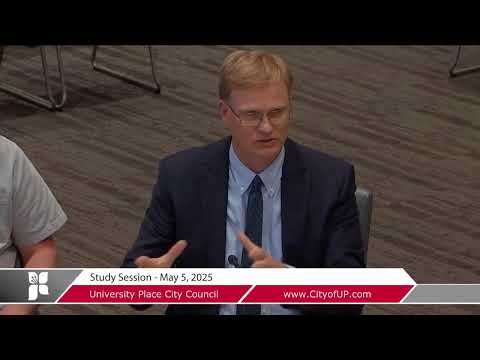
"The updates are fairly minor in nature," engineer Kyle Muren told council. Muren said telework is now incorporated into trip‑reduction calculations and that the updated plan reflects recent outreach and the city’s comprehensive‑plan language.
Who is affected: the CTR code applies only to affected employers that have 100 or more employees arriving during peak commute hours (6–9 a.m.). Staff said that, within University Place, the threshold currently applies to Pierce County’s wastewater‑treatment facility and its environmental‑services building; because Pierce County’s locations meet the threshold, the city is included in the regional calculation.
Performance target: staff explained the updated plan adopts a target to achieve a weighted average drive‑alone rate of 60% or less across affected employers in the jurisdictional grouping. Eklund said Pierce County’s large employer status means the county does much of the program administration and reporting, while the city collects and submits its own employee information.
Council questions and process Council members asked how the city encourages trip reduction among its own employees. Staff said the city supports telework, distributes transit information, and provides bike facilities as available, and that human‑resources staff administer internal participation. Council members asked whether changes would affect the city’s budget; staff said the update can be administered with current staffing and processes and that Pierce County shoulders much of the reporting burden for the affected employer group.
Next steps: staff said the draft has been reviewed by Puget Sound Regional Council and the Washington State Transportation Board; the city has time to propose edits and return with formal adoption materials before the statutory timeline, and staff invited council input prior to formal adoption. No vote was taken at the study session.
Ending Council members asked staff to circulate the final draft and to provide information on recent employee commute‑survey results so members can track local progress against the new target.