Get Full Government Meeting Transcripts, Videos, & Alerts Forever!
Get email alerts on the Planning 20th 77th Business District topic
No spam. Unsubscribe anytime.
University Place council reviews draft 20th/77th Street business-district plan, cites walkability and traffic as next issues
Summary
City staff and consultants presented a draft 20 Seventh Street business-district plan that emphasizes walkability, small retail, and mixed-use redevelopment; the plan is based on extensive community outreach and will return later for formal review, with council members urging follow-up on traffic, sewer and funding options.
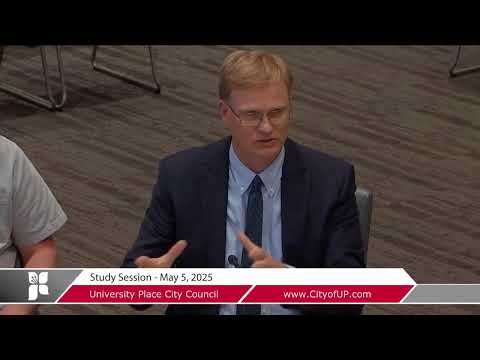
University Place city council members reviewed a draft 20 Seventh Street business-district plan during a study session on May 5, 2025, hearing a consultant presentation about visioning, market capacity and seven recommended action categories and asking for additional analysis of traffic, sewer service and funding tools.
The draft plan, prepared for the city by consultant Mandy Roberts and staff from the Community and Economic Development Department, lays out a vision to strengthen the corridor as a neighborhood destination with improved pedestrian crossings, festival streets, and mixed-use redevelopment. The consultant said the plan is implementation‑focused and will identify catalyst projects consistent with the city’s form‑based code.
"The purpose of the 20 Seventh Street business district plan is to really establish a vision with specific provisions that guide redevelopment," consultant Mandy Roberts said, summarizing the plan’s aims. The presentation noted the planning team gathered 681 survey responses and produced a nearly 100‑page draft plus a 60‑page market appendix.
Why it matters: the corridor was designated part of the city’s regional growth center; adopting subarea plans helps the city remain eligible for regional transportation grants and positions the city to accommodate county-assigned growth. "It allows the city, in a put us as in the best possible position to get grants for transportation improvement projects, primarily from the Puget Sound, Regional Council," said Kevin Burski, Community and Economic Development director.
Key elements and findings - Public outreach: the planning team used an advisory committee, multiple surveys (681 respondents), and a public open house; common priorities included walkability, local businesses, dining and reuse of vacant parcels. - Capacity and scenarios: consultants modeled low, medium and high redevelopment scenarios over a 20‑year horizon and assumed roughly 40% of land would not redevelop in the near term; prototypes used are consistent with the city’s form‑based code. - Concepts: illustrations showed mixed‑use buildings with ground‑floor retail, festival‑street treatment for selected blocks (for markets and events), and smaller middle‑housing types in narrower parcel areas. - Recommended actions: seven categories beginning with regional collaboration and climate considerations, and extending to land use, housing variety, transportation, placemaking and economic development. The plan includes seven specific action items for future council consideration.
Council questions and staff follow up Council members broadly praised outreach and the plan’s emphasis on local businesses and walkability, but several asked for more analysis before any final adoption. Members repeatedly pressed staff and consultants for: a traffic/transportation impact analysis for 20 Seventh Street under redevelopment scenarios; confirmation that sanitary sewer capacity and interlocal service agreements would support infill; and clarification of grant and incentive tools the city could pursue (for example, grant programs and tax tools were discussed in general terms).
Council member Worthington highlighted the link between the regional growth‑center designation and grant eligibility and asked staff to return with specific implementation steps. Council member Grassi and others asked that the plan protect the corridor’s existing small, historic businesses and ensure redevelopment options feel contextually appropriate.
Next steps Staff and the consultant said the draft plan will be returned later with a formal resolution for council consideration; the subarea plan is intended as draft goals and policies that could be incorporated into the city’s comprehensive plan. No formal vote was taken at the study session.
Ending Council members asked staff to provide additional technical detail — especially traffic impact estimates, sewer service confirmation, and a clearer list of funding and incentive tools — before taking the draft plan to a formal adoption hearing.