Get Full Government Meeting Transcripts, Videos, & Alerts Forever!
Get email alerts on the Trafficking Survivor Services topic
No spam. Unsubscribe anytime.
Thistle Farms outlines residential program, employment enterprises and policy work for survivors of trafficking
Summary
Amanda Cleland, director of communications and advocacy for Thistle Farms, presented the nonprofit's safe house, two-year residential program, social enterprises and statewide advocacy successes, including recent changes to Tennessee law and expansion of safe-house capacity.
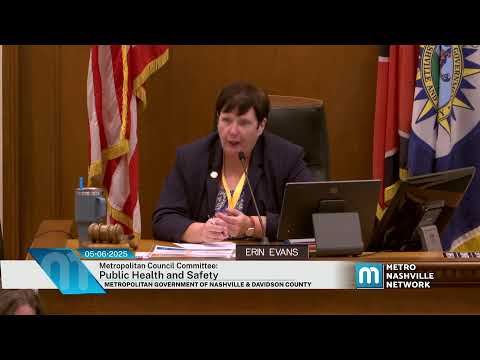
Amanda Cleland, director of communications and advocacy for Thistle Farms, briefed the Public Health & Safety Committee on the nonprofit’s residential, employment and advocacy programs for women survivors of commercial sexual exploitation and human trafficking.
Thistle Farms operates a safe house providing short-term crisis stabilization and an eight-bed capacity that was expanded from four beds this year; a two-year residential program that provides housing, food, trauma therapy and case management at no cost to participants; and social enterprises — including a manufacturing arm (Body & Home) and a cafe — that provide job training and second-chance employment.
“Without that residential program, Thistle Farms would not be here, and none of the 190 women who have graduated our organization's residential programs since 1999 would have had the support that they need,” Cleland said. She described the organization’s service pillars as “house, heal, employ, and respond.”
Cleland said Thistle Farms expanded safe-house bedding in response to demand from law enforcement and partners and that the residential program’s two-year length allows women time to stabilize and build skills. She described partnerships that route women from the Tennessee prison for women into the program through pre-release classes called “Thistle on the Inside,” and partnerships with law clinics for expungement assistance.
On policy work, Cleland summarized recent successes: a 2024 amendment removing a requirement that certain prostitution-related convictions place previously affected women on a sexual-offender registry, which allowed 86 people to exit the registry where appropriate; and a 2025 law tying human-trafficking awareness training to tattoo-artist licensing (referred to in the meeting as the Ink of Hope Act).
Committee members asked about specific therapies and employment timelines. Cleland said DBT (dialectical behavior therapy) and other psychoeducational supports are offered, and that job readiness begins after the first 90 days and leads into internships and placements in Thistle Farms’ enterprises where possible. She said Thistle Farms partners with law clinics at Vanderbilt and Belmont on expungement clinics and works to remove court fees and other barriers where possible.
Councilmember Greg praised the organization and encouraged colleagues to visit Thistle Farms’ restaurant and shop.
Cleland offered to supply the committee with presentation materials and contact information for referrals and partnership inquiries. She said if she did not know an answer she would follow up with written responses.
Notes: Presentation emphasized trauma-informed residential care, second-chance employment and state-level policy advocacy; the organization reported specific program metrics (number of graduates) and legal-policy outcomes (registry removals).