Get Full Government Meeting Transcripts, Videos, & Alerts Forever!
Get email alerts on the Water Funding topic
No spam. Unsubscribe anytime.
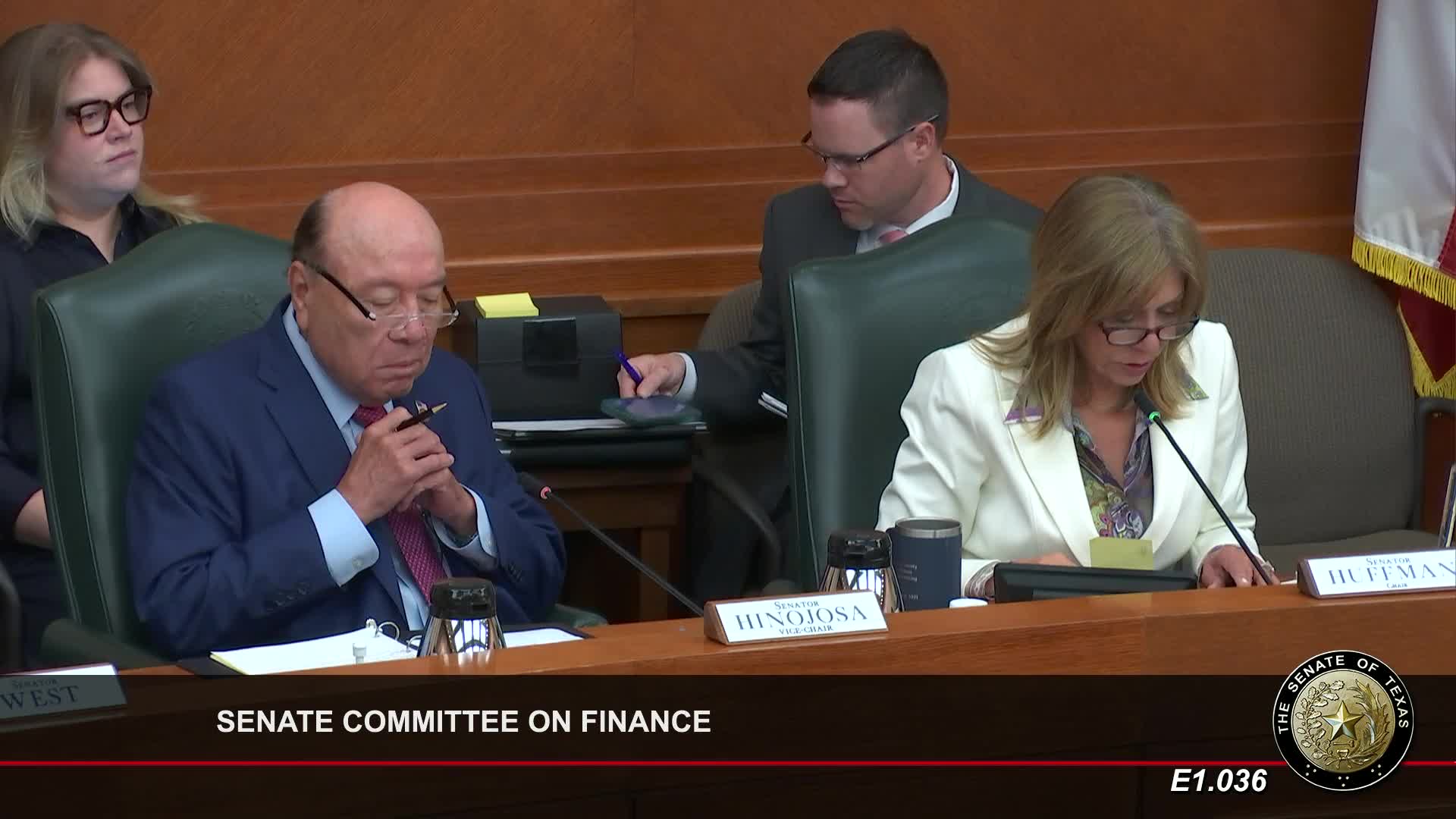
Senate Finance committee adopts HJR 7 substitute, debates $1 billion-a-year Texas Water Fund and 80/20 supply split
Summary
The Senate Committee on Finance adopted a committee substitute to HJR 7 and spent the hearing weighing whether a constitutionally dedicated revenue stream should be strictly apportioned with most money going to new water supply projects.
The Senate Committee on Finance adopted a committee substitute to HJR 7 and spent the hearing weighing whether a constitutionally dedicated revenue stream should be strictly apportioned with most money going to new water supply projects.
Senator Perry, who presented the committee substitute, told the panel the measure would “constitutionally dedicate a $1,000,000,000 per year to [a] Texas Water Fund for a 16 year term,” and said the money must be weighted toward new supply to address projected shortfalls.
The legislation would create a dedicated, long‑term revenue source to fund projects the Texas Water Development Board and regional planners identify as needed to address supply, wastewater and flood infrastructure. Senator Perry said the state water plan projects a shortfall and that accelerating population growth, drought and development make the gap more urgent. “We are 6,000,000 acre feet minimum, probably more than that, short of water supply needs,” he told the committee.
Supporters — including trade groups, engineering firms, environmental organizations and local water authorities — described a large unmet infrastructure need and urged action, while offering differing views on whether the constitutional language should prescribe an 80/20 split between new supply and other water programs.
Perry Fowler, executive director of the Texas Water Infrastructure Network, said his group supports constitutionally dedicated funding but raised concern about a prescriptive 80/20 allocation. “We prefer the original language passed by the House which gives the Texas Water Development Board broader flexibility and discretionary authority,” Fowler said.
Scott Stewart, vice president for legislative affairs at the American Council of Engineering Companies of Texas, called the dedicated funding “one of our big priorities” but said many firms favor flexibility and warned an 80/20 mandate could limit the Water Development Board’s ability to direct funds to the most needed projects.
Environmental Defense Fund and groundwater advocates pressed for protections for rural groundwater. Vanessa Puig Williams, who leads EDF’s Texas Water Program, said the committee substitute’s language “makes clear funding for new water projects cannot be used to develop or transport fresh groundwater,” a restriction she said would help ensure rural groundwater remains available to local communities.
Other witnesses urged the committee to balance priorities. The American Society of Civil Engineers’ Texas director, Jenny Peters, pointed to the 2025 Texas infrastructure report card — which assigns low grades to drinking water and wastewater systems — and said the initial Water Fund allocation represents “a small fraction of what is needed.” Texas 2036 noted long‑term needs of roughly $154 billion over 50 years, with substantial portions for both supply and aging drinking and wastewater systems.
Industry witnesses urged inclusion of new technologies and nontraditional supplies. Trace Finley of the Texas Independent Produced Water Association and Carr Ingham of the Texas Alliance of Energy Producers described produced water management and treatment as a potential source of new supply. The National Wildlife Federation’s Tom Entsminger and conservation groups urged that the fund retain flexibility to respond to regional needs and protect environmental flows.
Committee members asked detailed questions about the proposed 80/20 split, how the Texas Water Development Board would prioritize shovel‑ready projects, and the proposed 16‑year duration. Senator Perry said 16 years gives projects time to mature and produce supply; he warned that a shorter window would likely fail to produce material supply increases and could leave the state short again.
Several witnesses and members noted federal funding uncertainty for programs such as the clean drinking water and clean water state revolving funds (SRFs), and suggested increased state dedication could help fill gaps if federal support wanes.
The committee adopted the substitute language without objection and heard public and resource testimony. Committee members left the measure pending for further work and did not report HJR 7 to the full Senate during this hearing.
Proponents and critics signaled they will press for changes as the bill moves through the process: supporters argued for the predictability of dedicated funding focused on supply, while several engineering, conservation and municipal groups urged flexibility so the Water Development Board can allocate across water, wastewater and flood priorities.
The committee’s next steps were not set at the end of the hearing; members said they intended to continue negotiations on the split and precise uses before any final vote.